Showing posts with label Resource Capital. Show all posts

Wednesday, October 26, 2022

Acres Commercial Realty: Trading Well Below BV, Buybacks Over Dividends

This is a similar idea to WMC, Acres Commercial Realty (ACR) ($73MM market cap) is also a mortgage REIT trading at a similar discount to book value (38% of BV)  but without the near term catalyst of a potential sale.  ACR has gone through a few name and manager changes over the years, it was originally Resource Capital (RSO), then became Xantas Capital (XAN), and following a 2020 margin call of their CMBS portfolio, current management came in and once again rebranded.  This is my third bite at the apple and is less of a short term event driven idea and more a 2-3 year transformation path back to a normal commercial mREIT.  

While ACR doesn't have the near term catalyst of WMC, the assets and balance sheet are cleaner at ACR and a majority of the cheap price can be attributed to its small size, current market conditions and lack of a dividend, the latter being the main appeal of mREITs to retail investors.  The reason ACR doesn't pay a dividend is two fold, both of which should appeal to readers of this blog: 1) since shares trade at a significant discount, management have been buying back shares, approximately $30MM worth (significant for an entity this size) since November 2020, with $10MM remaining on their authorization; 2) following the 2020 margin call, ACR has a significant amount of both net capital losses and net operating losses ("NOLs").  To monetize the net capital losses, ACR has created a side pocket of opportunistic equity real estate investments with turnaround plans that if executed should generate taxable income or gains.  Those proceeds would then be reinvested in the core business of originating and holding transitional commercial real estate loans.  The tax asset is valued at $21.6MM (again, meaningful for an entity this size), but has a full valuation allowance against it on the balance sheet.  Once the tax assets are soaked up and the shares trade closer to book value, the REIT will turn the dividend back on and retail investors should return.

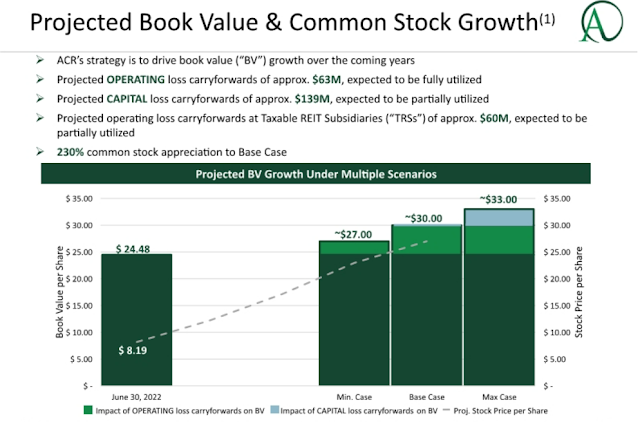
ACR lays out the tax monetization strategy in one of their slides, but this doesn't include the potential for more accretive buybacks.  Shares currently trade for $9.26 vs. $8.19 below and I wouldn't count on it trading for book ($24.48) anytime soon, but the math they layout is quite attractive.

ACR's core business is originating and holding "transitional" commercial real estate loans, this typically means ACR will help a developer or investor finance a value-add property, the equity owner will execute on their plan over a couple year period and then will refinance the property at stabilization, taking out ACR's loan in the process.  Over 3/4ths of ACR's loans are to multi-family properties, I remain reasonably bullish on this sector, at least from a lender's perspective.  With interest rates increasing, potential new homeowners will be stuck renting for a few more years and ACR's heavy concentration to FL and TX (44% between the two) should have continued demographic tailwinds as people/businesses migrate to sunny skies and lower cost of living geographies.  If multi-family properties do get hit, ACR does have a reasonable equity cushion below each loan with a weighted average loan-to-value of 72%.  ACR's loans are floating rate, thus should have minimal duration risk, although as rates continue to increase, that added interest expense borne by their borrowers will start to increase credit risk at a certain point.

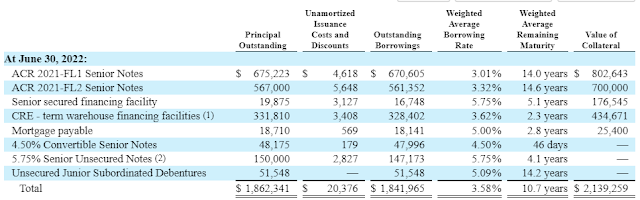
To fund their loans, ACR predominately relies on the CRE CLO market.
Newly originated loans are placed in the "CRE - term warehouse financing facilities" and once of sufficient size, they'll raise longer term CRE CLO financing (also floating rate) and transfer the warehoused loans into the CRE CLO.  ACR retains the junior bonds and equity of the CLO.  CLOs are great because they're not mark-to-market vehicles and give the manager flexibility to repurchase problem loans inside the SPV to avoid any tests failing that would cause cash flows to be diverted from junior tranches.  During the height of covid, CRE CLOs continued paying all noteholders and no test failures occurred, unlike in the CMBS market where the collateral has an observable mark and was financed via repurchase agreements that were marked-to-market daily.  The CRE loans inside ACR's CLOs are whole loans that are not syndicated and don't have live marks available on them.  ACR is likely still being punished for 2020, but the manager is gone and the CMBS assets that cause the blow up are gone too.  The CLOs originated by the old manager all performed fine.

There is an external manager here, Acres Capital, with a fairly traditional mREIT fee agreement that includes a base fee of 1.5% of equity and 20% of earnings above a 7% hurdle, that's not great, but they otherwise seem to be doing the right thing even if it goes against their incentive in the near term (like buying back a significant amount of stock).  One thing I don't like about the fee agreement, the manager receives 25% of their incentive fee paid in stock, at this discount that's highly dilutive to minority shareholders.  But overall, they own 6+% of the company and seem to be reasonable corporate stewards.  There is also the presence of two sophisticated credit investors which is a plus, Oaktree remains a significant shareholder following the 2020 bailout with 9% and First Eagle Credit Management (large CLO equity investor, they manage ECC which owns CLO equity and bonds) with 12.5% of common, plus a good slug of the preferred stock (check those out if you like yield).

Most of the commercial mREITs are trading at a discount to book value in today's market, the best of breed like Starwood Property Trust (STWD) and Arbor Realty (ABR) trade right at book, but even the small cap external peers like NexPoint Real Estate Finance (NREF) and Lument Finance Trust (LFT) trade for about 2/3rds of book (both pay a low double digit dividend), putting the same multiple on ACR would be about 75% upside.

Disclosure: I own shares of ACR

Thursday, February 18, 2021

Acres Commercial Realty: Yet Another Name Change, fka XAN, fka RSO

Acres Commercial Realty (ACR) is the new name for Exantas Capital (XAN) which was previously the new name for Resource Capital (RSO), which I wrote up back in 2016. The situation is somewhat similar to back then, while not a home run, there's a fairly clear path to a 20-30% near term return. Acres is similar to other commercial mortgage REITs, they provide transitional CRE loans so that borrowers can reposition a property (the risk is somewhere between a stabilized loan and a construction loan), traditional banks have largely been pushed out of this market.

Back in 2016, C-III Capital took over RSO and rebranded it Exantas, C-III cleaned up much of the messier non-CRE assets that were in RSO back then and for a while the company was a clean transitional CRE lender that used the securitization market via CRE CLOs to finance their loans on a non mark-to-market basis. Later, C-III then expanded into CMBS (transitional loans are typically shorter term, CMBS usually has stabilized loans underneath and adds some duration to the portfolio) which they financed through daily mark-to-market lending facilities, unfortunately the CMBS market saw a steep market value drop in March/April 2020 as liquidity dried up. Like many other mREITs, Exantas faced margin calls and was forced to liquidate much of that portfolio at a significant loss. While not the intended strategy, after the CMBS portfolio was largely liquidated, the company is back to a straight forward transitional CRE lender.

Oaktree and Mass Mutual came to the company's aid in July, provided rescue financing via 12% 7 year senior notes that also came with common stock warrants for a penny. At the same time C-III exited stage left and sold the management contract to ACRES Capital (Oaktree owns a stake in ACRES) who took over as the external manager. The ACRES team is mostly former Arbor Realty talent, Arbor primarily focuses on multi-family lending, which I anticipate being the primary focus going forward for ACR, the portfolio is already roughly 50+% multi-family so it shouldn't be a significant transition for the portfolio.

Earlier this week, the company completed the rebranding process to Acres Commercial Realty and simultaneously executed on a 3-for-1 reverse split. Oddly, the rebranding, corresponding reverse-split and ticker change to ACR, appears to have triggered a bit of a selloff in the company's shares for no apparent reason other than maybe market participants didn't follow the change from XAN to ACR. The new ticker doesn't show up in some of the more popular free data sites, while it sounds odd, the shares have dropped from above $13 to below $11 (~16%) in the couple days when the rest of commercial mREITs have been essentially flat.

The capital structure is very levered, most of the debt is CRE CLO financing, the first two CLOs have an attractive weighted average interest rate of about 1.50%, the one they did last September is at 3.28% when issuance was just restarting in the securitization market. Spreads have improved since then, whenever they do their next deal, I expect it to come in significantly.  The company did pause their preferred dividend for a couple quarters, but are now current again.
How the business model works on the debt side, Acres will originate new CRE loans utilizing the secured financing facility (5.75% interest rate, roughly what they earn on their assets) and once they build up a large enough portfolio, they'll obtain term financing via the CRE CLO market at significantly better terms. Now that Mass Mutual (financing lender) is also a shareholder via the warrants, makes sense that the new origination channel will open and available to Acres to continue new loan production and grow the business again. Back of the envelope, I have the earnings power at about ~$1.50/year to the common, and since the company has stopped paying the common dividend, book value should have built since 9/30.

Additionally, the company put in place a $20MM share repurchase program (roughly 15% of the market cap) that will be put to use quickly:
On November 2, 2020, the board of directors (the “Board”) authorized and approved the continued use of the Company’s existing share repurchase program in order to repurchase up to $20 million of the currently outstanding shares of the Company’s common stock over the next two quarters. Under the share repurchase program, the Company intends to repurchase shares through open market purchases, privately-negotiated transactions, block purchases or otherwise in accordance with applicable federal securities laws, including Rule 10b-18 of the Securities Exchange Act of 1934 (the “Exchange Act”).

Putting it together, book value has likely come up since 9/30 via earnings power and share repurchases, debt markets should be wide open to them as the new issuance CRE CLO market is surprisingly strong, especially to multi-family heavy portfolios.  I'm viewing this as more of a few month swing trade as the market "finds" ACR and their story, to potentially a bit longer if I want to stick around for a dividend reinstatement.  I'd put a target price at around $14-14.50, roughly 80-85% of where book value is likely to settle out.

Disclosure: I own shares of ACR

Wednesday, November 16, 2016

Resource Capital Corp: Dividend Cut, New Management Simplifying Portfolio

C-III Capital Partners, led by Andrew Farkas, in September closed on the purchase of Resource America (REXI) which was the external manager of Resource Capital Corp (RSO), a troubled commercial mortgage REIT that has struggled since the financial crisis.  Prior to the financial crisis, as was popular, Resource Capital financed most of their commercial real estate loans through the CDO market, unlike the other mortgage REITs of that era, the company has pretty much stuck to that strategy creating a confusing portfolio with a eclectic mix of assets financed through securitization structures.  These assets include syndicated bank loans, middle market bank loans, life settlements, etc., more fit for a BDC but all squeezed into the 25% taxable REIT subsidiary carve out along with another side pocket of residential mortgages and mortgage servicing rights.  To be cynical, it appears that prior management would see an opportunity to earn a fee managing a new pool of assets, and simply used Resource Capital as a seed investor whenever needed, how else do you end up with that mix of assets in a commercial mortgage REIT?

The company reported third quarter earnings on Monday, first under C-III, and new management basically hit the reset button on the balance sheet, strategy, and the dividend policy all in one swoop.  Book value went from $17.63 to $14.71 per share as they took several impairment charges, and the dividend was cut from $0.42 to $0.05 per quarter.  The result was as you'd expect with many yield investors selling sending the stock down ~30% as they reacted to the dividend cut irrespective of the underlying value.  While certainly tough for previous RSO shareholders, the changes C-III Capital is making should result in the company trading closer to book value over time compared to a 40% discount today.

Capital Structure: $275MM market cap ($450MM book value), $270MM in preferred stock (3 tranches), and $1.4B in debt (both recourse and non-recourse).  Resource Capital reports leverage just under 2x which includes the preferred stock in denominator, putting the preferred in numerator would result in the common shares being levered 3.7x equity.

New Business Plan
The old plan in the 10-K.  It's odd that they use "commercial finance assets" for bank loans and CLOs, never heard that before but maybe because it sounds closer to "commercial real estate"?
C-III Capital's plan:
"Our plan, candidly, is simplify the Company and make it more understandable for investors and improve the transparency of RSO's performance.  We're going to do this by disposing of underperforming assets, divesting non-core businesses, and investing solely in CRE assets that produce consistent recurring cash flows and pay dividends out of earnings and not just out of cash that's on the balance sheet." - Bob Lieber, RSO CEO
The fact that this is a new plan says a lot about previous management.  I've talked about how public investors, especially in REITs like clean and simple portfolios, and that investors could get ahead of this when management is prepared to execute on that plan.  We saw that with Gramercy Property Trust (GPT) twice, first when they were transitioning from a mREIT not unlike Resource Capital to a triple net REIT and second when they absorbed the mix and match portfolio that Chambers Street Properties had created as a private REIT.  A good example of that today would be iStar (STAR) as they clean up their foreclosed operating and land assets, eventually returning to a hybrid mortgage and net lease REIT.  I think Resource Capital could do something similar as Gramercy and iStar, but in a quicker 12-15 month timeline.

The good news is that roughly 70% of Resource's portfolio is already CRE whole loans with a subset of that being legacy pre-2007 loans.  But most of these are senior mortgages on stabilized properties, 80% LTV, 3-5 year maturities and financed with cheap non-recourse (to RSO) funding via securitization structures.  They're currently passing all their OC/IC tests in these structures, if these were to fail cash flow would be diverted to pay down the senior notes.  This portfolio can earn mid-teen ROEs before expenses.
Outside of the CMBS piece, the rest of the assets (C-III's pegs it at 22% of the portfolio) are now considered non-core and will either be sold or allowed to runoff (much of it in the next year).  Included in ABS and other is more syndicated and middle market bank loans that are held via CLOs, these can either be sold into the secondary market or possibly Resource could utilize call features as the equity holder and liquidate the CLOs as pricing on bank loans has bounced back significantly from earlier in the year.  To quote the CEO again:
"To summarize, our strategy is to prudently divest non-core and underperforming assets, which account for nearly $0.5 billion, or 22% of our book value and as we realize the proceeds from the maturities and sales, we will deploy incremental capital into our CRE lending business and CMBS acquisition business" - Bob Lieber, RSO CEO
In setting the stage for the updated business plan, new management took the opportunity to take $55.3MM worth of impairment charges and reset book value lower.  Much of the impairments were related to their middle market and syndicated bank loan operation that they're exiting, along with write-downs of pre-financial crisis CRE loans in legacy securitizations.  While each of these were likely prudent, it has the effect of lowering the bar for future incentive fees RSO will be paying to C-III Capital if the new plan materializes as expected.

Management Agreement
Andrew Farkas, the new Chairman of Resource Capital, is a veteran real estate investor who founded Insignia Financial Group in 1990, took it public in 1991 and eventually sold the business to CBRE in 2003.  More recently he started C-III in 2010, and has since acquired special servicers, real estate brokers, and asset management groups to create a diversified real estate company.  Farkas is savy and RSO is their new fund to extract management fees, important to never really forget that management and shareholders aren't on the same side.

The external management agreement is typical-to-bad:
  • 1.5% of equity base management fee (better than if it was of assets, but REXI called this 70% margin revenue in their own presentation materials)
  • 25% incentive fee over 8% return (25% of which is taken in shares, 75% cash)
  • Expense reimbursement for CFO's salary and partial reimbursement on investor relations team (not covered in the base management fee apparently)
  • Termination fee equal to 4x the average base management fee and the average incentive compensation earned by the manager during the two 12-month periods prior (this would be at least 20% of the market cap, and that's low because no incentive has been earned in recent years)
C-III Capital is inheriting 714,000 shares of RSO from Resource America, or 2.3% of the company, rather insignificant compared to the fees they'll be earning annually.  But from C-III's perspective, their goal is to get RSO in a place where they could raise capital and grow the platform, that will only happen at a share price closer to book value and by playing nice in the sandbox with investors going forward.

Valuation
The larger, best of breed, commercial mortgage REITs like Starwood Property Trust (STWD) trade well above book value, other smaller externally managed ones like Ares Commercial Real Estate (ACRE) trade for about 95% of book value.  At even 85% of current book value, Resource Capital's upside is 35+% and over time as the new plan is executed even that discount should close to peers.  New management has guided that 2017 will be a transition year, and that dividends will likely stay in the $0.05 a quarter range, once the dividend policy is updated about this time next year, I'd expect RSO to be trading at least 85% of a simpler to understand book value.

New management plans to have an investor day soon where they will disclose more details on their future plans which could be an additional catalyst for the shares.

Risks
  • External Management - There's always going to be inheritent conflicts of interest with external management agreements.  With C-III Capital and RSO it seems to be initially surfacing with the buyback, the old management repurchased 8-9% of the shares at prices above $12 over the last year.  C-III plans to shelve the plan and instead deploy capital in CRE whole loans, with the stock trading at a 40% discount, there's no CRE investment I'm aware of that would equate to the same return as buying back shares.  But buying back shares would reduce equity and thus reduce management fees.
  • Leverage - Mortgage REITs are leveraged bets on the underlying portfolio.  CRE whole loans are typically floating rate so the portfolio shouldn't have much interest rate sensitivity but will be concavely exposed to any defaults.  I don't believe we're on the edge of another blowup in CRE/CMBS, but that's certainly always a risk.  
  • More Non-Core Impairments - C-III Capital took $55MM worth of impairments in their Q-3 earnings, about half of that was on the non-core, non-CRE assets and business lines that they're looking to sell.  Logic would say that they'd take the opportunity to get those marks correct, but they could need to come down more as they market these assets and determine what they're really worth.  The good news is CLO/bank loan market is open for business, but as we saw in the first quarter of 2016, these markets can close very quickly.
Summary
I bought some shares on Tuesday for $8.70, and expect the share price to be a little volatile over the next few weeks.  I'm not a long term holder of externally managed companies as eventually the conflicts of interest usually settle with management being the beneficiary.  But my plan is to hold RSO until it finishes management's capital recycling plan and the dividend normalizes which should bring back in the typical yield investors and push the price back up near book value.

Disclosure: I own shares of RSO