Friday, November 25, 2022

INDUS Realty Trust: Potential Offer from Centerbridge

On a quiet Black Friday, private equity firm Centerbridge Partners filed a 13D on INDUS Realty Trust (INDT) ($590MM market cap) stating they "anticipate submitting a Potential Proposal" to acquire all the outstanding shares they don't own.

Item 4. Purpose of Transaction

The Reporting Persons initially acquired the shares of Common Stock for investment purposes. From time to time since the date of original investment in the Issuer, the Reporting Persons have engaged in evaluations of the Issuer and its business, including engaging in discussions with management, other shareholders and other persons. In connection with their regular review of their investment in the Issuer, and based on current market conditions and other factors, the Reporting Persons have changed their intent. On November 14, 2022, Centerbridge determined to explore possible strategic transactions involving the Issuer, including pursuing a proposal to acquire the outstanding shares of Common Stock not currently held by the Reporting Persons (a “Potential Proposal”) and to communicate with, among others, management, the Board of Directors of the Issuer (the “Board”), stockholders and other stakeholders of the Issuer, potential acquirers, service providers and debt and equity financing sources, and/or other relevant parties regarding the foregoing. The Reporting Person may exchange information with any such persons, which may be effected pursuant to one or more confidentiality or similar agreements which may include customary standstill provisions.

While the Reporting Persons have engaged in evaluations of the Issuer and its business, including engaging in preliminary discussions, the Reporting Persons have not definitively determined to make a Potential Proposal or otherwise with respect to any specific actions regarding the acquiring, holding, voting or disposing of any securities of the Issuer. However, based on the status of their evaluation of the Issuer and its business to date and based on current market conditions, the Reporting Persons anticipate submitting a Potential Proposal to the Issuer. Any such action may be made alone or in conjunction with stockholders and other stakeholders of the Issuer, potential acquirers, service providers, debt and equity financing sources and/or other relevant parties and could include one or more purposes, plans or proposals that relate to or would result in actions required to be reported herein in accordance with Item 4 of Schedule 13D.

The Reporting Persons have not yet determined what the terms of any such Potential Proposal may be and no assurances can be given that any Potential Proposal will be made, that any Potential Proposal, if made, would be accepted or that any transaction contemplated by the Potential Proposal with the Issuer will be consummated. No binding obligation on the part of any of the Reporting Persons will arise unless and until mutually acceptable definitive documentation has been executed and delivered.

INDUS is a pretty simple REIT, they own, develop, purchase industrial/logistics properties and lease them out on a triple net lease basis.  Despite concerns that Amazon is pulling back on their warehouse spending spree, demand for industrial properties remains high and cap rates low, according to INDT CEO Michael Gamzon (from BamSEC) on their recent Q3 earnings call:

William Thomas Catherwood BTIG, LLC, Research Division – Director & REIT Analyst

Appreciate that, Michael. And can I stick with that cap rate comment that you made. Obviously, you're in a select targeted set of markets. But with the comment that the cap rates on transactions would be below kind of what the market is expecting right now, do you have a sense of how much cap rates have moved in your specific markets?

Michael S. Gamzon INDUS Realty Trust, Inc. – CEO, President & Director

Yes, I think, akin to that comment, it's really hard to pick a number because it's sort of -- there's so few deals. They just feel almost your cherry picking. I can give you an example. In Charlotte, there was a nice portfolio located near the airport. It had 3.5 years of weighted average lease term. We thought the rents were kind of 25% to 30% below market, about a 600,000 square foot portfolio. We've heard that's been awarded, went through kind of a multiple round process -- and so this is real time last month, and we've heard it's kind of a 4.2%, 4.3% cap rate, which I think feels pretty low. I'd say peak of the market, maybe I would have guessed that would be kind of a 3.8. So has that moved 40 basis points. That seems pretty tight compared to where debt spreads have widened and other things, but that's where that's traded.

We know there's been a closed deal in Savannah with not a lot of mark-to-market and 5 years of lease term that traded at a 4.25% Again, it's not a market we're in. We've mentioned in the past, we look at it, so we track it a little bit. That feels pretty low. There is a deal kind of in the Berks County, which is kind of the Western submarket of the Lehigh Valley. We feel the core of the 2 Eastern counties. But -- this is further West. So we think it's not as good a location typically is traded wide of the Lehigh Valley, and that closed, I think, 2 months ago at 4.25%.

So it's really hard to say exactly how much things have moved. Some things that are going to have a very, very long 15 or 20-year single-tenant net lease with not a lot of bumps. That's going to be typically wider, probably 100 to 125 basis points wider. These other deals are anywhere from, call it, 25 to 75, but it's really hard to put a pin on it.

Those numbers seem difficult to believe in the current market, especially when INDT's shares were recently trading with an implied cap rate in the high 6%'s, higher than where they're currently acquiring and developing new industrial/logistics properties.  With their equity trading where it is, raising future equity after completing their current pipeline (2023) seems temporarily off the table.  It makes sense that private equity would come knocking on their door, so what might Centerbridge be willing to pay?

It is a little bit tricky, because of INDT's small size and growth posture, they're growing over 20% based on their acquisition and development pipeline in the next year.  Relying heavily on their recent Q3 earnings supplement (particularly pages 23, 24 and 27):
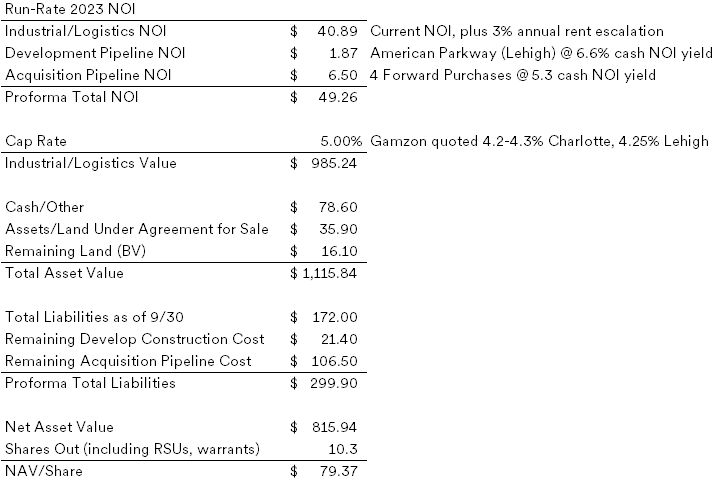
At a 5% cap rate, again, sort of hard to believe that industrial/logistics cap rates haven't moved higher recently, I come up with ~$79/share value, or 38% higher than Friday's $57.28/share closing price.  Centerbridge initially invested in INDT during the 2021 capital raise, they know the company/asset base well and should be seen as a legit buyer.  At a minimum, maybe they're trying to put INDUS in play and Blackstone enters with their unlimited checkbook to roll INDT's assets alongside Gordon DuGan's (chairman of INDT) GPT assets he sold to BX a few years back.

I've gotten a lot of speculative M&A wrong this year so I'm not rushing to add here, but optimistic the value of INDT's real estate will be realized one way or another.

Disclosure: I own shares of INDT

Wednesday, October 26, 2022

Acres Commercial Realty: Trading Well Below BV, Buybacks Over Dividends

This is a similar idea to WMC, Acres Commercial Realty (ACR) ($73MM market cap) is also a mortgage REIT trading at a similar discount to book value (38% of BV)  but without the near term catalyst of a potential sale.  ACR has gone through a few name and manager changes over the years, it was originally Resource Capital (RSO), then became Xantas Capital (XAN), and following a 2020 margin call of their CMBS portfolio, current management came in and once again rebranded.  This is my third bite at the apple and is less of a short term event driven idea and more a 2-3 year transformation path back to a normal commercial mREIT.  

While ACR doesn't have the near term catalyst of WMC, the assets and balance sheet are cleaner at ACR and a majority of the cheap price can be attributed to its small size, current market conditions and lack of a dividend, the latter being the main appeal of mREITs to retail investors.  The reason ACR doesn't pay a dividend is two fold, both of which should appeal to readers of this blog: 1) since shares trade at a significant discount, management have been buying back shares, approximately $30MM worth (significant for an entity this size) since November 2020, with $10MM remaining on their authorization; 2) following the 2020 margin call, ACR has a significant amount of both net capital losses and net operating losses ("NOLs").  To monetize the net capital losses, ACR has created a side pocket of opportunistic equity real estate investments with turnaround plans that if executed should generate taxable income or gains.  Those proceeds would then be reinvested in the core business of originating and holding transitional commercial real estate loans.  The tax asset is valued at $21.6MM (again, meaningful for an entity this size), but has a full valuation allowance against it on the balance sheet.  Once the tax assets are soaked up and the shares trade closer to book value, the REIT will turn the dividend back on and retail investors should return.

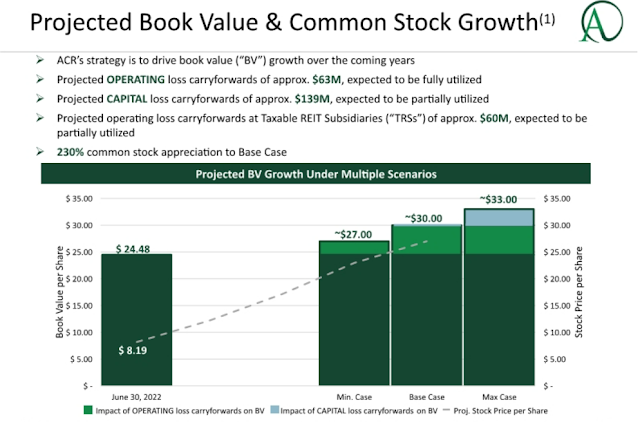
ACR lays out the tax monetization strategy in one of their slides, but this doesn't include the potential for more accretive buybacks.  Shares currently trade for $9.26 vs. $8.19 below and I wouldn't count on it trading for book ($24.48) anytime soon, but the math they layout is quite attractive.

ACR's core business is originating and holding "transitional" commercial real estate loans, this typically means ACR will help a developer or investor finance a value-add property, the equity owner will execute on their plan over a couple year period and then will refinance the property at stabilization, taking out ACR's loan in the process.  Over 3/4ths of ACR's loans are to multi-family properties, I remain reasonably bullish on this sector, at least from a lender's perspective.  With interest rates increasing, potential new homeowners will be stuck renting for a few more years and ACR's heavy concentration to FL and TX (44% between the two) should have continued demographic tailwinds as people/businesses migrate to sunny skies and lower cost of living geographies.  If multi-family properties do get hit, ACR does have a reasonable equity cushion below each loan with a weighted average loan-to-value of 72%.  ACR's loans are floating rate, thus should have minimal duration risk, although as rates continue to increase, that added interest expense borne by their borrowers will start to increase credit risk at a certain point.

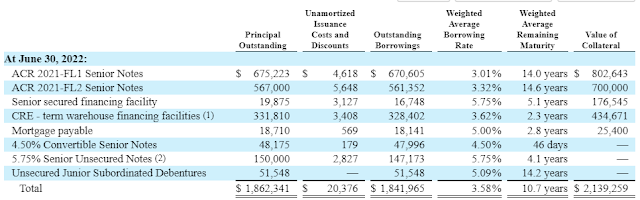
To fund their loans, ACR predominately relies on the CRE CLO market.
Newly originated loans are placed in the "CRE - term warehouse financing facilities" and once of sufficient size, they'll raise longer term CRE CLO financing (also floating rate) and transfer the warehoused loans into the CRE CLO.  ACR retains the junior bonds and equity of the CLO.  CLOs are great because they're not mark-to-market vehicles and give the manager flexibility to repurchase problem loans inside the SPV to avoid any tests failing that would cause cash flows to be diverted from junior tranches.  During the height of covid, CRE CLOs continued paying all noteholders and no test failures occurred, unlike in the CMBS market where the collateral has an observable mark and was financed via repurchase agreements that were marked-to-market daily.  The CRE loans inside ACR's CLOs are whole loans that are not syndicated and don't have live marks available on them.  ACR is likely still being punished for 2020, but the manager is gone and the CMBS assets that cause the blow up are gone too.  The CLOs originated by the old manager all performed fine.

There is an external manager here, Acres Capital, with a fairly traditional mREIT fee agreement that includes a base fee of 1.5% of equity and 20% of earnings above a 7% hurdle, that's not great, but they otherwise seem to be doing the right thing even if it goes against their incentive in the near term (like buying back a significant amount of stock).  One thing I don't like about the fee agreement, the manager receives 25% of their incentive fee paid in stock, at this discount that's highly dilutive to minority shareholders.  But overall, they own 6+% of the company and seem to be reasonable corporate stewards.  There is also the presence of two sophisticated credit investors which is a plus, Oaktree remains a significant shareholder following the 2020 bailout with 9% and First Eagle Credit Management (large CLO equity investor, they manage ECC which owns CLO equity and bonds) with 12.5% of common, plus a good slug of the preferred stock (check those out if you like yield).

Most of the commercial mREITs are trading at a discount to book value in today's market, the best of breed like Starwood Property Trust (STWD) and Arbor Realty (ABR) trade right at book, but even the small cap external peers like NexPoint Real Estate Finance (NREF) and Lument Finance Trust (LFT) trade for about 2/3rds of book (both pay a low double digit dividend), putting the same multiple on ACR would be about 75% upside.

Disclosure: I own shares of ACR

Applied Genetic Technologies: No Deadline CVR

It has been a while since I've dipped a toe into the CVR ("contingent value rights") pond, full disclaimer, I've only had one payout in the last 7-8 years, these normally don't work out.  But Applied Genetic Technologies (AGTC) ($25MM market cap) is an interesting situation because it has two buckets of CVR payments with attractive twists: 1) the miscellaneous AGTC assets the acquirer doesn't want that have values you can point to on AGTC's balance sheet; 2) your traditional FDA approval and sales milestones style payment thresholds but without a clock or deadline that often have the appearance to be gameable by CVR counterparties.

AGTC is the typical clinical-stage biotechnology company that relies on open capital markets to fund its development program, with current tight market conditions and their liquidity quickly draining, AGTC announced Monday it is being acquired by Syncona (LON: SYNC) for $0.34/share plus a CVR.  The alternative was bankruptcy as the company has near term debt and only had a cash runway through the end of the year.  AGTC's area of focus is gene therapy treatments, primarily for a rare eye disease, X-Linked Retinitis Pigmentosa ("XLRP"), that approximately 20,000 people suffer from in the U.S. and Europe.  No approved treatments exist for this condition.  In May, the company reported positive clinical results for their AGTC-501 product (positive based on their press release, I have no expertise to be able to confirm), but they don't have the resources to continue development themselves.  This *might* be a non-zero value asset that is just caught up in a terrible biotech capital raising market, Syncona is at least making that bet.

The shares currently trade for $0.37/share, a $0.03 premium (8%) to the $0.34/share cash consideration.  There's no financing condition, the buyer is real, the deal is scheduled to be a quick close (via a tender that launched tonight), now its just time to look at the CVR (link to the agreement) which has 4 potential milestone payments:

Milestone 1. Parent will be obligated to pay up to $12.5 million, in the aggregate, upon the (a) sale, license, transfer, spin-off of, or the occurrence of any other monetizing event, whether in a single or multiple transactions, involving, all or any part of the Non-RPGR Assets (as defined in the CVR Agreement), (b) the sale or transfer of the Bionic Sight Equity (as defined in the CVR Agreement) and/or (c) the sale, lease or transfer of the Manufacturing Assets (as defined in the CVR Agreement), in each case, that closes on or prior to the date that is eighteen (18) months after the date of the closing of the Merger. The aggregate amount payable in connection with such milestone will be equal to the amount by which the sum of (i) 60% of the Gross Proceeds (as defined in the CVR Agreement) attributable to the Non-RPGR Assets and/or (ii) 100% of the Gross Proceeds attributable to the Bionic Sight Equity and/or (iii) 100% of the Gross Proceeds attributable to the Manufacturing Assets (reduced by the amount of certain taxes and expenses as more particularly described in the CVR Agreement), collectively, exceeds $5.0 million;

Milestone 2. Parent will be obligated to pay an aggregate amount equal to $12.5 million upon obtaining U.S. Food and Drug Administration (the “FDA”) approval of a Biologics License Application (BLA) for AGTC-501 to treat patients with XLRP caused by mutations in the RPGR gene, as evidenced by the written notice of such approval by the FDA, which approval (a) must be consistent with the patient population, at a minimum, as established by the inclusion/exclusion criteria of patients studied in the pivotal clinical trial, (b) may be subject to conditions of use, contraindications, or otherwise limited, and (c) may contain a commitment to conduct a post-approval study or clinical trial (the “Marketing Approval”);

 Milestone 3. Parent will be obligated to pay an aggregate amount equal to $12.5 million if, as of the date of the Marketing Approval, no other AAV gene therapy product expressing the RPGR protein (including any derivative or shortened version of the RPGR protein) has received a marketing approval from the FDA; and

Milestone 4. Parent will be obligated to pay an aggregate amount equal to $12.5 million the first time that Net Sales (as defined in the CVR Agreement) of AGTC-501 in any calendar year is equal to or exceeds $100.0 million.

For simplicity, putting these in my own words, the first one is if Syncona decides (unfortunately I don't see anything that forces them to try) to monetize the non eye disease assets of ATGC.  These non-core assets include a 15.2% stake in Bionic Sight (partner in their optogenetic program) which is on the balance sheet for $7.8MM, ATGC's Manufacturing Assets, which I read to mean their $4.7MM in PP&E, plus other early stage programs that AGTC has abandon/paused.  If the total is more than $5MM within 18 months of closing ("Milestone 1 Deadline Date"), the CVR holders receive 100% of the excess for Bionic Sight/Manufacturing Assets and 60% of the excess for the other pipeline assets.  Some big "ifs" ahead, but if Syncona sells the assets in Milestone 1, and if they go for their book value (attributing no value to the other pipeline assets), that equals $12.5MM, or $7.5MM ($0.11/share) in excess of the $5MM threshold to CVR holders.  That would more than cover the $0.03-$0.04 the market is valuing the CVR above the $0.34 cash consideration.

The other three milestones are typical FDA approval and sales related, interestingly, combing through the CVR Agreement, they don't appear to have a termination date other than:

7.8 Termination. This Agreement shall be terminated and of no force or effect, the parties hereto shall have no liability hereunder (other than with respect to monies due and owing by Parent to Rights Agent), and no payments shall be required to be made, upon the earlier to occur of (a) the payment of the full amount of each potential Milestone Payment required to be paid under the terms of this Agreement, (b) the termination of the Merger Agreement in accordance with its terms and (c) the final determination that no further Milestone Payments will ever be payable under of this Agreement. Notwithstanding the foregoing, no such termination shall affect any rights or obligations accrued prior to the effective date of such termination or Sections 2.4(e), 3.2, 7.4 to 7.8 and 7.11, which shall survive the termination of this Agreement, or the resignation, replacement or removal of the Rights Agent.

There is a "Milestone 1 Deadline Date" but no corresponding ones for milestones 2-4.  This leads me to believe there isn't one, that is it open ended intentionally and doesn't allow Syncona the option to slow roll the development of AGTC-501 to reduce their CVR liability.  The total payout if all milestones are met is $0.73/share, to be clear that's highly unlikely to happen, but it seems like a lottery ticket worth taking given the structure of the CVR and the quick close on the deal.

Disclosure: I own shares of AGTC

Thursday, October 20, 2022

Western Asset Mortgage Capital: Trading Well Below BV, Exploring a Sale

Western Asset Mortgage Capital (WMC) ($56MM market cap) was one of the mortgage REITs caught up in the margin call wave of 2020 when otherwise safe mortgage back securities ("MBS") suddenly went no-bid.  Mortgage REITs often financed their MBS with daily mark-to-market short term financing, when MBS prices suddenly dropped (they would later recover), financing counterparties forced liquidations and significant shareholder value evaporated in the process.  WMC did survive, but in a wounded and subscale form.  Around the end of last year, they started to transition their portfolio away from commercial mortgages to residential mortgages, primarily in Non-QM loans (financed via RMBS under the Arroyo branded shelf).  Non-QM is short for non qualifying mortgages, those that aren't eligible to be purchased by the GSEs, most of these are actually to prime borrowers (746 average FICO) but those borrowers don't have regular W-2 income to meet tighter post-GFC mortgage underwriting standards.

Getting straight to the point, WMC trades for $9.35/share despite having an economic book value of $24.58/share, or WMC is trading at just 38% of book.  Their book value will likely come down a fair amount when they release Q3 earnings due to rates rising and spreads widening since 6/30, but it should still be very cheap to its net asset value.  WMC is managed by large fixed income specialist Western Asset Management, they've already cut their fees 25% for 2022, have no chance of raising additional capital to regain scale, and are thus waving the white flag by announcing they've commenced a strategic alternatives review process.  It is likely just not worth Western Asset's time at this size (their management fee is based on equity, not assets).

Here is WMC CEO Bonnie Wongtrakool discussing the rationale in their Q2 earnings call:

The primary way to achieve scale as a mortgage REIT is to issue additional common equity, but our philosophy and practice has been to conduct equity offerings only at such times when they have not been materially dilutive to existing shareholders. The last time we issued any meaningful amount of equity was in the second quarter of 2019, when we raised nearly $50 million, which was done at a modest discount to our book value at that time.

Unfortunately, when COVID hit the following spring, our portfolio experienced a significant decline in value and our stock price experienced an even greater decline relative to book value. Since then, our overarching goal has been to improve and stabilize our future earnings power.

Over the last two years, we have made significant progress by taking actions to improve our liquidity and balance sheet and by shifting our investment focus towards residential real estate. Nonetheless, we do not see these positive actions being reflected in our stock price. Therefore, we believe that yesterday's announcement regarding our decision to review strategic alternatives is the best path forward towards unlocking shareholder value, and we are committed to analyzing alternatives that may involve a sale, merger or other transaction involving the company.

I'm always a little skeptical of externally managed mREITs looking to sell themselves, sometimes it means they're simply selling the management contract to another asset manager that will just rebrand and the discount to NAV won't close much.  But here the discount is so wide and the language sounds slightly more focused on shareholders.  There is likely some middle ground in between the share price and book value to get a deal done that pleases all three parties: 1) WMC shareholders get some premium to current prices; 2) Western Asset rids themselves of the distraction and receives some value for their management contracts; 3) one of the countless potential acquirers gets a publicly traded permanent capital vehicle or a current mREIT gets some additional scale and fees for their manager.

Similar to LMPX, this is a completely commodity/fungible type business or balance sheet that trades hands regularly, even in this currently strained M&A market, a willing seller (which sounds like they are) should find no problem finding plenty of willing buyers.  Most likely this will be a stock-for-stock deal or reverse merger with a non-traded REIT, so the upside won't be as big as a liquidation or cash deal, but still an attractive risk/reward.  My best guess is $12-14/share in value.

Other thoughts:

  • Their balance sheet is a mess and difficult to untangle.  For example, one of their legacy commercial investments is a mezz tranche of the Mall of America CMBS (CSMC Trust 2014-USA) and due to accounting rules, WMC actually consolidates the entire SPV.  WMC's economic exposure is $10.7MM, but they consolidate the $1.4B in liabilities on their balance sheet.  Mall of America's future is certainly cloudy, they did restructure the loan during the pandemic, but as an important tourist attraction for the Twin Cities MSA, I would expect it to get political support to survive as a destination/entertainment mall.  In 2020, alongside the restructuring, Trep did put a $1.9B value on the mall, for whatever that's worth.
  • They also have one big problem CRE loan, "CRE 3" in their disclosures which is described as an entertainment/retail property in New Jersey.  I couldn't find it in their disclosures, but it wouldn't surprise me if that was the troubled American Dream mall as it shares ownership with Mall of America.  CRE 3 has been in non-payment status for about a year, if WMC needs to write down the full value of the loan, that knocks about $4/share off the book value.
  • Their Non-QM loans are highly concentrated in California, about 2/3rds.  LTVs look good (originally 65% at the time of underwriting) at the current moment, but we're early in any housing correction and California typically exhibits higher price volatility than other markets.  WMC disclosed that about 15% of their Non-QM loans have near term rate resets (these are ARMs) that will slightly help offset the price pressure of higher rates.

Disclosure: I own shares of WMC

Friday, October 7, 2022

Mereo BioPharma: Activist Proxy Fight

Back in the March 2019, I wrote up the merger between U.K. based Mereo BioPharma (MREO) (~$100MM current market cap) and OncoMed Pharmaceuticals (formerly traded as OMED) as a way to play the contingent value rights that were issued to OMED shareholders.  The CVR part of the thesis hasn't worked out, at least yet, there are still potential milestones on Navicixizumab in play before the CVR expire on 4/23/24.  Since closing out that trade (I received MREO shares in the merger but sold immediately at $5.30, shares trade for $0.95 today), I've checked in on the company occasionally as the CVRs naturally have Mereo counterparty risk.  On the most recent of those check ins, I came across two Seeking Alpha write-ups (here and here) by Dalius Taurus of SSI that piqued my interest.

Mereo BioPharma has six product candidates, four purchased from larger biopharmaceutical companies (Novartis and AstraZenca) that previously received considerable investment in the pre-clinical stage but were no longer strategic priorities and two product candidates inherited from the OncoMed acquisition.  MREO's market cap is approximately $100MM (MREO trades as an ADR, each MREO share equals 5 ordinary shares) and last reported a cash balance of $105MM (current conversion rate, MREO reports in GBP) as of 2021 year end, after some cash burn, it likely has a small positive enterprise value.  

Similar to most pre-revenue biotechs these days, Mereo's investors have lost their patience funding development pipelines, Rubric Capital (~14% owner) has stepped up as an activist to stop the cash burn by attempting to reconstitute the board of directors.  Rubric has its eyes on gaining control of the board, then monetizing assets and returning cash to shareholders in what amounts to a liquidation.  Rubric is run by David Rosen, who was a portfolio manager at SAC Capital (now Point72) before going on his own in 2016.  It just so happens that the second largest MREO shareholder is Point72 with 8.6%, likely friendly to Rubric, further increasing the likelihood that Rubric gains board seats in the proxy campaign as the current board/management owns an insignificant amount.

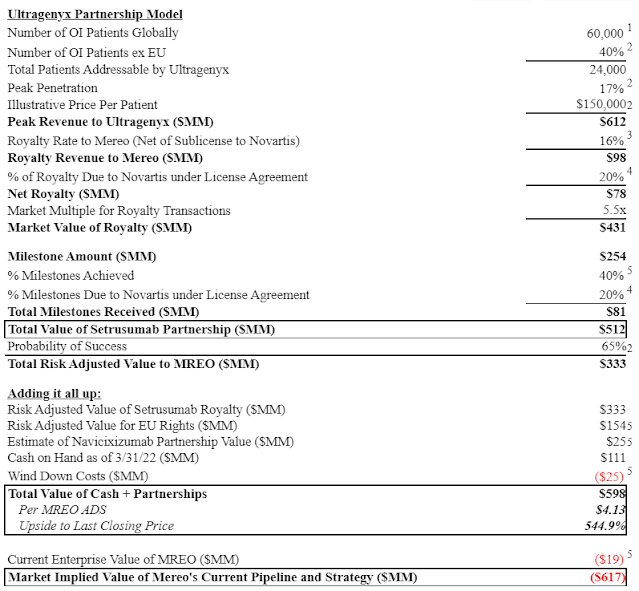
Below is the back of the envelope valuation math provided by Rubric in their 6/9/22 letter:


I have little way of confirming or refuting their valuation, but even if they're wrong by half the stock is approximately a double from here.  Mereo's most valuable asset according to Rubric is their partnership with Ultragenyx (RARE) on Setrusumab (originally purchased from Novartis) which is a treatment for a rare bone disease, osteogenesis imperfecta ("OI"), that currently has no approved therapies.  Mereo retained the commercial rights for Setrusumab in the UK and Europe, otherwise Rubric is ascribing no value to Mereo's other product candidates, including Alvelestat which is a treatment for a rare lung disease undergoing clinical trials.

Alvelestat is the one product candidate that came from AstraZenenca (AZN). In June, which to be fair is a lifetime ago in this market, The Times of London reported that AZN was considering a bid for MREO:

Word is that it is considering a bid for Mereo Biopharma, a specialist in cancer and rare diseases.

Mereo, which has developed a portfolio of six clinical-stage product candidates, is based in London but listed on the Nasdaq exchange in New York and lists AstraZeneca among its partners alongside Novartis, OncXerna and Ultragenyx. There are suggestions that at least one other suitor, possibly another partner, may also be on the prowl.

Shares in Mereo have been a stinker, shedding almost 80 per cent of their value in the past year, although they jumped by 8.5 per cent to 69 cents on Wednesday, valuing the company at $81 million. Analysts have an average target price of $7 and the talk is that Mereo would accept $5, equating to $500 million including American depositary receipts or ADRs. Evercore and Citigroup are said to be involved as advisers.

This article came out around the same time as the Rubric letter, they might be related, or it might be coincidence.  Even if the Setrusumab valuation is overstated, there might be other assets worth something here.  Rubric and Mereo's management have been going back forth on Rubric's request for a special meeting, Mereo seemingly was citing every technicality why Rubric's request was ineligible but eventually relented and the special meeting is now set to happen sometime in November.  It appears that a new board will be put in place shortly, we'll see what happens from there.  I bought a small position.

Disclosure: I own shares of MREO and some non-tradable OMED CVRs

Friday, September 16, 2022

Digital Media Solutions: Broken deSPAC, MBO Offer

Another quick idea -- hat tip to Writser again for pointing me in this direction -- Digital Media Solutions (DMS) ($135MM market cap) is a "technology-enabled digital performance advertising solutions" company that came public in July 2020 through a SPAC, Leo Holdings Corp (LHC).  From what I can gather, DMS gets allocated marketing spend from their clients, runs a digital campaign and then delivers warm leads or actual customers to their client depending on the arrangement.  DMS gets paid a percentage of that customer's lifetime value ("LTV") based on the advertising client's models.  While this isn't a great business, DMS is cyclical based on marketing spend (having a down year in 2022), it doesn't seem to be a scam or puffed up science fair project like other deSPACs of recent vintage, DMS is more a marginal-to-average business with potential long-term tailwinds.

Like just about every other deSPAC, DMS came to the market with inflated expectations, they originally guided to $78MM EBITDA in 2021, but only delivered $58MM.  DMS started 2022 with flat guidance of $55-60MM EBITDA, but now only expect $30-35MM due to wage inflation hitting their cost structure (500+ employees), marketing budgets getting slashed and LTV models being adjusted down in their core auto insurance market (Allstate and State Farm are two of their largest customers).  Management expects to return to growth in 2023.

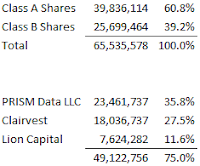
DMS is founder led, the company was started in 2012, the three co-founders are still in the c-suite today and own 35.8% of DMS through their "Prism Data LLC" investment vehicle. In 2016, DMS took on a PE investment from Clairvest, who still owns 27.5% of DMS, and rounding out the top 3 holders is Lion Capital at 11.6% ownership, Lion was the sponsor of the SPAC.  In total, these three firms own 75% of DMS, the remaining 25% has very little institutional ownership and is likely held by retail holders who were caught up in the SPAC mania.
Essentially no difference between A and B shares
On Monday 9/8, via Prism Data, management made a non-binding offer to acquire all of the publicly traded Class A shares for $2.50/share, a 121% premium from where the stock closed the previous Friday.  In their letter, they indicate that Clairvest and Lion "are likely to agree to participate" alongside Prism, leaving only 25% of shares needing to be purchased, or about $40MM.  The offer is not subject to a financing condition (important in today's market), but DMS does have $26MM cash on its balance sheet and Prism has $50MM in pre-committed financing from B. Riley (RILY) to complete the transaction.  

The offer values the minority interest at somewhere around ~10x potentially trough EBITDA, again management expects to return to growth in 2023 (they're the best positioned to know if there is indeed an inflection) so this could be an opportune time for them to take it private again.  In August 2021, the company announced they were exploring strategic alternatives, on the last two conference calls, CEO Joe Marinucci (the signatory on the Prism offer letter), has stated they were "hoping to have an update today" regarding strategic alternatives, this offer is likely the end result.  Marinucci would know where third parties offers were for the business before offering $2.50 to the board, this is likely the best offer and the independent board members will take it given there are no vocal or significant minority shareholders.

Shares closed today at $1.94/share, a 28% spread to the Prism offer.  Yes, there is significant downside given where DMS traded before the offer, but there are no shareholders to put up a fight and likely this is the best offer after the company ran a process.  Otherwise, I think the spread is wide because it is a low float former SPAC.  I bought a smallish position.  Given the number of deSPACs, I anticipate this being a similar fruitful hunting ground as the "broken/busted biotechs", please send me any others that sound or feel like this one.

Disclosure: I own shares of DMS

Wednesday, September 7, 2022

IMARA: Asset Sale, Below NCAV, Potential Liquidation

Since all my speculative M&A ideas seem to be falling flat on their face in the current market environment, it is time to go back to a broken biotech that appears set to liquidate.  IMARA Inc (IMRA) ($43MM market cap) is a clinical stage biopharmaceutical company that announced back in April their decision to discontinue further development of their sickle sell disease treatment (IMR-687) and initiate a process to evaluate strategic options.  The stock then crashed and traded at about half net current asset value.  In 2022, that's nothing exciting on its face, there are lots of broken biotech stocks trading well below cash that it is difficult to parse between them for actionable ideas other than taking a basket approach.  

But IMARA is interesting because today they announced via an 8-K (no press release) that they've sold IMR-687 to Cardurion Pharmaceuticals for $35MM, plus some contingent payments if things go well.  Excluded from the asset sale is IMARA's cash pile:  

Excluded Assets. Notwithstanding the provisions of Section 2.1, no right, title or interest is being sold, assigned, transferred, conveyed or delivered to Cardurion in or to (a) any property and assets of Imara that are not Purchased Assets (including any and all amounts of cash and cash equivalents of Imara), (b) any rights or claims of Imara under this Agreement or any of the Ancillary Agreements, (c) all assets of Imara exclusively related to IMR-261 and (d) all assets of any Third Party with whom Imara enters into a transaction on or after the Execution Date pursuant to which it becomes (or will become) an Affiliate of such Third Party (collectively, the “Excluded Assets”).

Prior to this surprise asset sale (I normally assume a broken biotech's IP is worthless), IMARA had a net current asset value at 6/30 of ~$60MM and 26.3 million shares outstanding, or $2.30/share in net cash.  After the asset sale closes, that number jumps up to $3.65/share (pre-cash/expense burn), yet the shares only trade for $1.67 today.  Hidden in the 8-K, the company mentions the below:

In connection with stockholder approval of the Asset Sale and the plan of liquidation, the Company intends to file a proxy statement and other materials with the SEC. Stockholders of the Company are advised to read the proxy statement and any other relevant documents filed with the SEC when they become available because those documents will contain important information about the Asset Sale and the plan of liquidation.

They did a few other things that hint this it for the company, they amended their retention plans to pay 50% out now on the execution of the asset sale and 50% on the closing of the asset sale, versus paying out on any subsequent reverse merger or other action.  And it appears their advisors are done too.  The current price seems far too cheap if the company is going to return their cash to shareholders, I bought some shares today.

Disclosure: I own shares of IMRA