Showing posts with label CVR. Show all posts

Monday, May 12, 2025

Kronos Bio: Tang Buyout w/ Curious CVR Consideration

Kronos Bio (KRON) ($45MM market cap) was historically focused on cancer and autoimmune disease treatments, late last year, the company discontinued development of their lead asset, istisociclib, due to safety issues and announced a plan to explore strategic alternatives.  At the time, I was nervous about their large operating lease obligation and ended up passing on adding it to my busted biotech basket as there was no shortage of cleaner opportunities at the time.

On May 1st, Kevin Tang's liquidation vehicle, Concentra Biosciences, entered into an agreement to buy KRON for $0.57/share in cash plus a CVR, the CVR is structured differently than many of Tang's recent deals where the CVR is mostly just IP dispositions, here the CVR is composed of a series of potential payouts:

(i) 50% of the net proceeds in the case of a disposition of the Company’s product candidates known as KB-9558 and KB-7898 that occurs within 2 years following closing; (ii) 100% of the net proceeds in the case of a disposition of the Company’s product candidates known as KB-0742, lanraplenib and entospletinib that occurs prior to closing; (iii) 100% of cost savings realized prior to closing; (iv) 80% of cost savings realized between the merger closing date and the second (2nd) anniversary of the merger closing date; and (v) 50% of cost savings realized between the second (2nd) anniversary of the merger closing date and the third (3rd) anniversary of the merger closing date, each pursuant to the contingent value rights agreement (the “CVR Agreement”).

Payouts (i) and (ii) are hard to predict and likely of minimal value, the legacy IP assets in (ii) need to be sold (but not closed) prior to the merger closing and (i) is their pre-clinical assets, who knows how much these are worth but the two year clock is pretty gameable, any value there likely accrues to Tang.

Payouts (iv) and (v) relate primarily to cost savings, subleasing or an early exit to their operating lease for a 40+k sq ft facility located in Cambridge, MA.  The lease ends in February 2031 and it has approximately $30MM remaining, given the long time frame, Tang could potential game this one by back weighting any lease amendment/termination to give him the best payout and avoid paying CVR holders.

Payout (iii) is where the potential cash is for CVR holders, it will be paid no later than 60 days following the merger closing, the savings calculation is as follows:

Additional Closing Net Cash Proceeds” means 100% of the amount by which the Closing Net Cash as finally determined pursuant to Section 2.01(d) of the Merger Agreement exceeds $40,000,000, adjusted for any claims that arise prior to 30 days following the Merger Closing Date that are not accounted for in such Closing Net Cash. 

Closing Net Cash” means, without duplication, (i) the Company’s cash and cash equivalents, restricted cash, and investments as of the Cash Determination Time, determined in accordance with GAAP, applied on a basis consistent with the Company’s application thereof in the Company’s consolidated financial statements, minus (ii) Indebtedness of the Company as of the Cash Determination Time, minus (iii) the Transaction Expenses, minus (iv) the Estimated Costs Post-Merger Closing, minus (v) $400,000 for the CVR Expense Cap under the CVR Agreement.

The curious part of this transaction is the $40MM threshold, why is it so low when the NCAV as of 3/31/25 is $73.5MM?  CVRs are intended to bridge the gap between buyers and sellers on how much an asset is worth, here the asset is primarily cash which should have minimal uncertainty given the quick merger close (a tender offer is required to be launched by 5/15/25).  What would Tang be protecting himself against with such a low closing cash number?  Istisociclib did have safety issues, but no legal proceedings have been disclosed that meet a reporting threshold.

Below is my attempt at a back of the envelope calculation of the Additional Closing Net Cash Proceeds value, shares trade for $0.72/share today, implying a $0.15/CVR value:


The "Estimated Costs Post-Merger Closing" is where some potential games could be played:

Estimated Costs Post-Merger Closing” means all costs that the Surviving Corporation would incur post-Merger Closing, including costs associated with: (i) CMC Activities; (ii) clinical activities; (iii) remaining lease-related obligations (including rent, common area maintenance, property taxes and insurance); and (iv) an aggregate of $250,000 for any legal Proceedings and settlements.

While the development pipeline is paused, potentially an argument could be made that spending some money to advance KB-9558 and KB-7898 could be worthwhile to CVR holders as they'd get paid 50% of any disposition proceeds?  I don't see it, but doesn't mean management might not have an agreement with Tang to include some spend in that bucket.  In the latest 10-Q, all their R&D costs sounded like legacy expenses, not ongoing expenses:

Research and development expenses were $2.1 million for the three months ended March 31, 2025, compared to $14.2 million for the three months ended March 31, 2024. The decrease of $12.1 million was primarily attributable to a $6.0 million reduction in consulting and other outside research expenses, a $4.2 million decrease in personnel-related costs and a $1.9 million decrease in facilities, depreciation and other costs. These decreases were primarily related to the discontinuation of the istisociclib clinical trial in November 2024, reduced headcount in our research and development organization following the restructuring activities and reclassification of lease costs to general and administrative expenses. Research and development expenses for the three months ended March 31, 2025 were related to performance obligations under the Transition Agreement and continued wind down of research and development activities.
I sort of expect to be screwed here, just not quite sure how, but the opportunity for a quick buck is too tempting, I added a small position.

Disclosure: I own shares of KRON

Wednesday, May 15, 2024

Inhibrx Inc: Cash Buyout + SpinCo (Inhibrx Biosciences) and CVR

Inhibrx Inc (INBX) (~$1.8B market cap) is a clinical stage biotech that announced the sale of their most advanced therapy, INBRX-101 (a treatment for patients with alpha-1 antitrypsin deficiency or "AATD"), in January to Sanofi (SNY) for $30/share in cash, plus 92% ownership in the remaining development pipeline via a taxable spin of NewCo Inhibrx Biosciences (SNY to retain the other 8%) and a $5/share CVR that pays out if INBRX-101 receives final FDA approval prior to 6/30/2027.  INBX shares trade for $34.20 today -- all approvals have been received and the merger will close 5/30/24.

The advantage of this structure is Inhibrx won't pay corporate taxes on the sale of INBRX-101, but shareholders will still pay taxes based on their tax basis, avoiding the double tax if Inhibrx had simply sold INBRX-101 and continued on in the same corporate structure.  We've seen similar deals with Pfizer/Biohaven (they even mention in the proxy wanting to do a "Biohaven-like structure")  and a little further back, JNJ/Actelion/Idorsia, where both SpinCos performed well initially post deal completion.

My thinking around this transaction is pretty straight forward, because the $30/share makes up a vast majority of the consideration here, the merger/stub securities are likely undervalued, although it is hard to size this up enough to create a meaningful position (INBX isn't marginable at my broker for some reason).  For the SOTP, I'm going to lean on the proxy statement as I don't have an informed view on the science other than this team already developed one valuable asset in INBRX-101.

The CVR is fairly simple, there's only one milestone, that's FDA approval of INBRX-101 for AATD:

At or prior to the Effective Time, pursuant to the Merger Agreement, Parent will enter into a Contingent Value Rights Agreement between Parent and Continental Stock Transfer & Trust Company (the “Rights Agent”), in substantially the form attached to the Merger Agreement (the “CVR Agreement”). Each CVR will represent the right to receive a contingent payment of $5.00 in cash, without interest, payable to the Rights Agent for the benefit of the holders of CVRs, if the following milestone is achieved:

The final approval by the U.S. Food and Drug Administration (“FDA”), on or prior to June 30, 2027, of the new drug application or supplemental new drug application filed with the FDA pursuant to Section 351 of the Public Health Service Act and 21 CFR §§ 600 et seq. (for clarity, including accelerated approval) that is necessary for the commercial marketing and sale of the Company’s precisely engineered recombinant human AAT-Fc fusion protein, also known as INBRX-101 in the United States of America for the treatment of patients with AATD and clinical evidence of emphysema following the clinical trial with identifier INBRX101-01-201, entitled “A Phase 2, Double-Blind, Randomized, Active-Control, Parallel Group Study to Assess the Pharmacokinetics, Pharmacodynamics, Immunogenicity, and Safety of INBRX-101 Compared to Plasma Derived Alpha-1 Proteinase Inhibitor (A1PI) Augmentation Therapy in Adults with Alpha-1 Antitrypsin Deficiency Emphysema,” regardless of any obligation to conduct any post-marketing or confirmatory study (which we refer to as the “Milestone”).

For the CVR valuation, Centerview (INBX's advisor) put the NPV at $2.05/share using a 60% success rate, which the company provided (management took down the success rate from 90%, citing a less advantageous regulatory environment and potential success of similar products):

Contingent Value Right Analysis
For analytical purposes, assuming a 60% probability CVR holders receive an aggregate payment of $5.00 per CVR upon the achievement of the Milestone based on the probability of success as estimated by Company management in, and the estimated timing of achievement of the Milestone under the CVR Agreement implied by, the Management Forecasts, as described under the section entitled, “The Transactions — Certain Financial Projections” and further assuming a discount rate of 13.5%, the midpoint of a range of discount rates from 12.5% to 14.5%, based on Centerview’s analysis of the Company’s weighted average cost of capital, Centerview calculated an illustrative net present value for one (1) CVR of $2.05.

Inhibrx Biosciences (SpinCo) is a little more complicated, SNY is going to seed the company with $200MM of cash, which is expected to get them about a year of cash runway.  The spin ratio is 0.25 shares of SpinCo for each share of INBX.  The spinoff will have INBX's remaining development assets, which includes two oncology therapies currently in clinical studies with data readouts within the next 12 months:


INBRX-106 is a hexavalent product candidate agonist of OX40. OX40 is a co-stimulatory receptor expressed on immune cells that is enriched in the tumor microenvironment. OX40 ligand is a trimeric protein that activates OX40 signaling through clustering.

INBRX-109 is a precision-engineered, tetravalent death receptor 5 (DR5) agonist antibody designed to exploit the tumor-biased cell death induced by DR5 activation.

INBRX-109 (which has both fast track and orphan designations) is farther along, it is currently in a registration enabling Phase 2 trial for the treatment of chondrosarcoma (an aggressive type of bone cancer where most patients do not respond well to current therapies) with data expected in the first half of 2025.  INBRX-106 is in a Phase 1/2 study testing it in combination with Keytruda, initial data is expected towards the end of 2024. Again, leaning on Centerview's analysis:

SpinCo Discounted Cash Flow Analysis
Centerview performed a discounted cash flow analysis of SpinCo based on the Management Forecasts. A discounted cash flow analysis is a traditional valuation methodology used to derive a valuation of an asset or set of assets by calculating the “present value” of estimated future cash flows of the asset or set of assets. “Present value” refers to the current value of future cash flows or amounts and is obtained by discounting those future cash flows or amounts by a discount rate that takes into account macroeconomic assumptions and estimates of risk, the opportunity cost of capital, expected returns and other appropriate factors.
For purposes of the analysis of the net present value of the future cash flows of SpinCo, Centerview calculated a range of equity values for 0.25 of a share of SpinCo common stock by (a) discounting to present value as of June 30, 2024 using discount rates ranging from 14.0% to 16.0% (reflecting analysis of SpinCo’s expected weighted average cost of capital) and using a mid-year convention: (i) the forecasted risk-adjusted, after-tax unlevered free cash flows of SpinCo over the period beginning on June 30, 2024 and ending on December 31, 2043, utilized by Centerview based on the Management Forecasts, (ii) an implied terminal value of SpinCo, calculated by Centerview by assuming that unlevered free cash flows would decline in perpetuity after December 31, 2043 at a rate of free cash flow decline of 60% year over year (with the exception of platform cash flows for which a 0% perpetuity growth rate was assumed), and (iii) tax savings from usage of SpinCo’s federal net operating losses from SpinCo’s estimated future losses, as set forth in the Management Forecasts, and (b) adding to the foregoing results SpinCo’s estimated net cash of $200 million, assuming SpinCo is capitalized with $200 million in cash and no debt, as of June 30, 2024, and the net present value of the estimated costs of an assumed $150 million equity raise in 2025 and $300 million equity raise in each of 2026 and 2027, as set forth in the Internal Data. Centerview divided the result of the foregoing calculations by the number of fully diluted outstanding shares of estimated SpinCo common stock (determined using the treasury stock method and taking into account the dilutive impact of warrants on the then-existing terms and 8% of shares of SpinCo common stock to be retained by the Company, and assuming no exercise of Company options receiving SpinCo common stock, as instructed by Company management) as of January 18, 2024, based on the Internal Data, resulting in a range of implied equity values per 0.25 of a share of SpinCo common stock of $5.85 to $7.95 rounded to the nearest $0.05.

Just based on cash, the NewCo would be worth $3.40/share of INBX at the outset, although that's a bit faulty logic as the cash is already spoken for in the projected cash burn.  But again, pattern recognition here tells me that this situation has a decent shot of working out well in the near term, $30.00 + $2.05 + $5.85 = ~$38/share versus the current $34.20/share.  If you back out the $30/share in cash, the stub is a potential bargain heading into closing at month end.

Disclosure: I own shares of INBX

Tuesday, November 14, 2023

Theseus Pharmaceuticals: Straight Forward Broken Biotech

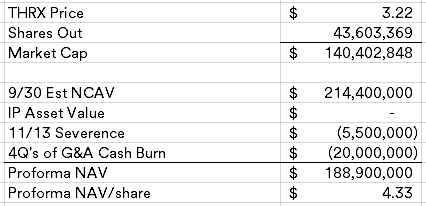
Theseus Pharmaceuticals (THRX) (~$140MM market cap), a cancer therapy researcher, is the latest addition to the broken biotech basket trade.  This week, Theseus announced a 72% reduction in workforce and the exploration of strategic alternatives "to consider a wide range of options with a focus on maximizing shareholder value, including potential sale of assets of the Company, a sale of the Company, a merger or other strategic action."  The company hasn't reported for Q3 as of this writing, but did disclose an estimated cash and securities balance of $225.4MM in the same press release.

The 6/30 cash and securities balance was $234.2MM, so the company only burned a bit under $9MM during the quarter despite attempting to push forward a few early stage programs (which may have some value?) after shutting down their Phase 1/2 trial for their lead candidate in mid-July, pointing to some expense discipline here.  Otherwise the balance sheet is fairly straight forward, there's a small lease obligation (already backed out in my NCAV number) and no debt.  Despite jumping 50% on the strategic alternatives news, I still think this one is attractively priced.

Disclosure: I own shares of THRX

Friday, September 15, 2023

Homology Medicines: Strategic Alternatives, Potentially Valuable JV

Homology Medicines (FIXX) (~$70MM market cap) is a clinical stage genetics biotech whose lead program (HMI-103) is meant to treat phenylketonuria ("PKU"), a rare disease that inflicts approximately 50,000 people worldwide.  In July, despite some early positive data, the company determined to pursue strategic alternatives as FIXX wouldn't be able to raise enough capital in the current environment necessary to continue with clinical trials.  Alongside the strategic alternatives announcement, the company paused development and reduced its workforce by 87% which resulted in $6.8MM in one-time severance charges.

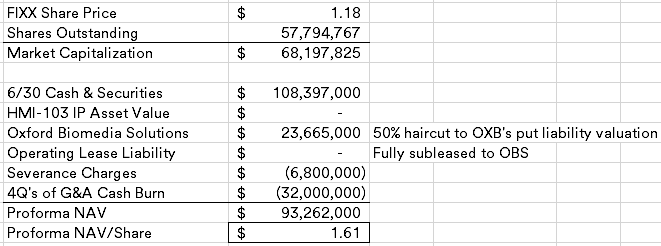
Outside of approximately $108MM in cash (netting out current liabilities), FIXX has a potentially valuable 20% ownership stake in Oxford Biomedia Solutions (an adeno-associated virus vector manufacturing company), a joint venture that was formed in March 2022 with Oxford Biomedia Plc (OXB in London).  As part of the joint venture, FIXX can put their stake in the JV to OXB anytime following the three-year anniversary (~March 2025):

Pursuant to the Amended and Restated Limited Liability Company Agreement of OXB Solutions (the "OXB Solutions Operating Agreement") which was executed in connection with the Closing, at any time following the three-year anniversary of the Closing, (i) OXB will have an option to cause Homology to sell and transfer to OXB, and (ii) Homology will have an option to cause OXB to purchase from Homology, in each case all of Homology's equity ownership interest in OXB Solutions at a price equal to 5.5 times the revenue for the immediately preceding 12-month period (together, the "Options"), subject to a maximum amount of $74.1 million.

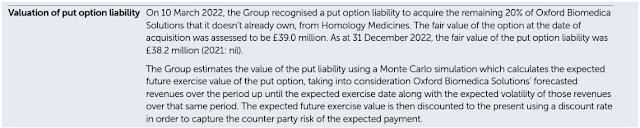
 Poking around OXB's annual report, they have the below disclosure:

Using the current exchange rate, that's approximately $47MM in value to FIXX.  Now OXB isn't a large cap phrama with an unlimited balance sheet, so there is some counterparty risk that OXB will ultimately be able to make good on this put.  In my back of the envelope NAV, I'm going to mark this at a 50% discount to be conservative.

Unlike GRPH, the operating lease liability at FIXX is mostly an accounting entry as the company's office space is being subleased to Oxford Biomedia Solutions, but doesn't qualify for deconsolidation on FIXX's balance sheet.  I'm going to remove that liability, feel free to make your own assumption there.  Additionally, even though HMI-103 is very early stage, it wasn't discontinued due to a clinical failure and might have some value despite me marking at zero since I can't judge the science.

It is hard to handicap the path forward, maybe OXB buys them out, they could do a pseudo capital raise with FIXX's cash balance while eliminating the JV put option liability.  Or FIXX could pursue the usual paths of a reverse-merger, buyout or liquidation.

Disclosure: I own shares of FIXX

Friday, February 3, 2023

Magenta Therapeutics: Trading Well Below Cash, Strategic Alternatives

This will be a relatively quick one, thank you to Writser for pointing me in this direction.

Magenta Therapeutics (MGTA) (~$47MM market cap) is another addition to my growing basket of failed biotechnology companies that are pursuing strategic alternatives like a reverse merger or liquidation.  Magenta is a clinical stage biotech focused on improving stem cell transplantation.  Their primary product, MGTA-117, initially had positive data readouts in December for their ongoing Phase 1/2 trial, but shortly after, patients using higher doses started experiencing adverse effects, culminating with the death of one trial participant and the subsequent shutdown of the MGTA-117 clinical trial.  Then yesterday afternoon, Magenta announced they were going to explore strategic alternatives, the press release is rather vague and generic.  But similar to SESN and others, I anticipate Magenta first trying to explore a buzzy reverse merger with a more promising biotech, if that doesn't work, pursue a liquidation.

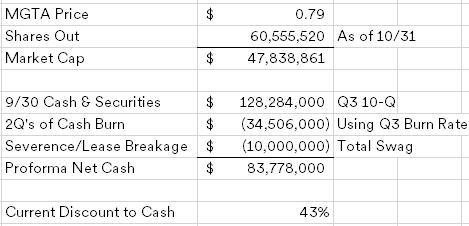
Magenta's balance sheet is fairly simple, they had $128.3MM in cash and treasuries as of 9/30, no debt other than subleased space in a Cambridge, MA office/lab complex.


Since we're getting close to half way through Q1, I annualized the Q3 burn rate for two quarters.  The company hasn't given any initial indication of eliminating their workforce (as of the last 10-K, they had 75 people), but I expect that to follow shortly, along with breaking their lease.  Cambridge is a biotech hot spot, Magenta or the primary lessee shouldn't have too much trouble finding a new tenant.  Feel free to make your own assumptions, but I come up with MGTA trading at about a 40% discount to proforma net cash even after spiking on the news today.  In terms of other assets, Magenta does have $247.2MM in NOLs and two other early stage product candidates (one has a Phase 2 trial ongoing), but as always, difficult to put a value on those.

The primary risk here could be the company deciding to double down on their two other early stage products, but the discount is wide enough here to warrant an add to the basket.

Disclosure: I own shares of MGTA

Thursday, January 26, 2023

Sesen Bio: Plan A Reverse Merger w/ Carisma, CVR; Plan B Liquidation

Sesen Bio (SESN) (~$130MM market cap) is another failed biotech themed investment idea.  Sesen Bio has one late-stage product candidate, Vicineum, a treatment for a type of bladder cancer, where a biologics license application (BLA) was filed with the FDA, but Sesen was sent back to the drawing board when the FDA issued a CRL (not a denial, but a "needs work") in August 2021 citing deficiencies in the original application that would require Sesen to complete a new (and long/expensive) Phase 3 trial before refiling.  Sesen believes that Vicineum still has a path to approval, but the stock traded well below net current asset value on the news, limiting Sesen's capital raising ability to move forward alone with a revised Phase 3 trial.  The company then announced they were pursuing strategic alternatives, which in failed biotech language usually means a reverse merger, if that doesn't work out, a liquidation.

In September 2022, Sesen's board went with Plan A, by announcing a reverse merger with Carisma Therapeutics, another cancer focused biotech with a supposedly promising platform ("CAR-M") but very much early/clinical stage.  The original deal was for 34.4% net ownership of Carisma and a CVR that would pay $30MM or ~$0.15/CVR out if Roche initiates a Phase 3 trial on EBI-031 (Sesen was f/k/a Eleven Biotherapeutics); Roche currently has Phase 2 trials ongoing with an estimated completion date of September 2024.  Importantly, none of the cash was to be return to shareholders and the combined Carisma would receive any proceeds from other asset sales.  Later it was first adjusted to include a special dividend of up to $25MM, based on the excess cash over $125MM delivered to the new merger entity from Sesen.

Shareholders disliked the deal, the stock promptly dropped on the news.  As an heathcare/biotech outsider, it can be difficult to tell which reverse mergers will pop and which will fail, often it seems to be timing, where the market's risk appetite is at any given moment.  But here, going from a liquidation candidate (similar to the situation over at ADES) to the board approving investing shareholder cash into a clinical stage company was a poor read of the room.  An investor in Sesen could sell their shares and invest in countless other similar science experiments, didn't need Sesen's board to do that for them.  What makes things worse here, management and the board own very little stock themselves.

Two investors came forward (dubbed "Investor Group", they own 8.5% of SESN) against the deal, instead pushing for Plan B, a liquidation.  Some back and forth went on behind the scenes, thanks to the activists, Sesen and Carisma recut the deal but it still is insufficient according to the Investor Group, who are still planning on voting against the reverse merger on the upcoming 3/2 shareholder meeting (if approved, deal will close shortly after).

Here's the new recut deal, for context, shares trade for $0.62/share today:

  1. $75MM or $0.34/share special dividend
  2. CVR that would receive the sale proceeds from Vicineum and other pipeline assets (no good guess here, but possibly a meaningful amount), plus the $30MM ($0.14/share) milestone payment from Roche if Roche initiates a Phase 3 trial for EBI-031 prior to 12/31/26
  3. 25% ownership in Carisma Therapeutics (CARM will be the new ticker), at the stated deal value of $357MM, that's $0.41/share of value to SESN shareholders.  This is the value pre-closing financing partners (which includes a few blue chips names like AbbVie and Merck) are purchasing shares in Carisma ($30MM at $15.60 per share, 37.7924 exchange ratio into pre-reverse split SESN shares) which should have some haircut applied
Investor Group is still pursuing a liquidation, claiming that Sesen could return $140MM in the near term, or $0.70/share with the remaining legacy assets monetized over the three years it would take to wind up the entity in Delaware.  Sesen struck back, saying they could only make an initial distribution of $0.40-$0.60/share.  I'm sort of indifferent to the outcome, could make arguments for both sides, a liquidation would provide a low floor/low ceiling return and the reverse merger also seems pretty protected on the downside here (assuming Vicineum does indeed have some value) with the immediate $0.34/share cash return but with upside of the CARM stub as the market begins to heat back up.  Luckily for me, I don't have to make a voting decision as the record date has already been set as 1/17, before I purchased shares.  I bought some shares this week to follow along with the drama, welcome others thoughts on this situation.

Disclosure: I own shares of SESN 

Wednesday, October 26, 2022

Applied Genetic Technologies: No Deadline CVR

It has been a while since I've dipped a toe into the CVR ("contingent value rights") pond, full disclaimer, I've only had one payout in the last 7-8 years, these normally don't work out.  But Applied Genetic Technologies (AGTC) ($25MM market cap) is an interesting situation because it has two buckets of CVR payments with attractive twists: 1) the miscellaneous AGTC assets the acquirer doesn't want that have values you can point to on AGTC's balance sheet; 2) your traditional FDA approval and sales milestones style payment thresholds but without a clock or deadline that often have the appearance to be gameable by CVR counterparties.

AGTC is the typical clinical-stage biotechnology company that relies on open capital markets to fund its development program, with current tight market conditions and their liquidity quickly draining, AGTC announced Monday it is being acquired by Syncona (LON: SYNC) for $0.34/share plus a CVR.  The alternative was bankruptcy as the company has near term debt and only had a cash runway through the end of the year.  AGTC's area of focus is gene therapy treatments, primarily for a rare eye disease, X-Linked Retinitis Pigmentosa ("XLRP"), that approximately 20,000 people suffer from in the U.S. and Europe.  No approved treatments exist for this condition.  In May, the company reported positive clinical results for their AGTC-501 product (positive based on their press release, I have no expertise to be able to confirm), but they don't have the resources to continue development themselves.  This *might* be a non-zero value asset that is just caught up in a terrible biotech capital raising market, Syncona is at least making that bet.

The shares currently trade for $0.37/share, a $0.03 premium (8%) to the $0.34/share cash consideration.  There's no financing condition, the buyer is real, the deal is scheduled to be a quick close (via a tender that launched tonight), now its just time to look at the CVR (link to the agreement) which has 4 potential milestone payments:

Milestone 1. Parent will be obligated to pay up to $12.5 million, in the aggregate, upon the (a) sale, license, transfer, spin-off of, or the occurrence of any other monetizing event, whether in a single or multiple transactions, involving, all or any part of the Non-RPGR Assets (as defined in the CVR Agreement), (b) the sale or transfer of the Bionic Sight Equity (as defined in the CVR Agreement) and/or (c) the sale, lease or transfer of the Manufacturing Assets (as defined in the CVR Agreement), in each case, that closes on or prior to the date that is eighteen (18) months after the date of the closing of the Merger. The aggregate amount payable in connection with such milestone will be equal to the amount by which the sum of (i) 60% of the Gross Proceeds (as defined in the CVR Agreement) attributable to the Non-RPGR Assets and/or (ii) 100% of the Gross Proceeds attributable to the Bionic Sight Equity and/or (iii) 100% of the Gross Proceeds attributable to the Manufacturing Assets (reduced by the amount of certain taxes and expenses as more particularly described in the CVR Agreement), collectively, exceeds $5.0 million;

Milestone 2. Parent will be obligated to pay an aggregate amount equal to $12.5 million upon obtaining U.S. Food and Drug Administration (the “FDA”) approval of a Biologics License Application (BLA) for AGTC-501 to treat patients with XLRP caused by mutations in the RPGR gene, as evidenced by the written notice of such approval by the FDA, which approval (a) must be consistent with the patient population, at a minimum, as established by the inclusion/exclusion criteria of patients studied in the pivotal clinical trial, (b) may be subject to conditions of use, contraindications, or otherwise limited, and (c) may contain a commitment to conduct a post-approval study or clinical trial (the “Marketing Approval”);

 Milestone 3. Parent will be obligated to pay an aggregate amount equal to $12.5 million if, as of the date of the Marketing Approval, no other AAV gene therapy product expressing the RPGR protein (including any derivative or shortened version of the RPGR protein) has received a marketing approval from the FDA; and

Milestone 4. Parent will be obligated to pay an aggregate amount equal to $12.5 million the first time that Net Sales (as defined in the CVR Agreement) of AGTC-501 in any calendar year is equal to or exceeds $100.0 million.

For simplicity, putting these in my own words, the first one is if Syncona decides (unfortunately I don't see anything that forces them to try) to monetize the non eye disease assets of ATGC.  These non-core assets include a 15.2% stake in Bionic Sight (partner in their optogenetic program) which is on the balance sheet for $7.8MM, ATGC's Manufacturing Assets, which I read to mean their $4.7MM in PP&E, plus other early stage programs that AGTC has abandon/paused.  If the total is more than $5MM within 18 months of closing ("Milestone 1 Deadline Date"), the CVR holders receive 100% of the excess for Bionic Sight/Manufacturing Assets and 60% of the excess for the other pipeline assets.  Some big "ifs" ahead, but if Syncona sells the assets in Milestone 1, and if they go for their book value (attributing no value to the other pipeline assets), that equals $12.5MM, or $7.5MM ($0.11/share) in excess of the $5MM threshold to CVR holders.  That would more than cover the $0.03-$0.04 the market is valuing the CVR above the $0.34 cash consideration.

The other three milestones are typical FDA approval and sales related, interestingly, combing through the CVR Agreement, they don't appear to have a termination date other than:

7.8 Termination. This Agreement shall be terminated and of no force or effect, the parties hereto shall have no liability hereunder (other than with respect to monies due and owing by Parent to Rights Agent), and no payments shall be required to be made, upon the earlier to occur of (a) the payment of the full amount of each potential Milestone Payment required to be paid under the terms of this Agreement, (b) the termination of the Merger Agreement in accordance with its terms and (c) the final determination that no further Milestone Payments will ever be payable under of this Agreement. Notwithstanding the foregoing, no such termination shall affect any rights or obligations accrued prior to the effective date of such termination or Sections 2.4(e), 3.2, 7.4 to 7.8 and 7.11, which shall survive the termination of this Agreement, or the resignation, replacement or removal of the Rights Agent.

There is a "Milestone 1 Deadline Date" but no corresponding ones for milestones 2-4.  This leads me to believe there isn't one, that is it open ended intentionally and doesn't allow Syncona the option to slow roll the development of AGTC-501 to reduce their CVR liability.  The total payout if all milestones are met is $0.73/share, to be clear that's highly unlikely to happen, but it seems like a lottery ticket worth taking given the structure of the CVR and the quick close on the deal.

Disclosure: I own shares of AGTC

Friday, March 29, 2019

OncoMed Pharmaceuticals: Merger Arb + CVRs

OncoMed Pharmaceuticals (OMED) is the latest entry in my occasional series on busted biotechs, as the name suggests OncoMed is a development stage company focused on cancer related therapies, it hit a series of setbacks in 2018.  It's now a micro-cap, just $40MM in market cap with $57.3MM in cash as of 12/31 (minus a significant burn rate) and few apparent prospects.  In December, OncoMed announced a merger with U.K. based Mereo BioPharam Group (MPH), the deal is effectively structured as a reverse merger/cash infusion for Mereo resulting in the new combined company being dual listed in the U.S. and U.K thus opening up more channels for inevitable future capital raises.  Mereo is focused on rare diseases, it has an interesting history of acquiring the "dogs and cats" of larger pharmaceutical companies that have received significant previous investment but for some reason or another are no longer strategic priorities.  Mereo is technically public and trades on the smaller AIM exchange, but liquidity is extremely limited with just a few trades occurring over the past couple months.

Mereo is going to create 23.7 million new MPH shares and through a depositary create Mereo ADRs that will trade in the U.S. to issue to OncoMed shareholders.  The exchange ratio is subject to adjustment based on an expected OncoMed cash balance of $38MM at the time of the closing (guided to Q2), it can be adjusted both ways if the cash comes in above or below that line.  At year end, cash was $57.3MM versus $70.9MM at 9/30, indicating about a $13.5MM quarterly burn rate putting that $38MM cash goal in jeopardy unless serious cost cutting as happened since the deal was announced.  But using the 23.7 million shares number, current market prices (again, MPH barely trades, but is quoted at 160 pence) and current GBP:USD exchange rates equates to ~$50MM in stock consideration versus a market cap of $40MM for OncoMed.

OncoMed has two therapeutic candidates currently in their pipeline, each is getting its own non-transferable CVR in the transaction:
Celgene is OncoMed's historical development partner, however, they have declined to exercise several license agreements on OncoMed assets in the last 18 months, TIGIT is the last of those options and based on recent events seems unlikely to get exercised.  NAVI doesn't have a commercialization partner (Celgene already turned it down), finding a new partner is step one before the CVR payment can be contemplated, in even the most optimistic scenario, receiving any payments is a long ways off.

Additionally, earlier this month, OncoMed added a 3rd(!) CVR which seems a bit silly for a tiny micro-cap merger.  However, it might signal that OncoMed is more optimistic that Celgene will opt-in to the TIGIT program than the market believes (okay, I'm probably stretching there), this new CVR will cover any additional payments received (other than the $35MM opt-in payment which would still be paid in MPH shares) from Celgene, so it only becomes a live bet after the opt-in occurs sometime in 2019 and diverts cash from NewCo to OMED shareholders.  This CVR wasn't contemplated at the time of the merger, its likely a result of shareholder feedback and an effort to gain additional support for the merger.

In summary, you have a potential ~25% upside from the arb spread closing (again, using stale/illiquid MPH market cap, I'm not underwriting to that number as it could drop significantly once there is liquidity but I've also had success from these reverse mergers going up after the deal closes) and the possibility of Celgene exercising their option on TIGIT which would add another ~90% return from the CVR before year end.  This is obviously very speculative,  I've sized my position small accordingly.

Disclosure: I own shares of OMED

Friday, June 9, 2017

Merrimack Pharmaceuticals: Broken Biotech with CVR-like Optionality

Over the last couple months I've been developing a basket of small broken biotechnology companies that all peaked around the sector's euphoric days in 2015 only to be forced to sell themselves more recently to larger companies as their funding has dried up.  Merrimack Pharmaceuticals (MACK) is one such company, they're focused on developing therapeutics for the treatment of cancer, in 2015 their first commercial product was approved by the FDA, Onivyde, a second-line treatment for those with pancreatic cancer.  Merrimack has struggled to market Onivyde effectively, its current addressable market is rather small as its not approved yet for front-line treatment, and its a difficult proposition to scale a sales force from nothing quickly and efficiently.  Add in the expensive nature of conducting clinical trials for the remaining cancer drugs in their pipeline, and it became clear that Merrimack needed to raise cash quickly.

So Merrimack sold their commercial business in Onivyde (along with a generic version of Doxil) to Ipsen (IPSEY) for $575MM in cash at closing, $33MM in near term milestone payments related to Onivyde sales through their licensing agreement with Shire (originally Baxalta), and up to $450MM in contingency payments based on additional regulatory approvals for Onivyde.  Following the sale, the company's plan was return cash to shareholders via a special dividend, pay off most of their debt, and refocus the company as a development stage biotech again.  The deal closed in early April, a $140MM special dividend was paid and their senior notes have been redeemed.  Today the company's market cap is roughly $200MM, or about the same as net cash following the closing of the Onivyde sale and resulting special dividend.

Merrimack 2.0
The company will now have a few different shots on goal, to be clear, this is all very speculative at this point and I know very little about the chances of any of these milestones being reached or the drugs in their pipeline ever being approved and commercialized.

Merrimack's board of directors has committed to passing through to shareholders any payments received net of taxes related to the Ispen deal in the form of special dividends.  In essence, these will function like contingent value right payments, but they're stapled together with the common shares and the company could go back on their word and find other uses for the cash in the future.

The three milestone payments are as follows:
  1. $225MM for FDA approval in first-line pancreatic cancer
  2. $150MM for FDA approval in small cell lung cancer
  3. $75MM for FDA approval in any third indication
There doesn't appear to be a deadline on any of these, at least one that's worrisome, that's good as it prevents Ipsen from delaying the approvals until just after the milestone date expires.
Milestone 1 is in a phase 2 trial, milestone is just beginning a phase 3 trial, and milestone 3 has a couple in phase 1 or beginning stages of phase 1 trials, translation, all are probably years away from potentially materializing.  Merrimack's financial advisers in the transaction estimated the probability weighted NPV of Ispen's offer at $685MM, with $575MM upfront and the Shire milestone payments of $33MM likely to hit this year, the bankers put the NPV of the contingency payments at roughly $77MM.  Seems fairly reasonable assuming a low-to-mid probability on either 1 or 2 being met in 3-4 year time and then discounting that back pretty heavily.

As part of Merrimack's restructuring, they've narrowed their pipeline to the three most promising anti-cancer products which they plan to focus their attention now as a new development stage company:
These three are also pretty distant catalysts, MM-121 has failed three phase 2 trials in non-small cell lung cancer, ovarian cancer, and breast cancer, so they're running out of options for that drug.  I'm curious to hear others thoughts on these three programs and their prospects as the company even after the restructuring is only funded through the end of 2019 - developing oncology drugs is extremely expensive.

Merrimack also has convertible debt outstanding, as part of the Ipsen deal the company eliminated their senior notes but conveniently left out any mention of their convertible debt, the convertible holders were understandably unhappy with the company.  Merrimack sold off their one commercial drug, bypassed them and distributed cash to shareholders, reducing the collateral backing the convertible notes which significantly increases the probability of default.  Bondholders are suing the company and as a result, Merrimack escrowed $60MM -- or about the amount it would take to redeem the upset bondholders.  The convertible bonds might be an interesting special situation in their own right, they trade in the upper 60s, way out of the money with a strike price of $6.25, have a 4.5% coupon, and if the lawsuit is successful they could be redeemed at par by year end.  If Merrimack is successful however, then the $60MM (or $0.45/share) will be distributed to shareholders as an additional special dividend.

Prior to the special dividend that's already been paid, MACK was trading between $3.30-$3.70 per share, after the $1.06 dividend it sold off down to $1.44 as of today, so roughly $0.80-$1.20 has come off the stock price for no other reason than the asset sale was completed and the dividend was paid.  There are a lot of upset retail shareholders and other day trader types in the stock, but it looks to be cheap and some forced selling happening after the restructuring has taken place as holders reassessed whether they wanted a pre-revenue stage biotech -- its almost like old spinoff selling dynamics taking place after the dividend was paid.

But at net cash, with new management taking over who were just issued a new options package, and the possibility of future contingent payments related to Onivyde, Merrimack seems like an another interesting speculation to add to my broken biotech bucket.  It'll be about 3 years before we know how this bucket turns out and that's likely a big part of the discount, but I think/hope I have the patience and ability to wait it out.

Disclosure: I own shares of MACK

Tuesday, May 2, 2017

GenVec: Intrexon Buyout, Novartis Partnership CVR

GenVec (GNVC) is another semi-failed biotech (and pretty tiny - only a $14MM market cap), GenVec is being purchased by Intrexon (XON) in a deal that should close by the end of the second quarter.  GNVC shareholders will receive 0.297 shares of XON + contingent payment right equal to 50% of any milestone or royalty payments received within 36 months after closing from GenVec's collaboration agreement with Novartis (NVS).  Assuming the deal closes as expected, the CVR is currently being valued at approximately zero.

Back in 2010, GenVec struck a partnership agreement with Novartis to discover and develop treatments for hearing loss and balance disorders.  The partnership centers around CGF166, currently in phase 1/2 trials, the goal of CGF166 is to regenerate sensory hair cells in the inner ear using gene therapy to restore hearing.  Hearing loss is a big addressable market and many of those suffering don't utilize hearing aids and the like due to social stigmas.  GenVec licensed the rights to this program to Novartis, in return, GenVec received a $5MM upfront payment, Novartis purchased $2MM of GNVC common stock, and GenVec was eligible to receive up to an additional $206.6MM in milestone payments.  To date, GenVec has only received $5.6MM in milestone payments, and none in the past two years.
Sorry if that's too small, but there's $201MM in potential milestone payments out there, plus royalties on any sales, the CVR will split any potential payments 50/50 with Intrexon.

Without knowing much about the probability of milestones being met (let's just go with a very low probability), the interesting thing about this CVR is its success or failure is in the hands of Novartis, a third party not involved in the merger.  The 36 month clock on the CVR doesn't directly relate to anything I can see in the Novartis partnership, so Novartis has less incentive to game the milestone dates, the 50/50 split with Intrexon puts the CVR on equal footing.  Within 36 months, we should know if there's something to CGF166 or not.

There's likely not much value in the CVR, but with a tiny market cap and a long dated non-tradeable CVR, I could come up with some behavioral arguments on why its being completely discounted.  Intrexon feels a bit scuzzy to me, they're highly promotional and did a weird faux spinoff earlier this year, so I'd recommend shorting out the 0.297 shares of XON for every share of GNVC to just synthetically own the CVR.

Thanks to the reader who sent me this idea after my INNL post.

Disclosure: I own shares of GNVC

Friday, April 21, 2017

Innocoll Holdings: PE Buyout, Big CVR Attached

Innocoll Holdings (INNL) recently agreed to be acquired by Gurnet Point LP, a healthcare investment fund headed by Sanofi's former CEO Christopher Viehbacker and backed by billionaire Ernesto Bertarelli's family office, for $1.75 per share plus up to $4.90 per share in contingent value right ("CVR") payments.  The CVR has several milestones based on the approval and commercial success of Innocoll's drug/device Xaracoll which is a biodegradable implant that delivers bupivacaine to provide non-opioid acute pain relief for several days post surgery.  During surgery, Xaracoll is implanted near the incision to provide an initial burst of bupivacaine followed by a slower sustained release that delivers pain relief over 72 hours, and since its biodegradable, it doesn't need to be removed and instead dissolves in the body.

Prior to the buyout offer, Innocoll was troubled and near insolvent.  In 2016, the company pulled the plug on their previously touted Cogenzia (for treatment of diabetic foot infections) after studies failed to show it was effective.  Then late in the year Innocoll experienced another set back when Innocoll received a Refusal-to-File letter from the FDA for Xaracoll causing the stock price to drop roughly 60% in a day.  According to the company, the Refusal-to-File was mostly clerical as the FDA considers Xaracoll a drug/device, not just a drug, thus requires additional information/studies to be performed before the FDA could take it under full consideration for approval.  However, Innocoll didn't have the cash to fund additional studies and was forced to either raise capital or find a buyer, Innocoll found a buyer.

The specifics of the CVR Payment Events:
  • First CVR Payment Event: Gurnet Bidco will pay $0.70 in cash per CVR if on or before December 31, 2018, Xaracoll is approved by the FDA with a label covering indications for the treatment of postsurgical pain immediately following open abdominal Hernia repair
The first payment event seems like a low hurdle, they ran a successful phase 3 trial for postsurgical pain following open abdominal Hernia repair, it seems reasonable that once the paperwork is in order, the FDA will approve it.  Innocoll's only other potential pipeline product is CollaGuard which prevents post-operative adhesions, CollaGuard's potential commercialization is farther out and the addressable market appears smaller than Xaracoll (there are over 1MM Hernia repair surgeries annually in the US).  Often the drug or asset contemplated in the CVR is a secondary asset that the seller believes in more than the buyer, but here the CVR is referencing the primary remaining asset of Innocoll and the deal structure appears to be more of a risk mitigating scheme for Gurnet Point than a typical CVR.  If Xaracoll fails completely, the remaining assets are likely worth less than the $1.75 per share cash offer making Gurnet Point incentivized to at least meet this first initial milestone.
  • Second CVR Payment Event: Gurnet Bidco will pay an additional $1.33 in cash per CVR if, on or before December 31, 2018, Xaracoll is approved by the FDA with a label covering indications for the treatment of postsurgical pain immediately following Soft Tissue repair (and not limited to hernia repair).
  • Third CVR Payment Event: If the milestone is met, Gurnet Bidco will either pay: $1.00 in cash per CVR if, on or before December 31, 2019, Xaracoll is approved by the FDA with a label covering indications for the treatment of postsurgical pain immediately following Hard Tissue repairs; or, if not $0.60 in cash per CVR if, after December 31, 2019 but on or before June 30, 2020, Xaracoll is approved by the FDA with a label covering indications for the treatment of postsurgical pain immediately following Hard Tissue repair.
The second and third CVR payment events require new clinical trials that Gurnet Point will need to fund.  The phase 3 trial for Hernia repair ran for 8 months, so the timelines given for these events seem reasonable.  However, since Gurnet Point will need to fund these trials, there's a risk that they'll time the trials *just so* to miss the CVR payment date.  That's the primary risk with CVRs, the seller is essentially putting the final purchase price in the hands of the buyer, the incentives are misaligned.
  • Fourth CVR Payment Event: If the milestone is met, Gurnet Bidco will either pay: $1.87 in cash per CVR if global net sales of Xaracoll exceed $60 million in any four consecutive Calendar Quarters ending on or prior to December 31, 2019; or, if not, $1.00 in cash per CVR if global net sales of Xaracoll exceed $60 million in any four consecutive Calendar Quarters ending on or prior to March 31, 2020.
I don't feel comfortable handicapping the potential sales of Xaracoll so its hard to have an opinion on the fourth CVR.  There is a competitor in Exparel that combines bupivacaine with a foam in a similar manner and has annual sales above $200MM.  However, opioid painkillers are cheap and they're great at treating acute short term pain, the real opioid epidemic problem revolves around their use for treating long term pain, so its hard to determine if the benefits of Xaracoll would be worth the additional cost?  Maybe for addicts or those at risk to be?

Most likely for today's $2.05 stock price, you get $1.75 cash in the next few months and $0.70 for 1st CVR milestone in ~12 months, plus the optionality of the long dated payment events.  Seems like a reasonable speculation to me, I bought a small amount.

Disclosure: I own shares of INNL