Showing posts with label Portfolio Review. Show all posts

Wednesday, December 31, 2025

Year End 2025 Portfolio Review

Another ugly year for me, that's three of the last four.  My portfolio was down -5.93% on the year, compared to a positive +17.91% for the S&P 500.  My long term performance has shrunk to 18.49% annualized, below my long term target of 20.00%.  I've spent some time considering how much more effort I want to put into trying to outperform the market going forward.  Starting in the new year, I'm taking on an expanded role in my day job, so even if performance bounces back considerably I'm going to scale back on the blog and individual stocks.  Focusing on my career seems to be the best return on investment at this point in my life.  However, I plan to continue posting for the love of the game, just will be less frequent and/or be dedicated to higher conviction ideas.  

Current Positions (alphabetical order):

  • Braemar Hotels (BHR) is an externally managed (Ashford Inc) lodging REIT focused on luxury hotels and resorts, back in August, BHR announced the initiation of a sales process.  In keeping with the "K-shaped economy" theme, BHR's high end luxury resorts have performed well on an individual basis, but the REIT's abusive external management agreement and conflicts of interest have kept the stock from performing.  Ashford is incentivized to sell BHR because they're due a 12x termination fee, but not necessarily incentivized to sell at an advantageous price for the equity (other than getting a reasonable enough deal to secure the vote).  @somehotelguy posted on Twitter back at the end of October, "Braemar call for offers tomorrow.  Any guesses?" and the CEO Richard Stockton wrote in his annual letter that "further announcements should be coming in 2026."  I'm hoping for a good outcome in Q1.  Interestingly, Ashford's other lodging REIT, Ashford Hospitality Trust (AHT), initiated a similar sales process in December, adding legitimacy to both, seems like Monty Bennett is serious about one last grift and leaving public markets.
  • Brightstar Lottery (BRSL) is a pure play lottery operator following the sale of their IGT gaming terminal business to Apollo (APO).  Brightstar trades cheap at just ~6x EBITDA for a fairly high quality business with clear revenue line of sight.  Brightstar is returning cash to shareholders via a large buyback plan and an above average dividend yield.
  • Franklin Street Properties (FSP) is an office REIT in the midst of a sales process, shares have traded down significantly since my original post.  FSP's debt (combination of two term loans and senior notes) is likely the reason, their debt matures on 4/1/26, the company issued a press release on 11/21, "FSP is currently in active negotiations with a potential lender to refinance all of its existing indebtness."  At a current price of $0.90/share, I have the implied cap rate at 14-15%.  There's a lot of talk about 2026 being the year when commercial real estate transaction activity returns as bid-ask spreads shrink with sellers accepting the new reality; a sale of FSP should happen early in Q1.
  • Forward Air (FWRD) is primarily an asset-lite less-than-truckload transportation services provider that historically had a nice niche in airport-to-airport routes.  They're almost a year into a strategic review that has had a few twists and turns.  There's a lot of debt here, but FWRD insists the process is ongoing, with potential proxy fight / director nominations around the corner, the company might end up taking the best offer on the table sooner than later.
  • Golden Entertainment (GDEN) is a regional casino owner operator focus on the Nevada market, they announced a transaction with VICI buying the real estate and Chairman/CEO Blake Sartini taking the operating company private.  The implied multiple on the operating company is around 1x EBITDA leaving open the possibility for a bump to secure shareholder approval.
I left the VICI side of the trade unhedged which appears to be a mistake, shares are currently trading below the merger consideration and depending on when the close happens, GDEN could get another $0.25 dividend or two that I didn't account for in the above.
  • GCI Liberty (GLIBA/K) is an Alaskan telecom that recently completed a $300MM rights offering backstopped by John Malone (the backstop wasn't needed).  The rights offering worked out nicely for those who participated with equity being raised at $27.20/share compared to the current price of $36.09/share.  Now we wait for Malone to put those funds to work with an acquisition to turn GLIBA into a "new Liberty Media".  I hope we see a true arms length transaction and not something like GLIBA buying distressed Liberty Puerto Rico from Liberty Latin America (LILA).  In the meantime, GCI Liberty remains reasonably cheap at just 5.7x LTM EBITDA, but competition from satellite providers like Starlink is a concern.
  • Green Brick Partners (GRBK) is primarily a Texas homebuilder, mostly focused on Dallas, but they've recently branched out to the Austin and Houston markets.  The company has performed exceptionally well, but in the back of my head I wonder what is really their competitive advantage?  They would tell you land sourcing and development, they like to talk about infill communities, but its questionable.  GRBK trades for 10x earnings and 1.5x book, both pretty reasonable for this business, I've coffee canned this position for the time being.
  • Income Opportunity Realty Investors (IOR) is a money-market like investment with almost all of its assets consisting of a cash sweep account receivable with its external manager that owns almost all of the shares.  The play here is to wait until they squeeze out the remaining shares.  The controlling family ownership group, via TCI, continues to buy whatever shares are available below $18 per share, book value is $30.72 per share.
  • Mechanics Bancorp (MCHB) is a California based regional bank with branches up and down the west coast that swallowed up distressed HomeStreet (HMST) this past year.  The bank is majority owned by Ford Financial Fund, their strategy is pretty simple, chip away at the expense ratio and pay out the vast majority of net income as a dividend.  The team at Ford Financial has run this playbook a few times in the past before selling out, the same will likely happen here at somepoint.  I plan on selling down my position sometime in 2026 as my original thesis with HMST has played out.
  • Mount Logan Capital (MLCI) is a subscale, lower-quality private credit asset manager that recently completed a reverse merger with 180 Degree Capital (TURN), providing MLCI with a U.S. listing and some cash/securities on its balance sheet.  A lot of digital ink is being spilled about the risks of private credit, I generally think the systemic risk fears are overblown and much of the "cockroaches" that have been uncovered are unrelated to private credit.  But, I'm under no impression that Mount Logan is a long term winner in this space, the company has an odd management structure that doesn't scream alignment and the management team has some past missteps with credit picking in their prior seats.  This week, MLCI formally launched their previously announced tender offer for approximately 12% of the shares outstanding at a price that reflects the merger date book value of $9.43 per share.  The tender is set to close on February 2, 2026, doing a little work on what potential outcomes could look like I get the below:

The math will end up a little better because I'm assuming 100% of shares tendered in the above, management has pledged not to tender and there will be some legacy shareholders asleep at the wheel or that just forget to tender.  The IRR swings pretty wildly depending on what discount-to-book you believe the manager will trade at post merger.  In the long run, the hope is that MLCI will decouple from being valued off of its balance sheet and rather be valued based off an earning stream, but that bridge is pretty shaky and confusing at the moment.

  • Net Lease Office Properties (NLOP) is an office REIT with an explicit liquidation business plan, it was spun from W.P. Carey (WPC) with corporate level debt, but that's all been paid off and the REIT is now distributing asset sales proceeds to investors.  NLOP is a pretty safe way of playing the return to office theme.
  • NSTS Bancorp (NSTS) is a small thrift conversion located in the far northern suburbs of Chicago.  The thesis is fairly simple but requires patience, NSTS passed its three year mark following the conversion making it eligible to be acquired by another bank or credit union.  NSTS trades for 0.80x tangible book value, stopped repurchasing stock and is facing shareholder pressure to sell.  Tim Melvin was on Value After Hours a few weeks back and gave a quick pitch for NSTS.
  • Sotherly Hotels (SOHOO) is a small lodging REIT that is being taken private by Kemmons Wilson Hospitality Partners and Ascendant Capital for $2.25/share.  SOHO has a three classes of preferred stock, each of these classes features a conversion option to common in the case of a change of control, but the number of shares has a cap.  Below is what I show as the spreads and IRR based on a 3/31 close for the common (the merger is targeted to close in Q1) and a 5/15 close for the preferred stock (the conversion happens post merger closing).
The take-private transaction appears to be on track: the definitive proxy is out, shareholder vote is set for 1/22/26, insiders own 17.73% of the shares and have signed on to vote yes, Apollo (Marc Rowan has recently said the firm is in a defensive posture) is leading the financing of the transaction.  Sotherly Hotels is my largest position heading into 2026.

Closed Positions:

  • Mereo BioPharma Group (MREO) earlier this week announced their two phase 3 trials for Setrusumab with partner Ultragenyx (RARE) did not meet their primary endpoints.  That news sent the stock down 90%.  I had coffee canned this position for several years, fully aware that it was a science based biotech which is generally against my rules when turning over rocks in the sector.  Taking this one on the chin stings quite a bit.
  • Seaport Entertainment (SEG) is an owner of real estate and entertainment assets in Lower Manhattan that was a spinoff of Howard Hughes (HHH) in 2024.  I sold because don't want to be in the Ackman business anymore and losing their CEO was a blow to my thesis.  Cash burning real estate plays relying on a low cap rates (the Seaport was originally built to a 4% cash yield) don't typically perform well in public markets.  The current market price is currently valuing the equity at a fraction of replacement cost, but given the treatment of minority shareholders over at HHH, I'm skeptical SEG shareholders will enjoy the fruits of any eventual turnaround.  The discount will be used against them when Ackman eventually acquires SEG back.
  • The broken biotech basket is currently empty, during the last six months I sold or transactions closed for: Athira Phrama (ATHA) unfortunately before the recent great news on an asset sale, CARGO Therapeutics (CRGX), ESSA Pharma (EPIX), HilleVax (HLVX), Ikena Oncology (IKNA), Mural Oncology (MURA), Repare Therapeutics (RPTX) and Third Harmonic Bio (THRD).
  • Par Pacific Holdings (PARR) was also a long term holding of mine, it had a great year as crack spreads widened again.  I like the management team, they're rational allocators of capital, I might re-enter PARR the next time crack spreads tighten or some other shock hits the refining industry.
  • I wrote some covered calls on two of my "catching knives" stocks in Jefferies Financial Group (JEF) and Fiserv (FISV), both ended up rallying and my short calls were exercised.
  • I also closed out CKX Lands (CKX), Enhabit (EHAB), Soho House (SHCO), Creative Media & Community Trust (CMCT) and Light & Wonder (LNW) during the last six months.

Odds & Ends:

  • I participated in the Verve Therapeutics (VERV) tender offer for the CVR.  In June, Eli Lilly announced the acquisition of VERV, a gene editing biotechnology company targeting cardiovascular disease, for $10.50/share plus a CVR for up to $3/share.  The CVR is tied to VERV's lead asset VERVE-102 beginning a Phase 3 trial.  Eli Lilly is VERV's development partner on this asset, must have seen what they liked, shares traded around $11.10/share heading into the tender valuing the CVR at approximately $0.60. 
  • In July, I tried to put on a full position in Synlogic (SYBX), a broken biotech that counts Cable Car Capital as a lead investor (Jacob Ma-Weaver published a letter outlining his process for busted biotech reverse mergers), but the stock ran away from me as rumors swirled that SYBX could merge with a crypto treasury company.  I could no longer justify owning it in my biotech basket, never wrote it up because I never filled enough to own more than a tracking position.
  • I bought Solstice Advanced Materials (SOLS) shortly after its spin from parent Honeywell (HON), mostly thanks to this Quick Value post.  I flipped it a week or two later for a quick profit.
Performance Attribution:

Watchlist:

Current Portfolio:
As always, thank you for reading and commenting, please feel free to share any ideas in the comment section.  Happy New Year, despite my poor performance, I am optimistic about 2026.

Disclosure: Table above is my taxable account, I don't manage outside money and this only a small portion of my overall assets.  As a result, the use of margin debt, options or concentration does not fully represent my risk tolerance.

Monday, June 30, 2025

Mid Year 2025 Portfolio Review

I joke that any large recurring conference call is incomplete without the host commenting on how quickly the year is progressing, but here were are, already halfway through 2025.  My performance struggles continue as my portfolio lost -3.64% in the first half of the year, versus the S&P 500 gaining 6.20%.  My long term performance (hopefully only temporarily) dipped below my goal of a 20% CAGR, the threshold where I think the effort is worth my time.

My biggest contributors thus far have been Par Pacific Holdings (PARR), Third Harmonic Bio (THRD) and ACRES Commercial Realty (ACR); with the biggest distractors being Creative Media & Community Trust (CMCT), Mereo BioPharma Group (MREO) and 23andMe Holdings (ME).

Below are some quick elevator pitch summaries on my current positions.  As usual, some of these were written up to a week ago and could be slightly stale. 

Current Positions:

  • Broken Biotechs
    • Athira Pharma (ATHA) has a market capitalization of ~$12.1MM despite having $33.7MM in NCAV as of 3/31.  This busted biotech announced a strategic review back in September, hiring Cantor Fitzgerald, but didn't completely halt their research pipeline.  ATHA has one potential ALS therapy (ATH-1105) currently in a Phase 1 trial with healthy adults, the company is hoping to dose with actual ALS patients later this year.  If we assume they'll burn another $15MM (currently spending ~$9MM/quarter) chasing the drug development ghost and on any strategic transaction expenses, liquidation value comes in around $0.48/share versus a current quote of $0.31/share.  That's before ascribing anything for the public listing or IP value with ATH-1105.  Perspective Advisors is the largest shareholder with ~14% of the shares outstanding, they previously indicated in a 13D filing they have been in discussions with management on a reverse merger or other transaction.  BML owns 8% and has been more active in pushing for liquidations recently.  This situation isn't as clean as I typically like and has a significant ongoing burn, but I continue to hold a small position.
    • CARGO Therapeutics (CRGX) fully waived the white flag on 3/18, did a 90% reduction in force, suspended all drug development and appointed a new CEO to run the strategic alternatives process.  The stock responded and closed much of the gap to my estimate of liquidation value, which is still a bit under $5/share ($235MM, large enough sum that it should be attractive to potential merger partners), it trades for $4.14/share today, representing a fair amount of upside still remaining.  Madison Avenue Partners and Kevin Tang each own about 6.5%.
    • ESSA Pharma (EPIX) is trading for $1.75/share and my estimate of its liquidation value is approximately $2.10/share.  9.5% shareholder BML and 5.1% shareholder Soleus Capital Management have both written public letters to the board pushing for a liquidation.  Kevin Tang is also here with a 9.7% stake, but BVF Partners is the largest shareholder at 20%.  In the Q1 results (filed after the Soleus & BML letters), EPIX included the line "we have taken productive steps towards a decision and hope to share an update in the near future."  That was 53 days ago, hopefully a resolution will take place shortly.
    • HilleVax (HLVX) is the oldest in the basket, having stopped development efforts last July and later announced their strategic alternatives process in August.  My estimation of liquidation value is approximately $2.50/share (HLVX still has their operating lease to clean up, I'm valuing it at a 50% haircut to the full face amount) compared to a current quote of $1.90/share.  The shareholder registry here is a little more traditional biotech centric with Frazier Life Sciences owning 21%, Takeda owning 13.5%, but Kevin Tang is lurking with just under 10%.  There is more status quo risk here compared to others, HLVX has kept the line in their press releases and filings that one potential outcome of the review is to pursue continued development of their vaccines in adults (they originally targeted infants in the failed trial).
    • In late December, Ikena Oncology (IKNA) entered into a reverse-merger agreement with InmageneBio (IMA) whose lead asset IMG-007 has an ongoing Phase 2b clinical trial for the treatment of atopic dermatitis (chronic itchy / inflamed skin).  The market doesn't like this deal despite the $75MM concurrent PIPE, IKNA is targeting $100MM net cash at close or ~$2.05/share versus a current quote of $1.35.  I recently voted against the merger, but still expect the deal to go through as 25.8% of IKNA shareholders have signed on to a support agreement (although BML, 8.4% shareholder, has popped up saying they're voting against the deal).  Even in these disappointing deals, occasionally there's a little pop after close as the shareholder base turns over.
    • No major news at Mural Oncology (MURA), development has been fully halted and the company is pursuing strategic alternatives.  My estimation of liquidation value is $3.25/share against a current quote of $2.50/share.  There is some good discussion in the comments about the two-year safe harbor for spins (would falloff this November) and Irish takeover rules pushing this towards being acquired or a reverse merger versus a liquidation.
    • Repare Therapeutics (RPTX) is a busted biotech with a liquidation value of at least $2/share (possibly more, could be some IP value), but nothing really notable has changed since my write-up last month.  One slight positive, they did include a new line in their 10-Q making the strategic review more clear, from the MD&A section: "We plan to explore a full range of strategic alternatives and partnerships across our portfolio to maximize shareholder value."
    • In April, only two short months after announcing strategic alternatives, Third Harmonic Bio (THRD) announced it would be liquidating and returning cash to shareholders.  The liquidation was approved almost unanimously (other similarly situated biotechs should take note), the initial distribution is scheduled to take place in the third quarter with an estimated total of $5.30-$5.44/share (the initial distribution will likely be 90-95% of this value).  This doesn't include any proceeds from the sale of THB335 (here's what appears to be the asset sale deck).  Along with AVTE or ABIO, a model for other broken biotechs to follow.
  • M&A / Strategic Alternatives Processes
    • CKX Lands (CKX) is a microcap Louisiana land bank that started a strategic alternatives process almost two years ago (August 2023), admittedly the success rate for long drawn out processes is not good.  The latest update appeared in the 2024 10-K: "As part of management’s desire to maximize value for shareholders through this process, the Company expects to seek to partition, in kind or by sale, ownership of its undivided interests in lands co-owned with others. There can be no assurance that the Company will be successful in reaching a negotiated partition of its co-owned acreage that would avoid the need to seek partition in court."  About half of their net acreage is held through a 16.67% ownership in joint venture, it sounds like the leading bidder doesn't want to be part of the JV (understandable!) and wants the acreage partitioned/subdivided which could take significantly more time or not happen at all.  There's not much else to go on here, fair value is still likely meaningfully above the current $10-$11 share price, but any failure to sell the company means CKX is likely in forgotten microcap purgatory for another decade.
    • HomeStreet (HMST) is a west-coast regional lender that was caught up in the 2023 banking crisis, originally they sold themselves to FirstSun Capital Bancorp (FSUN) in January 2024, but that deal faced regulatory scrutiny over the combined entities CRE exposure and the deal was terminated in November 2024.  HMST then went about another sale process, leading to an all-stock deal with California based Mechanics Bank (MCHB) which effectively is a reverse merger, MCHB is private with limited liquidity on the OTC market, their shareholders will own 91.7% of the combined company.  The controlling shareholder of MCHB is the Ford Financial Fund, their principals are strong operators having run this playbook a few times where they chip away at the efficiency ratio and ultimately sell their bank holding company investments to larger institutions.  In the meantime, they plan to pay 90+% of net income as a dividend which should make MCHB eligible for inclusion in some dividend ETFs and attract other income focused investors.  The transaction is scheduled to close September 1st, Mechanics Bank is guiding to $1.31/share in 2026 EPS, which would equate to a 10x earnings multiple on a forward basis at today's $13 HMST share price.
    • Income Opportunity Realty Investors (IOR) days in public markets should be numbered.  The company is incredibly simple, the majority of the assets are in a cash-like receivable from the external manager, with remainder in a note to an affordable housing development.  In January, the controlling family via Transcontinental Realty Investors (TCI) completed a tender offer where they were only shake out 21,128 shares of IOR at $18/share (versus a book value of $30.22/share) (if you read through the multiple tender offer amendments, it appears some shareholders backed out of the tender) to bring their ownership above the 90% level (allowing them to perform a squeeze out in Nevada).  Since the close of the tender, TCI has continued to buy shares in the open market adding another 33,524 shares, all below the $18/share tender offer.  Recently, shares have drifted closer to $19, soon the controlling family is likely going to determine they've run out of disinterested sellers (very little public float is remaining) to purchase shares from and do a squeeze out.  Hopefully at a more equitable price.
    • NSTS Bancorp (NSTS) is a small converted thrift located on the outskirts of Chicago's northern suburbs.  NSTS passed its three year cooling off period in January and can now be acquired, shareholders are pushing the bank to sell itself and management doesn't appear to be standing in the way.  Tangible book value of ~$15/share seems like a nice floor on any takeout, NSTS currently trades for $12.25/share.
    • Soho House & Co (SHCO) is an operator of private social clubs, late last year, the company announced it had received a $9/share cash offer from a consortium that includes Executive Chairman Ron Burkle.  In late January, Dan Loeb's Third Point (9.9% owner) sent a letter to the Soho House board pushing for a better deal.  Since then, the company has been mysteriously quiet, the debt markets seem pretty open, I'm not sure what the hold up is exactly?  I've lightened up a bit on position after adding to it during the tariff driven broad market selloff.
  • Spinoffs / Asset Sales
    • Enhabit (EHAB) is a home health and hospice operator that was spun-off of Encompass Health (EHC), following the spinoff the company stubbed its toe badly (as is typical for many spins) as it was behind the industry shift from Medicare to Medicare Advantage plans.  Much of that mix-shift is largely behind them, now it is more of a deleveraging story with a nice demographic and economic tailwind.  Seniors want to stay and its cheaper to care for them in their homes.  There's not an obvious near-term catalyst here, but a multiple at 9.4x EBITDA (during the last round of consolidation, industry peers were taken out at double this multiple) and levered 5.4x EBITDA, a return to steady growth should do wonders for the share price over time.  [Late edit, CMS proposed some pretty punitive rate action for 2026, including -5% temporary adjustment to recoup perceived overpayments from 2020-2025.  Not great if you're overweight Medicare and leveraged.]
    • International Game Technology (IGT) is about to change their name to Brightstar Lottery (BRSL) on the closing of their deal with Apollo and Everi Holdings (EVRI), rumored to happen this week.  Brightstar "won" the Italian Lotto rebid that includes a 2.23 million Euro upfront fee, significantly higher than many expected.  We should find out more detailed capital return plans in the near future, which might spark a longer update from me including revisions to my valuation thinking after the Italian lotto bid and better accounting for the non-controlling interests.
    • Seaport Entertainment Group (SEG) is a collection of real estate and entertainment assets located primarily in Manhattan (I tend to think concerns over the potential new mayor are overblown) that was spun-off from Howard Hughes (HHH) last year, Bill Ackman's Pershing Square owns just under 40% of SEG.  The company is marketing their 250 Water St land parcel which should provide a catalyst, I expect the company to participate in a JV by contributing the land and letting their partner take the development and construction risk.  CEO Anton Nikodemus and team are hard at work repositioning (again) the Seaport, signing some important leases and trying to reign in costs to bring down the cash burn but there's still significant wood to chop.  Bill Ackman's ownership percentage looms large here, there are some majority ownership restrictions on the AAA baseball team which partially drove the spinoff, but the market is likely heavily discounting SEG on the anticipation of Ackman shifting value to himself somehow. 
  • Other / Legacy Holdings
    • Creative Media & Community Trust (CMCT) continues to confound me a bit, this disaster of a REIT has somewhat stabilized its death spiral of preferred stockholders requesting redemption, the company then paying for in common stock (which they have elected since CMCT doesn't have the cash), then lastly the new common stockholders selling at whatever price they can.  As a preferred stock holder, the game theory would seem to suggest at this point you would not want to redeem?  CMCT has the cashflow to pay the remaining preferred dividend and has paid off the defaulted term loan at the corporate level, replacing it with new property level mortgages (done at presumed 50% LTVs?  Validating some equity value in the real estate), essentially taking a corporate bankruptcy off the table.  The company put out a cryptic 8-K this past week where they both seemed to disclose that they continue to get preferred redemption requests and that they're in the process of selling assets (my guess, the SBA loan portfolio gets sold first), which might suggest that redemptions could be paid in cash?  Office properties around the country continue to recover in value, their properties were unharmed by this year's wildfires in Los Angeles.  L.A. has the Olympics, World Cup and Super Bowl all coming in the next few years which should continue to provide some economic stimulus via additional infrastructure in the area.  The demise of the Bay Area (their other area of concentration) seems to have subsided with the AI boom.  I might be a bagholder at this point, but continue to think there might be something here if you squint, whether common stockholders see any of that value is another story (this is externally managed by a team that has previously showed they're not fully aligned with minority shareholders).
    • Green Brick Partners (GRBK) is a Dallas metroplex based homebuilder, at this point I only continue to own it since it's held in a taxable account.  The company is well run, seems to have some secret sauce in sourcing infill real estate (is it possible to have a competitive advantage here?) and trades for a bit under consensus 10x NTM earnings.  I continue to hold, but if my poor performance continues and I have excess tax losses to soak up, selling some or all of GRBK might be an option.
    • Mereo BioPharma Group (MREO) is charging towards a key data read out of Setrusumab's Phase 3 trial with partner Ultragenyx (RARE), either a second interim analysis in mid-2025 or a final analysis in Q4.  As usual, no real opinion on the science here, merely crossing my fingers.  Don't think I'd own this if I managed outside money.
    • Par Pacific Holdings (PARR) is a downstream energy company focused on niche markets like the upper Rockies and Hawaii.  The company has benefited from increasing refining crack spreads due to a mixture of tariff concerns, military conflicts and other market factors.  This is another well run company, I like management, but don't really consider it a particularly actionable investment idea.  I've sold a little into this recent rally and have been considering sell the rest to reallocate to other new ideas.
Current Portfolio:
Quick Hits on Closed Positions:
  • 23andMe Holdings (ME) has been quite the saga this year, I bought hoping for a pretty straightforward take out but didn't have conviction in the idea for all that happened since January.  ME declared bankruptcy and recently sold most of the assets to co-Founder Anne Wojcicki for $305MM (which was the original thesis but didn't take the original path).
  • ACRES Commercial Realty (ACR) is a non-dividend paying commercial mortgage REIT that got in trouble during covid, new management took over and has performed their new strategy admirably.  ACR hasn't turned the dividend back on, but the stock rallied anyway at the start of the year, even though the thesis is about 80% of the way there.  I sold after holding for several years to recycle into other new ideas.
  • Aerovate Therapeutics (AVTE) and AlloVir (ALVR) both closed on their reverse mergers, I sold shortly after on each.
  • Elevation Oncology (ELEV) entered into a cash plus CVR buyout deal with Kevin Tang's Concentra Biosciences that acts a liquidation.  When the shares traded quickly above the $0.36 cash consideration, I sold, don't think there's much value in the CVR, not enough to justify the opportunity cost for me to continue to hold.
  • Dun & Bradstreet Holdings (DNB) was a short-term trade based on buyout rumors, the buyout happened, but at a rather low price of $9/share.  The private equity buyers timed the deal well in the midst of the tariff driven selloff, I'm sure they'll do well on their investment.
  • The Enzo Biochem (ENZ) saga finally ended, with a $0.70/share cash merger.  I sold.
  • Keros Therapeutics (KROS) announced a return of capital to satiate activist investors but seems set on continuing with research and development.  I decided to sell as the near term event has passed and don't have conviction to own KROS for the medium term. 
  • Kronos Bio (KRON) is a strange situation to keep in the memory bank, the company entered into agreement with Kevin Tang's Concentra Biosciences to be bought for $0.57/cash plus a CVR.  The CVR was overly complicated and the near term cash portion of the CVR was valued at $0.02 to $0.05 in the proxy, that's when I sold assuming I was wrong on the situation.  But a couple weeks later, the company announced they had terminated their operating lease, generating significant cost savings to be paid to CVR holders that wasn't accounted for in the original proxy.  Presumably the lease negotiations were ongoing at the time the proxy was published, great outcome for those that continued to hold, but I'm still a bit puzzled by the timeline and disclosure transparency.
  • I've spilled enough virtual ink on Howard Hughes Holdings (HHH), I disagree with the direction the company is taking to become a permanent capital vehicle for Pershing Square and sold my position.
  • Selling Inhibrx Biosciences (INBX) was a reaction to the tariff selloff, it was my lowest conviction idea at the time as its science based biotech where I have little-to-no edge (could argue that for most of my positions), so I sold it to raise cash / pay down margin.
  • Limoneira Company (LMNR) ended their strategic process without a transaction, I thankfully sold immediately and recognized a reasonable gain, shares have slid considerably since.
Current Watchlist:

As always, thank you for reading and commenting, please feel free to share any ideas in the comment section.

Disclosure: Table above is my taxable account, I don't manage outside money and this only a portion of my overall assets.  As a result, the use of margin debt, options or concentration does not fully represent my risk tolerance.

Tuesday, December 31, 2024

Year End 2024 Portfolio Review

Welp, it was bound to happen, but I underperformed the broad U.S. market by an embarrassing amount this year.  My portfolio lost -6.39% compared to the S&P 500's 25.02% gain in 2024, however my lifetime-to-date IRR is still hanging in just above 20%.
I spent the last couple weeks going back through my portfolio, reaffirming the thesis for each, below are the elevator style pitches for my current holdings (didn't have enough time to discuss closed positions, if you have any questions on those, feel free to comment):

Rumored M&A:
Coincidentally, these are all land bank companies where the strategic review processes are getting a little long in the tooth, creating varying levels of anxiety in each situation.
  • CKX Lands (CKX) is an illiquid microcap that owns land in Louisiana that it primarily monetizes via oil and gas royalties.  About 500 days ago, the company announced a review of strategic alternatives and this past spring updated CKX had received interest from multiple parties, but that was close to 9 months ago now.  A commenter posted on 12/4, an email from Gray Stream (Chairman & President, who is working on an expired contract) confirming that CKX Lands is not involved in the Project Cypress sequestration effort, but also that strategic alternatives "efforts and discussions are still ongoing in earnest.  We hope to have a material update soon."  I do worry that a no deal announcement will significantly hurt the stock, it trades very little on a daily basis, is semi-popular in small cap value circles and a no-deal would signal a dead money stock for years to come.  If it doesn't get sold after this long process, when will it?  Let's hope something is in the works and announced soon.  My best guess is still something gets done, but my expectations are for a lower premium, something in the $15-17/share range.
  • Howard Hughes Holdings (HHH) is now a pure-play master planned community real estate developer following the spinoff of Seaport Entertainment Group (SEG).  A week after the spinoff, Bill Ackman's Pershing Square Holdings (37.5% owner) updated their 13D to state their interest in taking the company private.  It's five months later, we don't have much of an update, Bill is busy discussing politics and his investments in Fannie and Freddie on Twitter, which is a bit concerning.  I thought something would be done by now (had some December call options that unfortunately expired worthless, still have a few January calls that are out of money), there's not going to be another bidder for the company that can pay a full price, management would be best to take a fair deal from Pershing Square versus continuing to trade at a discount into eternity.  My current best guess, they come to a deal for $90-95/share sometime in January.
  • Limoneira (LMNR) is a lemon grower and packager that is increasingly moving acreage to avocados, but that will be a several year transition.  Limoneira also has a real estate development arm which has a JV developing homesites from their former agricultural land.  13 months ago, the company announced they were pursuing strategic alternatives, we haven't seen too much of an update, other than mentions of "significant interest".  In August, the company added a new incentive agreement with senior management to provide bonuses for a transaction over $28/share ("Base Share Price") with escalators up to $40/share ("Target Share Price"), and then even greater escalators above that.  Shares trade today below $25/share after the stock dipped a bit following 2025 guidance disappointed a bit, but the long term story seems in place.  I'm still anticipating a deal above $28/share, my only concerns is it could be a complicated deal (resulting in an attractive headline premium, but the market valuing it at a discount), management has mentioned exploring OpCo/PropCo structures as part of this process.
Spinoffs:
  • Enhabit Inc (EHAB) is a mid-2022 spinoff of Encompass Health (EHC), like many spins, Enhabit was spun with too much debt and a management team that didn't appear ready for life as a public company.  They stumbled right out of the gate and attracted activist investors who pushed for a sale.  No sale appears on the horizon near term (insurers like UHC were previously buyers, but they're tangled up in other issues right now), but at ~8.5x EBITDA (when similar comps have been sold for mid-teens multiples or higher) it seems relatively cheap.  The home health and hospice sector should have similar tailwinds to senior housing with the aging population, but home health has the added benefit of being more cost effective and keeping seniors in their homes.  Enhabit has a lot of leverage, 4.8x EBITDA, would like to see that come down to more tolerable levels for public markets, this isn't my highest conviction idea, but does seem like a reasonable setup to outperform from the initial spin disappointment.
  • Inhibrx Biosciences (INBX) is the spinoff of Inhibrx Inc, basically a restart of the development engine after selling INBRX-101 to Sanofi.  New INBX has two ongoing trials, the further along one, a registration-enabling phase trial for INBXR-109 should have a data readout in mid-2025.  I'm just along for the ride, no thoughts on the pipeline, just letting the spin play out over 1-2 years post Sanofi transaction.
  • Seaport Entertainment Group (SEG) is the Howard Hughes spin, they did complete their rights offering and now we look forward to their first earnings call in March which will be their management's first chance to tell their story to the market.  There's a lot of wood to chop here, yes, SEG owns a full Manhattan block, but its extremely underutilized (seen plenty of pictures on Twitter of it near empty).  I do like the management team that was brought in to run SEG, but also cautious on the speed of change, my best guess is a mixed use tower at 250 Water in the Seaport District is the first development project undertaken.  With two mega resorts opening this year and a new casino/stadium complex being constructed at the former Las Vegas Tropicana site, assigning any value to the Fashion Show air rights seems a ways away.
Broken Biotech Basket:
  • On 11/8/24, AlloVir (ALVR) announced a reverse merger agreement with privately held Kalaris Therapeutics, this proposed merger includes no oversubscribed PIPE, special dividend or CVR to current AlloVir shareholders which are features of deals that have recently gotten a post announcement pop.  Instead, AlloVir will be bring essentially all of the proforma cash ($100MM) to closing and receive 25% of the company, putting a fairly lofty valuation on Kalaris, which only just commenced enrollment in a Phase 1 trial.  $100MM cash on 115.5 million ALVR shares is roughly $0.86/share, despite that, shares currently trade for $0.42/share.  ALVR shareholders owning 29.4% have already pledged their support for the merger, the deal is expected to close in Q1, voting this one down might be difficult, but it seems too cheap to sell now.  There might be some tax loss selling happening and once the deal closes, maybe we get some uplift from continued shareholder rotation as the story gets out.  But now very low conviction.
  • On 10/31/24, Aerovate Therapeutics (AVTE) announced a reverse merger agreement with privately held Jade Biosciences, unlike AlloVir, this merger includes a special dividend of virtually all of AVTE's remaining cash at close (estimated at $65MM or $2.25/share, but that might be conservative) and a large $300MM oversubscribed PIPE.  Post closing, AVTE shareholders will only own 1.6% of the combined company.  This is a liquidation that's structured as a reverse merger, the best kind of outcome.  The plan is to hold through the special dividend / merger and then exit shortly after as those that didn't get their full allocation in the PIPE might bid up the shares.
  • ESSA Pharma (EPIX) recently announced the termination of their License Agreement, further solidifying their pursuit of a liquidation or reverse merger.  Other than that, nothing has really changed since my write-up in early November, the spread between my estimated liquidation value of ~$2.15/share is about 20% above where the $1.79/share it trades today.  Tang Capital and BML Capital are both just under 10% holders here, the cash pile here is a healthy $100+MM, this is probably my current favorite in the basket.
  • Ikena Oncology (IKNA) snuck in a reverse merger transaction before year end, announcing on 12/23 a deal with Inmagene Biopharmaceuticals that includes a CVR plus an oversubscribed $75MM PIPE from both current IKNA investors and new names.  This reverse merger hasn't been well received by the market, I'm a bit surprised by that given the PIPE, but there will be limited return of capital here (maybe a token special dividend if the cash at close is above $100MM) compared to AVTE.  The PIPE values IKNA at approximately $120MM or $2.40+/share, despite that, shares currently trade at $1.64/share.  The deal is targeted to close in mid-2025, I would anticipate the price will rally a bit from here into the close as the shareholder registry turns over.
  • Nothing has really changed at Athira Pharma (ATHA) since my early November write-up, shares are down mid-single digits since, it might be a bit more attractive now as we wait for a potential deal with 14% holder Perceptive Advisors.  This one is a little more risky, rather than waiving the white flag following a failed clinical trial, Athira has stated they're doubling down on their development pipeline.  Shares trade at $0.59/share, a wide discount to my estimated liquidation value of $0.86/share.
  • HilleVax (HLVX) reported a failed clinical trial in July along with a vague intention to "explore the potential for continued development" of their pre-clinical assets, but on 12/5, we received further validation this situation is a regular-way broken biotech seeking strategic alternatives with the announcement HLVX was doing a 70% reduction in force, including three executive officers.  There's still work to do before this is a clean shell, cash burn is higher than I expected as R&D expenses didn't come down much in Q3 despite halting the trial in early July,  HLVX also still has yet to terminate their significant operating lease.  Shares still trade at a discount to my updated liquidation value of approximately ~$2.50/share.
REITs:
  • ACRES Commercial Realty Corp's (ACR) share price performed surprisingly well (+60%) this year despite the slow motion train wreck that is commercial real estate.  ACR had a few foreclosures this year, but mostly sidestepped the worst of it, although 23% of their loan portfolio is rated 4 or 5, the quality loans can refinance out of their bridge loans but the junk can't.  This commercial mREIT is essentially in runoff at the moment, they haven't had much if any new origination this year and their CRE CLOs are outside of the reinvestment period.  They do have a handful of owned real estate positions where they've guided to monetizing at a profit over the next several quarters in order to soak up their tax assets.  Once the tax assets are exhausted, the plan is to turn the dividend back on, hopefully re-rate from ~$16/share somewhere closer to ~80% of the $27.92/share book value.  That's possibly a 2025 story.
  • Creative Media & Community Trust Corp (CMCT) is a total dumpster fire caught up in a death spiral of preferred redemptions into common stock that then get puked out, which encourages others to puke it for the tax loss.  On the positive side, CMCT was able to refinance their hotel property which is one of the several assets they plan to put asset level debt on to repay their non-compliant credit facility.  We'll see if tax loss season ending will cause the stock to recover, from the action on 12/31, that might be the case, but a bit too early to tell.  My current plan is to own this a little longer than just for a January effect bounce, think the real juice could be if they are able to stabilize and show progress in the strategic shift to multi-family.
Miscellaneous Special Sits:
  • Enzo Biochem Inc (ENZ) is a two-step liquidation, after selling their clinical lab division to Labcorp in mid-2023, they're left with a subscale unprofitable life sciences division.  The market seems to be losing in faith that ENZ will actually be able to monetize their remaining division and return cash to shareholders, in mid-December, ENZ released their fiscal Q1 results disclosing a 20% revenue decline due to "general continued headwinds in the life sciences tools space" without much other detail on the ongoing strategic process, which wasn't confidence inspiring.  On the positive side, ENZ did appoint Jon Couchman to the Board, he has previous liquidation experience.  Following my experience with PSFW, a similar two-step liquidation that took a long time to fully play out, I'm willing to give this one some space too.
  • HomeStreet (HMST) is a zombie bank, their balance sheet is upside down as a result of the Fed taking rates up to combat inflation.  HomeStreet had a deal with FirstSun Capital Bancorp (FSUN) to be sold in a stock-for-stock deal that valued HMST at approximately $15/share, but regulators balked at the deal, especially as FSUN forum shopped their regulatory/charter structure from the OCC to a Texas state charter.  The primary concern of Texas regulators was HMST's commercial real estate exposure (they have a significant slug of Class B/C multifamily loans in the LA area, regulators have been spooked on that market since NYCB had their struggles this past spring).  The FirstSun deal broke, HMST has responded by selling $990MM of their commercial real estate portfolio (about 20% of the CRE exposure) to Bank of America for 92 cents on the dollar, which is 4 cents lower than where they've marked the fair value of their overall loans held for investment on their balance sheet.  The longer HMST stays standalone, the worse, hopefully they get pushed into the arms of a new merger dance partner here soon at a similar ~$15/share valuation.  Many are predicting 2025 as the year of regional bank mergers, hopefully HMST is one of the first taken out.
Legacy Positions:
  • While significant holdings for me, Green Brick Partners (GRBK), Mereo BioPharma Group PLC (MREO) and to a lesser extent Par Pacific Holdings (PARR), these legacy positions are not really active actionable ideas in my mind.  Happy to chat with others fellow investors, but for now I'm just letting these investments play out and defer capital gains taxes.
Performance Attribution:
Current Watchlist:
As always, interested in hearing new ideas, please post in the comments, in the spirit of sharing, here's my current watchlist with a few notes on each.  The blue are the busted up biotechs that I've been looking at, but didn't make it into the portfolio yet for one reason or another.
Current Portfolio:
Additionally, I own a fifteen or so CVRs and non-tradeable liquidation stubs, most of these are marked at zero.  I withdrew funds from this account in the second half of the year to reallocate elsewhere in my personal balance sheet.  Despite the tough year, still love markets and discussing investment ideas with others.  Thank you as always for reading and happy new year.

Disclosure: Table above is my taxable account, I don't manage outside money and this is only a portion of my overall assets.  As a result, the use of margin debt, options or concentration does not fully represent my risk tolerance.

Sunday, June 30, 2024

Mid Year 2024 Portfolio Review

** Note, I'm a little late in posting my mid-year review as I was unplugged a bit for the last couple weeks.  Back dating the post to its usual spot.**  

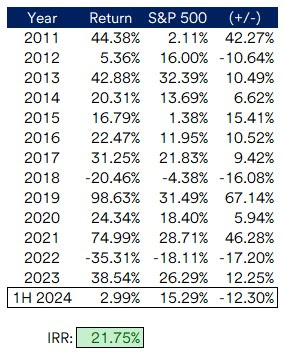
My blog portfolio is essentially flat year-to-date with a gain of 2.99%, well behind the S&P 500 with a gain of 15.29%.  The broken biotech basket performed well but was generally offset by declines in a lot of my legacy holdings and just malaise in my speculative M&A ideas (crossing my fingers that M&A picks up in the second half).  Long term performance remains solid at a 21.75% pre-tax IRR.

Closed Positions:
  • Quite a bit of churn happened in the broken biotech basket, I sold Eliem Therapeutics (ELYM), Homology Medicines (FIXX), Graphite Bio (GRPH), Kinnate Biopharma (KNTE), Reneo Pharmaceuticals (RPHM), Cyteir Therapeutics (CYT), AVROBIO (AVRO) and Theseus Pharmaceuticals (THRX) as each of these had some sort of buyout or reverse merger transaction.  If there was a CVR component, I held through the merger and sold shortly after.  Some of these rallied significantly post reverse merger, but in attempt to stick to the original thesis, I generally sold after the shareholder base turned over a bit.
  • I got spooked out of both Instil Bio (TIL) and Aclaris Therapeutics (ACRS) -- although I made a nice profit on ACRS -- as both management teams don't appear to be following the reverse merger and/or buyout with a CVR strategy.  Instil Bio has yet to sell their new manufacturing facility and I don't have confidence in the property valuation, plus TIL included the line of their intention of "Exploring opportunities to in-license/acquire and develop novel therapeutic candidates in diseases with significant unmet medical need."  Aclaris announced alongside their Q1 results "we have decided to progress ATI-2138 into a proof-of-concept Phase 2a trial in patients with moderate to severe atopic dermatitis", however this one might be worth looking at as BML Capital Management has accumulated a significant stake and could push ACRS to revisit their go-forward strategy.
  • Sio Gene Therapies (SIOX) made their liquidating distribution and is now pushed into the non-traded bucket.  Similarly, Merrimack Pharmaceuticals (MACK) made its liquidating distribution, the remaining penny or two is now in a non-traded liquidating trust.
  • Pieris Pharmaceuticals (PIRS) announced they are pursuing a similar strategy as MACK did, minimizing corporate expenses in an effort to extend their cash runway long enough to capture any milestone payments among their disparate portfolio of development partnerships.  I sold to capture a tax loss, but will continue to monitor this one for a re-entry, if any of their milestones do hit, the return could be a multiple of the current market cap.
  • MariaDB (MRDB) and Asensus Surgical (ASXC) were similar situations, cash burning companies with potentially valuable IP that was subject to a non-binding tender offer, if the tender fell through, both could be worthless.  Luckily for me, both deals went to a definitive agreement and I sold each as the spread tightened to a normal range.
  • First Horizon (FHN) was added shortly after their transaction with TD Bank broke in middle of the short lived bank crisis last year, this spring FHN passed over the long-term capital gains mark for me and I booked the profit.  I could see FHN being an acquisition target for one of the super regional banks trying to use an acquisition as a springboard into a higher regulatory tier category.
  • I should probably leave the traditional merger arbitrage trades to the experts, I exited Spirit Airlines (SAVE) after the judged ruled against the merger on anti-trust grounds, Albertsons (ACI) hasn't gone to court yet, but under the current administration, likely faces a similar result.  Unlike Spirit, Albertsons is cheap on a standalone basis and their PE sponsor Cerberus is likely to seek liquidity in other ways if their merger with Kroger (KR) fails.
  • NexPoint Diversified Real Estate Trust (NXDT) and Transcontinental Realty Investors (TCI) both fall into a similar bucket for me, real estate companies trading at very wide discounts to their NAV, but with management in no hurry to close those gaps (or simply unable to in the current interest rate regime / real estate market).  NXDT has seen some recent insider buying that improves the story, but it has been several years since the old closed end fund converted to a REIT and little has been done to simplify the portfolio or tell the story.
Previously Undisclosed Positions:
  • I've initiated a small position in DMC Global (BOOM) which owns three separate and distinct industrial businesses.  The company has announced a strategic review to sell two of the three businesses, leaving behind a multi-family residential building products business (Arcadia).  I didn't buy earlier in the story because it is unclear to me why Arcadia is chosen one to remain in the public shell, but the situation changed when Steel Partners (savvy, NOL maximizing conglomerate) lobbed in a $16.50/share offer (shares currently trade sub $14).  BOOM has acknowledged the offer and stated they'll consider it as part of their greater strategic alternatives process.
Current Portfolio:
I will be doing some reshuffling of my personal balance sheet, likely withdrawing cash from this account in the near future so keep that in mind when I post the year end results.

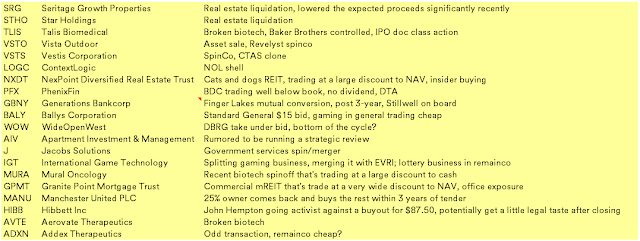
Since this is a pretty brief update, thought I'd include my current watchlist with a little blurb on each, as always, feel free to share any ideas or provide any pushback.

Disclosure: Table above is my taxable account/blog portfolio, I don't manage outside money and this is only a portion of my overall assets. As a result, the use of margin debt, options or concentration does not fully represent my risk tolerance.

Friday, December 29, 2023

Year End 2023 Portfolio Review

Markets have seen quite the rally in the past two months, my portfolio followed along, pulling my returns for 2023 up to 38.54% for 2023 versus 26.29% for the S&P 500.  My lifetime-to-date IRR is currently 22.47%, which continues to be above my 20.00% goal.  
Despite the good year, I'm still below my high water mark due to a disappointing 2022.  I admire anyone that invests professionally through volatile markets, my returns wouldn't be as good if I was managing outside capital.

Updated Thoughts on Current Positions
As usual, these brief updates were written over the past two weeks, share prices might have moved around a little, but hopefully still directionally relevant.  Excuse the inevitable typos.

Broken Biotech Basket:
  • Homology Medicines (FIXX) has been the laggard in the broken biotech basket, in November the company announced a reverse merger with Q32 Bio, a private biotech focused on the treatment of severe alopecia areata and atopic dermatitis, hair loss and a skin condition respectively.  The transaction assigned an $80MM ($60MM of cash, $20MM public listing) to FIXX exclusive of their legacy assets, which equates to roughly $1.38/share compared to the current share price of $0.55/share.  The cash at closing is expected to be $115MM, pre-merger FIXX shareholders will own 25% of the post-merger company, or roughly $0.50/share in cash.  It is not unusual in the current market for the enterprise value of a pre-revenue biotech to be near zero, but in addition to the NewCo, FIXX shareholders will get a CVR for the monetization of any legacy assets.  There's reason to believe that the CVR will have some value, FIXX's IP had initial positive Phase 1 results, but the data is still "immature and inconclusive".  Plus there's the JV, OXB Solutions, that will be put to Oxford Biomedia Solutions for 5.5x TTM revenue by March 2025.  My current plan is to hold through the reverse merger, maybe the name change, upcoming Phase 2 study data readouts (second half of 2024), conferences/investor reach out, etc., will encourage traditional biotech investors to rotate into the stock providing a slightly better exit.  And I'm bullish on the CVR, it'll act as a liquidating trust, Q32 Bio needs to use "commercial reasonable efforts" to dispose of the legacy assets.
  • Graphite Bio (GRPH) is a similar situation, they also announced a reverse merger in November, this one with LENZ Therapeutics, LENZ has a late stage product candidate for treating near sightedness that is expecting a Phase 3 read out in the second quarter of 2024.  GRPH shareholders will receive approximately a $1/share special dividend at close (targeted for Q1) plus will own 30.7% of the post-merger LENZ.  Post-merger LENZ is expected to have $225MM in cash after close (there's a $53.5MM PIPE), equating to another ~$1.20/share of cash per GRPH share.  GRPH currently trades at $2.33/share, giving it only a slightly positive enterprise value, seems cheapish for a biotech with a near term catalyst in a big addressable market.  I'll likely hold onto the stub and see what happens.
  • AVROBIO (AVRO) announced strategic alternatives in July and is still determining its next steps.  As of 9/30, the company has ~$100MM of NCAV, assuming another $10MM of cash burn (they further reduced their workforce in October) before a deal can be commenced would equate to $2/share of value without any value attributed to their IP.  AVRO sold one of their programs to Novartis for $80+MM, the other, HSC gene therapy for Gaucher, might have some value as a kicker.  Shares currently trade for $1.32/share, making it an attractive risk/reward.
  • Pieris Pharmaceuticals (PIRS) ran up quickly after my initial write-up, I took profits, but then it fell and I re-entered, a little too early in hindsight as shares have dropped roughly in half since.  As of 9/30, PIRS had $30.5MM in net current asset value, or $0.31/shares versus a current share price around $0.15/share.  That number doesn't include a number of IP assets and possibly valuable partnerships, but with limited cash on an absolute basis, they'll need to move fairly quickly.  Pieris did just terminate their operating lease, often a precursor to a deal announcement.  This one is on the riskier side, but could be interesting if you see any value in their hodgepodge of IP.
  • Sio Gene Therapies (SIOX) is a liquidation that's now a dark stock.  One reader has been keeping better tabs on the liquidation than me (see the comments), apparently they have two of their three subsidiaries liquidated and should have the third done soon.  The expected initial distribution in the proxy statement was $0.38-$0.42/share versus a current price of $0.37/share.  It's been an annoying wait with limited-to-no public disclosure, which is one of the downsides of investing in liquidations, you need to have a certain personality quirk to set it aside in the meantime.  Hope this liquidation is put to bed soon.
  • Cyteir Therapeutics (CYT) is in the final stages (as we've seen with SIOX, could last a while) of its corporate life, shareholders approved the liquidation plan on 11/16/23 and now we await timing of the liquidation distribution which is estimated at $2.92 to $3.31/share in the company's proxy.  Liquidation estimates tend to be conservative and this appears to be a cleaner situation than most as CYT is only holding back $500k for a reserve account.  Shares trade at $3.09/share, I likely wouldn't buy it today, but content to hold awaiting the liquidation distribution.
  • Kinnate Biopharma (KNTE) and Theseus Pharmaceuticals (THRX) are in similar situations to each other where Foresite and OrbiMed, as a group, have indicated plans to make an offer for each company.  Presumably the structure would result in a cash buyout for a discount to net cash plus a CVR for any IP value, similar to Pardes Biosciences (PRDS) which Foresite took private earlier in the year.  Both stocks trade for only a slight discount to my best guess of a take private offer (5-15% upside on each), but it's worth keeping an eye out for other biotechs where these two are involved as they pop up.  Late breaking news, on the Friday before the Christmas holiday weekend, Theseus announced they reached an agreement with Kevin Tang's Concentra Biosciences for $3.90-$4.05/share in cash, plus a CVR for 80% of legacy asset sales proceeds and 50% of synergies.  I'm a bit surprised that it was Tang versus Foresite/OrbiMed but hopefully that means well for Kinnate.
  • Eliem Therapeutics (ELYM) is a new addition to the basket, nothing too much has changed since that write-up.
  • Reneo Pharmaceuticals (RPHM) received an offer from Kevin Tang's Concentra Biosciences for $1.80 per share plus a CVR for 80% of any legacy asset sales.  Considering the company has not yet declared strategic alternatives formally, I think it might be some time before we here an official yes/no response to the offer or an alternative deal.  But with Tang tossing in a cash offer early, maybe it is less likely Reneo chooses the reverse merger path.
Esperion Therapeutics (ESPR) is a broken biotech adjacent idea, unlike the others, this is a revenue generating company that has a non-satin commercial product (Nexletol) for cholesterol.  Esperion is locked in a lawsuit with their primary commercialization partner, Daiichi Sankyo, over a disputed milestone payment tied to the amount of "relative risk reduction" for heart attacks and other cardiovascular diseases/events that was reported in the company's CLEAR Outcomes Study.  Esperion has a PDUFA date set for 3/31/24 that would expand the label of their primary asset to include cardiovascular risk reduction and a trial start date of 4/15/24 with Daiichi Sankyo.  This remains a speculative idea, but could be a multi-bagger if both catalysts go their way in the first half of 2024.

Mereo BioPharma (MREO) is more of a regular-way biotech, the original thesis revolved around Rubric Capital taking an activist stance and gaining board seats with a general plan to realize the sum of the parts valuation of MREO's hodgepodge of programs.  No publicly disclosed progress has been made in that regard, but the company did report positive Phase 2 results for Setrusumab in patients with osteogenesis imperfecta with partner Ultragenyx (RARE) that boosted the stock.  Following the announcement, Rubric Capital has been a consistent buyer of MREO shares, giving confidence that their plan is working out.

Albertsons (ACI) and previously unmentioned Spirit Airlines (SAVE) are two well covered merger arbitrage situations that don't necessarily need more inked spilled on them.  I'll use this post as a thank you to Andrew Walker and his wonderful Substack/Podcast, he really ramped up coverage on Spirit as the market became increasingly nervous in early November dropping the shares into the low $10s/share.  I picked some up and the market has bid up shares since awaiting a ruling any day now in their anti-trust case with the U.S. government.  Albertsons is facing similar push back, regulators are pointing to local market monopolies similar to Spirit, although I still believe the asset divestiture and any further divestitures should be able to create a compromise situation given Albertsons and Krogers general lack of national overlap.

MBIA (MBI) is a bond insurance company that has been in runoff for many years now.  It has confusing accounting due to a GoodCo/BadCo structure hiding the value of the GoodCo in their consolidated financials.  My original thesis centered around MBIA putting itself up for sale, but as rates increased (this company is also very interest rate sensitive due to their bond investment portfolio) and the Puerto Rico Electric Power Authority ("PREPA") restructuring continuing to drag on, the company paused the sale process since they presumably weren't getting anywhere near management's adjusted book value of $27/share.  At the start of December, shares were trading under $8/share, then some lucky news hit that National Public Finance Guarantee Corporation (the GoodCo) was dividending up to the parent $550MM in a special dividend.  Much of which was then going to be distributed to MBIA shareholders in an $8/share dividend, more than the shares were trading at the time.  Post special distribution, the company should have a book value of ~$11-12/share ex-BadCo and ~$19/share if you use management's adjustments and back out the unrealized losses on their investment portfolio and add in their unearned premiums.  On the 11/3/23 Q3 earnings call, CEO Bill Fallon (presumably knowing the National dividend was a possibility/probability) said, "With regard to the strategic alternatives, as we've suggested in the past, we think the optimal transaction would be a sale of the company."  With shares current trading for $6/share, there's still room for a healthy premium for MBIA shareholders and a discount to book for an acquirer.  Absent a deal, if rates do indeed come down and municipal credits remain strong, MBIA can continue to limp along in runoff, returning capital via either repurchasing shares or potentially more special dividends in future years.  I lost a fair amount on some call options speculating on a takeout earlier in the year, I won't make that same mistake with MBI today, but I continue to hold.

HomeStreet (HMST) is a regional bank based in Seattle that also does a lot of business in southern California, which was caught up in the deposit flight crisis last spring.  I bought it after a Bloomberg article suggested the company was exploring a merger or an asset sale, later we found out that several bidders have made offers for the company's DUS business line (a license that allows them to directly originate Fannie Mae commercial loans), but the company has thus far not been agreeable to a sale.  HomeStreet's deposits costs have risen dramatically, squeezing net interest margin, they've cut expenses, and reduced loan originations to the point where they could be classified as a zombie bank.  A full out sale is highly unlikely here in the near term, any acquirer would be required to mark-to-market HomeStreet's balance sheet, which currently would have negative equity value due to the current value of their loan portfolio (rate driven, not credit driven, yet).  Without the DUS asset sale as a catalyst, this bank is one big bet on lower interest rates, indeed in the last few weeks, shares have spiked back above $9/share.  Tangible book value is $26/share (ex-loan fair market value), if rates decline enough over the next year or two, HomeStreet will limp along until the accounting is satisfactory enough where they become an acquisition target by someone with a stronger deposit franchise.  That's a bit of thesis drift for me and I have plenty of interest rate risk elsewhere in my portfolio, so I might exit this position for future new ideas.

First Horizon (FHN) is a mid-to-large sized regional bank that does most of its business in the southeastern United States.  It came on my radar when their sale to TD Bank was terminated after regulators made it clear they were penalizing TD for previous anti-money laundering wrongdoings by not approving the merger.  The deal broke towards the tail end of the regional bank panic earlier this year and FHN sold off hard as arbs exited and market participants were unsure if the regional bank model was even sustainable anymore.  Six months later, things have calmed down considerably for banks, deposit costs are still rising but with the Fed about to pivot, many bank board rooms are breathing a sigh of relief.  First Horizon is a solid franchise, footprint has good demographics (although I've seen some stories about multi-family overbuilding in Nashville), minimal mark-to-market losses and strong capital ratios to the point where management has signaled plans to return cash to shareholders next year by repurchasing shares.  On the negative side, the bank had a surprise loan go bad for $72MM (Yellow maybe?) and they've got some expense ramp happening as FHN modernizes its technology stack.  Today it trades at $13.80/share, tangible book value is $11.22/share, a target valuation of 1.5x book still seems reasonable, which would yield a $16.83/share target price.  I'm content holding until we get a bit closer to that number, maybe get long-term capital gains tax treatment too.

Banc of California (BANC) is another regional bank that closed on their transformational merger with PacWest (PACW) after the former got caught up in last spring's banking crisis.  Following the merger, Banc of California should have a tangible book value around $14.25/share compared to the current share price of $13.43/share (0.94x book), with earnings guidance of $1.65-$1.80/share (12% ROE, sub-8x earnings).  My thesis continues to be that there will be significant realized synergies as the two banks had significant overlap which will become more apparent in 2025 earnings.  Until then, the bank is in pretty decent shape after an equity injection, low 80s loan-to-deposit ratio and sub-4% office exposure.

CKX Lands (CKX) is a micro cap (~$25MM) land bank in Louisiana where management is potentially looking to take it private (management hasn't said this explicitly, but the company is exploring strategic alternatives) as plans advance for a carbon capture sequestration plant on or near CKX's land.  Historically, CKX has generated revenue from timber sales, oil and gas royalties and other miscellaneous land fees.  The rock underneath CKX's land is porous rock that makes it suitable for carbon capture sequestration technology, which is essentially means collecting the pollutive output of the area's numerous refineries and piping it back deep into the earth.  If a sequestration plant is constructed on CKX land, the company would be entitled to a revenue share, management might be trying to get ahead of that event by taking the company private.  This article provides a great overview of the sequestration opportunity and mentions CKX CEO Gray Stream quite a bit.  I don't have a great sense of what the fair value is for CKX, but others more familiar with the situation have put an $18/share value of it, today it trades a bit under $13/share.

MRC Global (MRC) is a distributor focused on natural gas utilities, energy transition projects and servicing the upstream oil & gas industry.  No MRC specific news has really come out since my write-up, so it still holds up fairly well, the macro backdrop has improved a bit as LBO financing conditions have improved.  The company needs to refinance a term loan that comes due in September, the preferred shareholder is blocking any contemplated refinancing that wouldn't include taking them out, I still think a sale should work well for all sides here and is likely to happen.

Green Brick Partners (GRBK) is a homebuilder with a land development heavy model that continues to outperform, turning on its head the value investor idea that an asset-lite homebuilding model is necessary to succeed in this cyclical industry.  Count me as surprised too how their land sourcing and infill location model has continued to be a sustainable competitive advantage (key man risk with Jim Brickman?), but with migration trends continuing to be a tailwind for their Dallas and now Austin markets, their growth should continue.  GRBK currently trades at a reasonable 7.5x NTM earnings according to TIKR estimates and has $121MM remaining on their share repurchase plan.  I cut back on my position during the year, but still have confidence in Green Brick's medium-to-long term future although not necessarily an actionable idea today.

Acres Commercial Realty Corp (ACR) is a commercial real estate bridge lender, primarily to multi-family properties, but also a smattering of office, hotel and retail.  The market is particularly worried about lenders like ACR, they lend to developers/sponsors who are repositioning a property, which upon stabilization will then obtain long term financing to take out ACR's bridge loan.  Banks have pulled back, no one wants to extend new loans to office in particular, but multi-family also has some fears of covid induced overbuilding, the pull back in financing itself could cause a sinkhole in CRE asset value.  If the sponsor is unable to obtain new financing, ACR might be handed back the keys.  The formation of ACR was basically sponsored by Oaktree, the distressed specialist, my inclination is their loan book is stronger than the average commercial mREIT as a result.  ACR additionally is the odd REIT that doesn't pay a dividend, which gives them flexibility to plug credit holes or as they recently announced, return cash to shareholders via a share repurchase program.  Shares have rallied with the repurchase news and Fed pivot, but at $9.80/share, it still trades at a massive discount to book of ~$25/share.

Howard Hughes (HHH) is a real estate developer effectively controlled by Pershing Square's Bill Ackman, he has been a consistent buyer of shares this year as the stock has traded around $80/share in recent months.  With rates increasing, new commercial development has slowed at Howard Hughes, plus one of their main products in new office is all but dead for the next decade or so.  Even if commercial development slows in the near term, their land sales should be strong in the near term as homebuilders are increasing their activity to meet demand.  Absent some kind of Ackman take-private, the near term catalyst for HHH is their upcoming spinoff of Seaport Entertainment which will house the disastrous Seaport segment (much of which they operate themselves), the Las Vegas Aviators (presumably the stadium too, but they need lender approval) and the Fashion Show air rights.  They've hired Anton Nikodemus to be the CEO of Seaport, he previously was an executive at MGM where he ran the CityCenter properties and was instrumental in the development of MGM National Harbor and MGM Springfield.  Presumably that means they're finally serious about utilizing the Fashion Show air rights, but with several large new strip casinos coming online this year, their timing might not be right.  My initial reaction is the spin is a positive development, it'll remove the Seaport cloud from the pure play real estate assets, although I question how Seaport will be funded/financed.  The Aviators ballpark provides a nice steady revenue stream, but not enough to cover further Seaport losses, let alone develop their planned 250 Water St tower or a new Las Vegas strip casino.  I'll likely do a deeper dive once the Form 10-12 comes out on the spin.

DigitalBridge Group (DBRG) is in the final stages of its transition from a diversified REIT to a pure play asset manager focused on the digital infrastructure industry.  Continually increasing rates in 2023 were initially a negative for DigitalBridge as many of their portfolio companies were purchased at low entry cap rates, but the company was saved a bit by the artificial intelligence trend that has continued the need for data centers and other digital infrastructure assets.  This remains a bit of a jockey bet on CEO Marc Ganzi, he's a talented fund raiser, but he is losing his number 2 in CFO Jack Wu who is moving on to lead his own investment organization.  I don't have much to add to the discussion on DBRG, content to hold a while longer to see the full transition from a balance sheet play to an income statement story, we're still probably 1-2 years away from that being complete.

Transcontinental Realty Investors (TCI) is a heavily controlled real estate company that primarily owns multi-family properties in the sunbelt, but does have a smattering of office and land development projects as well.  This year was pretty quiet for TCI, they did start developing two new apartment complexes (one in FL, the other in TX), but otherwise simply deleveraged their balance sheet after the previous transformational Macquarie JV sale in 2022 (which in hindsight was very well timed, sold near the very top).  The recent proxy statement had two interesting proposals, one put forth by management that would clear some red tape in merging the Russian doll structure with ARL and IOC and another from a shareholder asking the company to hire an advisor and pursue strategic alternatives.  The shareholder proposal naturally failed since TCI is 85% owned by the controlling family.  But seems like there might be some movement in cleaning up the structure, it is still a bit puzzling why TCI is public, management does have an external management agreement, but it really only applies to the 15% of stock that is held by the public.  With NAV arguably over $100/share and the stock trading for $35/share, there's a lot of room for minority shareholders to be happy and management to transfer significant value to themselves in a take-private deal.  I had an outsized position in TCI to start the year, did trim my position by a third, content now to wait a year or two longer for a corporate action to happen here.

NexPoint Diversified Real Estate Trust (NXDT) is formerly a closed end fund that 18 months ago converted to a REIT.  Unfortunately, this story has been very slow to develop, not much has happened here post conversion, the REIT continues to be a confusing mess of limited partnership stakes, many of which are with related parties, and limited investor outreach to simplify the story.  Rising rates didn't help NXDT and its valuation has suffered, trading around $8/share today versus a $23.89/share reported NAV (as of 6/30) or a $22/share tangible book value.  CEO James Dondero (a controversial figure) continues to buy shares via funds he manages, personally and is taking their management in shares (although that's a bit of a negative given where the shares trade), all bullish signs for the underlying value compared to trading price.  The REIT doesn't cover its dividend with AFFO, it recently started paying 80% of the dividend in shares, I'd rather see them cut the dividend to zero and build some liquidity, only paying a special dividend necessary to comply with IRS REIT regulations.  In summary, it is just odd that NXDT doesn't publish press releases, conduct earnings calls or do the typical REIT conference circuit investor presentations.  All things I would have assumed they would do considering how they manage NexPoint Residential Trust (NXRT).  Similar to TCI, I'm willing to give management here another year or two to see what develops, but my confidence is lower than when I first bought into the idea.

Par Pacific Holdings (PARR) is a downstream energy company with refining, midstream and retail locations in geographically niche areas in the Rockies, Pacific Northwest and Hawaii.  Par Pacific has benefited from another year of above average refining crack spreads causing the company to gush cash.  They've successfully fixed their post-covid balance sheet and this year closed on the acquisition of a formerly Exxon refinery in Billings, MT.  The company is generating significant taxable earnings which are now offsetting their $1B+ NOL tax asset.  Par Pacific is additionally beginning to invest in renewable fuel assets, which might help people think through the terminal value question of oil refineries, but I tend to think that's premature by a couple decades.  The management team is formerly from Zell's Equity Group and continues to execute on value accretive deals (other than injecting additional equity in Laramie (a private natural gas producer PARR owns 46% of), it is hard to think of a bad deal they've done).  It's not necessarily actionable today, I did sell down some of position during the year, but at 5x NTM EBITDA and 6.75x NTM earnings (TIKR estimates, to be fair, they're overearning in the current environment), I continue hold due to being comfortable with the management team.

Closed Positions (since 6/30)

Broken Biotech Basket:
PFSWeb (PFSW) was a third party logistics ("3PL") provider that was acquired by GXO Logistics (GXO), the deal closed in October for $7.50/share, a nice result.

Sculptor Capital Management (SCU) was a hedge fund manager that put itself up for sale after a very public spat between founder Daniel Och and CEO Jimmy Levin.  The firm found a buyer in Rithm Captial (RITM) (fka New Residential), a little bidding war ensued but eventually Rithm Capital closed on the deal in November for $12.70/share.

Western Asset Mortgage Capital Corp (WMC) was a mortgage REIT that never recovered from the covid era liquidations, it was acquired by AG Mortgage Investment Trust (MITT) in a cash and stock deal.  I would anticipate seeing a few more of the small left for dead mortgage REITs acquired in the coming years, particularly if we see more stress on the CRE side.

Jackson Financial (JXN) is a 2021 spin of Prudential PLC that primarily provides variable annuity insurance products.  I liked the setup because it was a UK listed company spinning off a much smaller US listed company; Jackson Financial initially traded substantially below book value (still does) as it was an orphaned security with no initial index ownership and complicated financials.  Over the following two years, Jackson was added to indices, paid a healthy dividend and bought back a substantial amount of stock.  While that gameplan is still occurring and some potential excess capital could be dividended up to the parent (similar to MBIA) in the near future, my initial thesis has generally played out and I'm not a strong enough accountant to figure out their financial statements.  I decided to sell and relocate to newer ideas.

Carlyle Credit Income Fund (CCIF) (fka VCIF) was previously a residential mortgage closed end fund that transitioned to a CLO equity fund.  The thesis generally played out expect for one important risk, when it came time to sell the residential mortgages in the old VCIF portfolio and deliver the cash to Carlyle, the fund took a large 17% write-down.  I'm still not entirely clear why or what happened in the few weeks from the proxy to the asset sale, but that cut almost all my gains in the investment.  Carlyle is a quality manager and I generally like CLO equity as an asset class, but post transition and dividend reinstatement, my position was generally smallish and decided to move on.  Might re-visit it if we see some stress in private credit and the leveraged loan market.

Manchester United (MANU) is the famed English Premier League soccer club, my thesis revolved around the bidding war between Sir Jim Ratcliffe and Sheikh Jassim of the Qatari royal family, I wrongly guessed that Sheikh Jassim would come out victorious since his bid was for all MANU shares and at a higher price than Ratcliffe.  But for whatever reason, the Glazers choose Ratcliffe, after months/weeks of rumors, the official announcement was made this past week that Racliffe was tendering for 25% of both Class A and Class B shares at $33/shares, plus investing another $300MM at $33/share for club facility improvements.  I had hoped there would be some language around a path towards majority or full ownership, but didn't see anything explicitly stated to that effect.  Without a concrete timeline, and Ratcliffe taking operational control of the team, its uncertain why or when he'll buy economic control of the team, the prestige is being the ownership face, and he'll be that now.  As a result, I would expect MANU shares to trade at a significant discount following the tender and possibly be dead money for a while.  I was wrong, but didn't really lose any money on this one.

Performance Attribution
Current Portfolio
In addition to the above, I also have a bunch of CVRs, non-traded/illiquid liquidations, an illiquid bond and a litigation stub.

Please feel free to ask any questions or leave any interesting new ideas for 2024.  Thank you to all my readers, especially those that have reached with positive or negative feedback, new ideas, or just wanting to chat.  Happy New Year, hopefully 2024 is prosperous as well.

Disclosure: Table above is my taxable account/blog portfolio, I don't manage outside money and this is only a portion of my overall assets. As a result, the use of margin debt, options or concentration does not fully represent my risk tolerance.