Friday, June 21, 2019

Command Center: Reverse Merger with Hire Quest, Tender Offer

Command Center (CCNI) is an illiquid micro-cap staffing company providing temporary semi-skilled and unskilled labor to light-industrial, hospitality, transportation and retail customers.  Through a network of 67 branches in 22 states they deployed over 32,000 employees to 3600 customers last year, a sizable operation given their $25MM market cap.  The company has historically struggled with mediocre management, exposure to oil and gas markets and a lack of scale, all of which led to activist investors pressuring the company to explore strategic alternatives in 2018.

On 4/7/19, the company announced a merger with privately held Hire Quest Holdings, effectively structured as a reverse merger where Hire Quest management will run the combined company and Hire Quest shareholders will own 68% (76% after the tender) of the proforma company's stock.  Temporary staffing is a fragmented industry with several large players and then many "mom and pop" type operators. Hire Quest's business is structured as a franchiser, they provide the back office support and negotiating scale on workers compensation insurance (a significant expense for this industry) to its franchisees under the brand names Trojan Labor and Acrux Staffing.  After the merger with Command Center is complete, the company plans on franchising the 67 Command Center branches to mirror the Hire Quest business model.  Interestingly, Command Center previously operated under the franchise model but bought out their franchisees in 2006.

In tandem with the reverse merger, the combined company will be conducting a tender offer of up to 1,500,000 shares at a price of $6 (versus a price of $5.45 today), in the proforma financials provided in the proxy, it shows the current cash on CCNI's balance sheet of $7.5MM being withheld for the tender offer.  They're a little short of the $9MM necessary for the tender, but given the cash build since the Q1 financials came out, I'm going to assume the company is essentially both cash and debt free.  Additionally, since the company will be franchising the current 67 Command Center locations, they should see some cash inflow from those sales.  The 2006 acquisition of 69 franchised stores which formed Command Center was done for 13.2 million shares which traded at roughly $1 at the time of the announcement (data is a bit hit and miss, this was an even tinier OTC stock at the time so my figures could be off), or we'll call it $180k per location which sounds reasonable as the buyers are going to be the store manager or someone looking to own their own job.  If correct, that's another $12MM in additional cash that could be used for buybacks/tender offer or expansion.

In the press release announcing the reverse merger, management provided the following pro-forma commentary:
"If Hire Quest revenue were determined on a similar revenue for the year ended December 31, 2018 would have been approximately $189 million.  Based on our current projections, after some period of integration and normalization, we believe the combined entities will produce annual EBITDA in excess of $15 million, exclusive of growth opportunities."
Following the tender offer, the company will have 12,968,678 shares on a diluted basis, at today's share price of $5.45 (and the assumption of zero net cash/debt, no value to the franchising), the enterprise value for the proforma company is approximately ~$70.5MM.  Against a post deal (could be messy the first year or so) estimated EBITDA of $15MM, the new Hire Quest is trading for roughly 4.7x EBITDA, well below the large publicly traded staffing companies.
Clearly some of these companies have higher quality businesses than that of a sub-scale CCNI, but with a new owner-operator management team in place, a differentiated franchise business model, post deal closing Hire Quest could have a more attractive story to tell investors narrowing some of that valuation gap.  At 7.0x EBITDA, still a discount to the group, shares would be worth $8.10 per share, or nearly 50% higher than today's trading price.  If we want to get a little crazy and use my $12MM cash number from the sale of franchises, that's just under another $1 per share, call it $9 per share total. Originally the deal was targeted to close in the second quarter, but that time frame has slipped a bit, the company is holding the shareholder vote alongside their annual meeting on 7/10/19 with the merger likely to close sometime shortly after it's approved.

Disclosure: I own shares of CCNI

Craft Brew Alliance: Speculating on ABI Qualified Offer

Craft Brew Alliance (BREW) is a collection of craft beer brands formed with the merger of Redhook Ale and Widmer Brothers in 2008, but it is best known for its fast growing Kona Brewing brand of beer.  Originally a Hawaiian craft beer, Kona is now positioned as a beach inspired mass marketed lifestyle beer.  If you're unfamiliar with Kona, they recently did a big media buy during the 2019 NCAA basketball tournament, here a link to one of their commercials espousing the island lifestyle.  CBA is ~31% owned by brewing giant AB InBev ("ABI"), in August 2016 ABI entered into a distribution agreement with CBA that laid out a path for ABI to purchase the remaining ~69% they don't already own.  The agreement has a graduated payout schedule based on the date of an announced acquisition, the first two dates have passed and the last deadline for ABI to make a "qualified offer" for CBA is 8/23/2019, the qualified offer has a minimum of $24.50 per share.

Craft Brew Alliance is an unfortunate name, it's now widely agreed the craft beer segment is over-saturated with thousands of breweries, it's difficult for the mid-sized independent brewers to survive as most craft drinkers have migrated to the ultra-local inside your own zip code breweries.  It's much more fun to show up to a party with a growler of IPA from down the street than a 6 pack from a super-regional brand you can get at any Walgreens.  The original version 1.0 craft brands like CBA's stale Redhook or Widmer brands are in free fall and pioneering brands like Boston Beer (SAM) have pivoted to so called "alcopop" and spiked seltzers.  Similarly, Kona has morphed into a mass-marketed lifestyle brand, their two flagship beers (Blue Wave and Longboard) are relatively easy drinking and light.  A small anecdote reflecting that shift, my old college bar now has "$3 Big Wave Thursdays" as the weekly special, it's no longer "craft brew" if 19 year olds are playing beer pong with it.

AB InBev is viewed as over-leveraged after the acquisition of SABMiller, they also cut the dividend in half last October sending their shares to multi-year lows as they deal with declining beer volumes, but since the dividend cut shares have recovered nicely this year.   Acquiring CBA would be a relatively small check (~$325MM) for ABI to write and would fill a hole in their U.S. portfolio where they don't have the rights to the similarly positioned Corona brand.  Additionally, if ABI passes on making a qualified offer, they would owe CBA a $20MM fee and potentially open themselves up to another brewer making an attempt to purchase CBA, how would ABI feel about a competitor (Constellation Brands?) getting a free ride on their distribution system for the next several years?

But the market clearly doesn't believe it will happen, today shares trade for $13.60, the minimum qualified offer price of $24.50 would represent an 80% premium.  The downside is probably in the $8-9 range if there's no offer, so by triangulating the implied odds the market is telling you there's about a 4-1 or 3-1 chance of the deal being completed.  Let's just assume that's right, an interesting way to speculate on the deal getting done is through August $20 call options which are trading for ~$0.20 per contract.  If the deals consummates, it's likely to be all cash and at the minimum price, so we know the timing and we know the price, assuming a small spread, the calls would move up to ~$4.00 or so on a deal announcement, or a 20-1 payout structure.  I'd love to be able to invest in 30 similar trades to spread out the dispersion, but even on its own its a compelling proposition and I have made it about a 1% cost basis position in the calls.

Disclosure: I own BREW August $20 calls

Monday, June 3, 2019

Spirit MTA REIT: Sells MTA Assets to HPT, Remains Compelling

[Apologies for another SMTA update, I'm still active, but I haven't really bought much new lately.]

Spirit MTA (SMTA) this morning announced the sale of the assets contained within the Master Trust to Hospitality Properties Trust (HPT) for ~$2.4B, after redeeming the Trust's debt and other transaction expenses will net SMTA approximately $450MM (I was hoping for more like $500MM, but this is a reasonable outcome).  HPT shareholders (bagholders?) might be asking why a hotel REIT is buying net leased retail assets, but it is good news for SMTA shareholders as the transaction is for cash that has committed financing from an investment grade borrower and doesn't require an HPT shareholder vote.  HPT is externally managed -- abused -- by RMR Group (RMR), they're interested in increasing AUM and resulting management fees, closing is targeted for the end of Q3.

Updating my NAV for the $450MM sale:
With no value to the remaining NAV pieces that are in question, the value to SMTA shareholders is approximately $7.90, so at today's price of $8.30 (and assuming the deal closes), you can buy the remaining assets for $0.40 with upside of potentially up to ~$2.50-3.00 of value on the workout and other assets.

Old news to those deep in the comment section of my earlier SMTA post this year, but here are additional thoughts on the remaining NAV components/risks:

As part of the spinoff, SRC via SMTA loaned Shopko $35MM via a term loan to receive access to ShopKo's periodic financials.  When Shopko filed for bankruptcy in January, SMTA wrote off the term loan and as a result, it doesn't appear in their NAV table, however, per the liquidation waterfall in the almost wrapped up Shopko bankruptcy, the term loan should be paid in full.
The low end estimate also shows essentially a full recovery, that's approximately $0.75/share, already well ahead on the $0.40 investment in the other assets above the MTA and cash.

The Academy Sports + Outdoors distribution center in Katy, TX is another big component to the other asset category, it is Academy's largest warehouse and home to their headquarters.  Like many other retailers, the company is struggling, it's owned by KKR and has significant debt that trades at a discount.  But if they were to restructure, I'm guessing they'd keep this warehouse as again, it's their headquarters, and it serves their largest/original market in Texas.  Katy, TX is outside of Houston, home to many large warehouses including Amazon.  Industrial real estate is hot right now, just this weekend Blackstone announced another deal (they've done several including GPT and FRPH).  As part of the CMBS financing transaction, the property was appraised at $144MM in 2018, and Academy's distress was very apparent at the time of this appraisal, below is the chart of the Academy term loan going back to issuance.  It trades for 75 today, down from early 2018 levels, but was still in distressed territory back then, it's not a new story.
In my NAV, I'm putting a 8.5% cap rate on the $9.5MM NOI, call it a 20-25% haircut from the appraised value done before the spinoff.

On the workout portfolio, many want to write these off completely, much of these are actively leased, just don't fit the portfolio profile of a publicly traded REIT but still of institutional type asset quality.  From the Q1 recorded conference call:
"Starting with portfolio activity, we continued to actively manage the portfolio during the first quarter, selling three properties for $5.4 million in gross proceeds. We also executed a lease with 7-Eleven on a former non-core vacant asset which we will look to dispose of at a far improved price above its previous start value.
In addition, the leases for two non-core assets formerly leased to Neighbors Health System have recently been assumed by new operators. We plan on contributing those two assets into the Master Trust, which allows us to deploy restrictive release account cash before that cash is swept to repay ABS notes with corresponding make whole penalties. In turn, these contributions will enhance our unrestricted cash position outside of the Master Trust."
The new tenant is Diagnostic Health and according to the servicer report, entered the trust with a collateral value of $8.41MM at a cap rate of 13.6%, assuming the same cap rate across the rest of the workout portfolio plus the book value of the vacant properties nets out a $57MM value.  This number likely has the widest range of outcomes, much of the value is a multi-tenant office building leased to PwC in Columbia, SC, hard to get a read on how much that asset is worth, open to others thoughts.

Another risk people site is the Shopko CMBS lender coming back to SMTA, but it appears the CMBS lender has moved on, as mentioned in the SITE Centers (SITC) Q1 call:
"First, we signed a management agreement with Credit Suisse, providing them advisory and operational services for 83 assets leased to Shopko on which they have recently foreclosed. Importantly, the agreement came with rights of first refusal for 10 assets in the portfolio and allowed us to leverage our existing operating platform to generate nearly 100% margin on any fees we received. Credit Suisse's needs were ultimately short-lived, but we nonetheless earned the $1 million in the process which was a contributor to our strong quarterly results."
Later in the Q&A, they clarified it was a short lived asset management agreement because their client sold the portfolio quickly.

Putting it all together, I think it's pretty reasonable to come up with $10.70 NAV with some range of outcomes around that value primarily dependent on the Academy distribution center and other workout assets being sold for reasonable valuations.  The main risk from here is the timing, HPT didn't buy the SMTA holding company, so there will likely need to be a small holdback amount to address any clean up and other shut down expenses.  Maybe its $10 by the end of Q3 with the remainder sometime down the road after that?  The other concern might be the HPT deal requires a shareholder vote at SMTA, SRC is waiving their promote/incentive fee surprisingly, maybe to get in the good graces of a couple activist shareholders in Indaba and Mangrove, but surprising nonetheless for Jackson Hsieh to leave money on the table.  I find the valuation compelling today and added more, it's my largest position by a decent margin at this point.

Disclosure: I own shares of SMTA and Oct $7.17 Calls

Friday, March 29, 2019

Howard Hughes: Updated Thoughts 2019 Version

It's been about three years since my last post on Howard Hughes Corporation (HHC) and I wanted to updated my mini-model and walk through some updated thoughts on their progress.

Howard Hughes is a real estate development company that was originally spunout of GGP during its restructuring to hold the master planned communities and non-core assets of GGP.  Since the spin, close to 9 years ago now, HHC has focused its efforts on five key markets: Houston, Las Vegas, Honolulu, Columbia MD, and the Seaport District in New York City.  Their story is pretty well known by now in the investment community but HHC shares still provide a compelling long term value for a few primary reasons:
  1. Howard Hughes is a real estate company that is not a REIT and does not pay a dividend, also because of its mixed portfolio, doesn't screen well or fit into any easy to value bucket.  Additionally, much of its value is in land and large assets that aren't currently producing any cash flow (for example, the Seaport).  A counter to this, many REIT funds are including non-REIT real estate companies, for example, Vanguard's switched its mandate from a REIT fund to a real estate fund and included HHC in the process.
  2. Much has been written about the lack of new home construction since the financial crisis, one day this will normalize and HHC will be well positioned, their master planned community ("MPC") assets are highly sought after, providing the raw material homebuilders need and because of their maturity (hundreds of millions have been spent previously on infrastructure), feature high cash margins.  HHC uses these cash flows to self fund commercial construction (office, multi-family, retail) in these MPCs that HHC holds for investment.
  3. NOI (and thus NAV) should continue to grow at a fast clip without needing to raise any equity capital, additionally the company has further growth levers it can pull via several under appreciated assets outside of their core markets that could have significant value.
The easiest way to value the company is to run an net present value calculation on the land sales in the MPCs and the condo sales in Honolulu and add it to a NAV of the current operating properties and strategic developments minus any remaining construction costs and debt.

Master Planned Communities
The company publishes an undiscounted and unappreciated value of their land holdings in their 10-K, this is simply the average recent selling price of their land multiplied by the remaining acres, it doesn't account for the time value of money or any future appreciation in pricing as the remaining acreage should get more valuable over time as Howard Hughes builds out the amenities.  I took those numbers and simple ran an NPV using a 10% discount rate assuming a straight line selling pace until the sell out date with no price appreciation built into it.  Note: I just used book value for The Summit, which is an ultra-luxury community in Summerlin that's being developed with a JV partner, it's been a big success and likely worth more than book.
In 2018, the MPC assets generated EBIT of ~$200MM, this roughly equates to a 10-11x EBIT multiple for the land business if you value it at $2.3B, which seems reasonable to me.  Using roughly the same framework for the condo development business in Honolulu, ~$1300 square foot average selling price and costs of $1100/square foot and running an NPV using a 10% discount rate until the 2028 sell out date equates to about $833MM in remaining value.  This doesn't account for the retail transformation that will happen over that time, just the condos, which the company has mentioned they'll be increasing their pace of tower construction as they have found a niche in smaller pre-furnished units in Oahu's highly supply constrained market.

The company also provides a lot of detailed disclosure on their operating property and strategic developments segments making an NAV calculation fairly straight forward.  Below, sorry its small, but I've taken each property, assigned a cap rate and deducted any property level mortgages or remaining construction costs on the unstabilized properties.

Office Properties
HHC's office portfolio was heavily weighted towards Houston 2-3 years ago, they clearly made a mistake in overbuilding ahead of the oil rout in 2015 and several of the office assets in Houston remain unstabilized years later.  However, since then they've been focusing office construction on Columbia, MD and in Las Vegas, most of these properties are new in the last three years.  Another asset that didn't get much attention until recently is 110 N Wacker, it was a four or five story building that covered an entire city block along the Chicago river, it was previously the headquarters of GGP and was recently demolished.  HHC along with JV partners (HHC owns 33% now, mostly just contributing their land) have commenced construction with a projected finish date in the back half of 2020.
110 N Wacker - 3/29/19
Bank of America will be the anchor tenant, leasing activity was brisk enough that two additional stories were added to the building to meet demand.  It's a prime location on the river and near transportation, despite the building boom in the Loop, I can't imagine them having difficulty fully leasing the building upon completion.  At that point, I'd expect them to sell their stake as it is non-core in that they don't control any properties or land around it, but anyway it's an asset that was an after thought in NAV models until recently, HHC has a couple others that could be even more significant that I'll touch on later.

Retail Properties
The biggest piece to the retail portfolio is the Seaport District located on the East River in Lower Manhattan, it was a tired yet popular tourist attraction until Superstorm Sandy destroyed it in 2012.  Since then, Howard Hughes has been working on redeveloping the area, it has taken longer than originally expected and gone through a few strategic changes (notably switched from a "regular mall" to more of an experiential shopping experience).  I don't like commenting too much on the Seaport's value as I'm not a New Yorker like many in the investment community who might have stronger opinions on the asset, but I mentioned in my year end post that a similar property in Chelsea Market was sold for over $2.4B.  Chelsea Market is roughly twice the square footage as the Seaport, giving rough credit to the $1.25B value I'm putting on the Seaport before the remaining construction costs.  HHC also bought a parking lot for $180MM near the Seaport that it plans to redevelop, likely into multi-family, as the Seaport stabilizes and increases demand around the neighborhood.

Multi-Family, Hotel, Other
They've heavily invested in multi-family properties in recent years, mostly successfully, less successfully on the hotel properties which are located in the Woodlands and were built right before the oil rout, similar to their office portfolio there, these properties have taken longer than anticipated to stabilize.
These are the random other assets that Howard Hughes owns including the new AAA ballpark they built in Summerlin, a ground lease beneath the Vegas Golden Knights practice facility and the marina in Honolulu.

Two of these other assets that I think are interesting and carried at little value on the balance sheet but could be significant drivers of NAV growth over the next 2-5 years are the Fashion Show air rights and Monarch City.
Fashion Show Mall - Las Vegas
HHC owns 80% of the air rights above the Fashion Show mall on the Las Vegas strip across the street from the Wynn and adjacent to Trump Tower on one side and TI on the other side.  Back in 2017, there were rumors that the company was reaching out to design and construction firms for a potential casino resort development, but nothing more has really come of it and Las Vegas is in a mini-slowdown right now.  The mall was owned by GGP, but Brookfield bought GGP last year and likely makes a more natural development partner for the project as Brookfield's stated strategy is to redevelop many of the acquired malls into mixed use properties. It may be another few years before anything happens here, but it's another potential driver of NAV that isn't included in my model or any that I've seen put out by analysts.

Promotional Deck for Monarch City
Another under followed asset that HHC owns is 280 acres of land in Allen, TX on the corner of two highways that was recently renamed Monarch City and has plans for over 9 million square feet of mixed use development.  To put that scale in perspective, HHC has 14 million square feet of entitlements (only a small fraction of which are currently built) in Downtown Columbia, but Monarch City is still large enough be a significant asset and potentially a 6th core market for HHC.  Allen is an attractive market, it is a suburb north of Dallas and right in the heart of a big housing development corridor, fellow long time holding of mine Green Brick Partners (GRBK) is active in the area with several ongoing communities being built within a short drive of Monarch City.  The Dallas metro area is very popular with corporate relocations given its low taxes, Howard Hughes is likely waiting for a big relocation opportunity to anchor the development before breaking ground or publicizing the asset further, if they're able to sign one, Monarch City is large enough to be a nice call option that's not currently factored into the stock price.

Adding it all up, I get a reasonably conservative "today" price of HHC around $140 per share.
Other Thoughts:
  • HHC likes to point to their control of the markets they operate in and the reinvestment opportunities available to them within those tightly controlled locales.  It potentially limits the risk of oversupplying a market (although they did that to themselves in Houston), plus it gives them an advantage when non-HHC owned assets come up for sale.  They've recently purchased underperforming properties in The Woodlands and Columbia that they didn't previously own and have added them to their redevelopment pipeline, creates some synergies and continunity.
  • Three years ago I got some feedback that Ward Village was unsustainable because of Chinese buyers, similar to the impacts Vancouver has seen, but HHC discloses the types of buyers in Ward Village and Chinese make up a low single digit percent, essentially a non-factor, most of the buyers are locals, Japanese and mainland second homes as you'd expect for that market.
  • Mentioned this previously, but one thing I do like about Bill Ackman recruited senior management is he insists on skin in the game, with HHC, CEO David Weinreb put up $50MM out of his own pocket (one could argue he's rolling his previous warrant payday over, but I think the message is still the same) to buy a warrant package with a strike price at $124.64 expiring on 6/15/22.  There's still plenty of time, but the stock price hasn't moved much despite all the activity over the last five years, I think management will do whatever they can to close the gap between the share price and their perceived NAV (which is much higher than mine) over the next 4 years.  The CFO and COO are under similar incentive packages, but they put up significantly less money, $2MM and $1MM respectively.
  • HHC has started publishing an AFFO metric, it was $5.41 for 2018, for approximately a 20x multiple which given the NOI growth path over the next 5-10 years seems cheap compared to many popular REITs.
  • A similar company that I follow (but don't own) is Five Point Holdings (FPH), it's a developer of three master planned communities in California.  It was created out of a partnership with Lennar (LEN) and is much earlier in its life cycle than HHC, but it has a similar plan to develop/sell lots to homebuilders and then build commercial development for investment once demand occurs.  FPH is a broken IPO, trading about half its IPO price from a year or two ago, if anyone has thoughts on them I'd be grateful and interested to hear.
Disclosure: I own shares of HHC

OncoMed Pharmaceuticals: Merger Arb + CVRs

OncoMed Pharmaceuticals (OMED) is the latest entry in my occasional series on busted biotechs, as the name suggests OncoMed is a development stage company focused on cancer related therapies, it hit a series of setbacks in 2018.  It's now a micro-cap, just $40MM in market cap with $57.3MM in cash as of 12/31 (minus a significant burn rate) and few apparent prospects.  In December, OncoMed announced a merger with U.K. based Mereo BioPharam Group (MPH), the deal is effectively structured as a reverse merger/cash infusion for Mereo resulting in the new combined company being dual listed in the U.S. and U.K thus opening up more channels for inevitable future capital raises.  Mereo is focused on rare diseases, it has an interesting history of acquiring the "dogs and cats" of larger pharmaceutical companies that have received significant previous investment but for some reason or another are no longer strategic priorities.  Mereo is technically public and trades on the smaller AIM exchange, but liquidity is extremely limited with just a few trades occurring over the past couple months.

Mereo is going to create 23.7 million new MPH shares and through a depositary create Mereo ADRs that will trade in the U.S. to issue to OncoMed shareholders.  The exchange ratio is subject to adjustment based on an expected OncoMed cash balance of $38MM at the time of the closing (guided to Q2), it can be adjusted both ways if the cash comes in above or below that line.  At year end, cash was $57.3MM versus $70.9MM at 9/30, indicating about a $13.5MM quarterly burn rate putting that $38MM cash goal in jeopardy unless serious cost cutting as happened since the deal was announced.  But using the 23.7 million shares number, current market prices (again, MPH barely trades, but is quoted at 160 pence) and current GBP:USD exchange rates equates to ~$50MM in stock consideration versus a market cap of $40MM for OncoMed.

OncoMed has two therapeutic candidates currently in their pipeline, each is getting its own non-transferable CVR in the transaction:
Celgene is OncoMed's historical development partner, however, they have declined to exercise several license agreements on OncoMed assets in the last 18 months, TIGIT is the last of those options and based on recent events seems unlikely to get exercised.  NAVI doesn't have a commercialization partner (Celgene already turned it down), finding a new partner is step one before the CVR payment can be contemplated, in even the most optimistic scenario, receiving any payments is a long ways off.

Additionally, earlier this month, OncoMed added a 3rd(!) CVR which seems a bit silly for a tiny micro-cap merger.  However, it might signal that OncoMed is more optimistic that Celgene will opt-in to the TIGIT program than the market believes (okay, I'm probably stretching there), this new CVR will cover any additional payments received (other than the $35MM opt-in payment which would still be paid in MPH shares) from Celgene, so it only becomes a live bet after the opt-in occurs sometime in 2019 and diverts cash from NewCo to OMED shareholders.  This CVR wasn't contemplated at the time of the merger, its likely a result of shareholder feedback and an effort to gain additional support for the merger.

In summary, you have a potential ~25% upside from the arb spread closing (again, using stale/illiquid MPH market cap, I'm not underwriting to that number as it could drop significantly once there is liquidity but I've also had success from these reverse mergers going up after the deal closes) and the possibility of Celgene exercising their option on TIGIT which would add another ~90% return from the CVR before year end.  This is obviously very speculative,  I've sized my position small accordingly.

Disclosure: I own shares of OMED

Friday, January 18, 2019

KAR Auction Services: Insurance Auto Auctions Spin

KAR Auction Services (KAR) will soon be spinning off their salvage car auctions business, Insurance Auto Auctions (IAA), leaving the wholesale used car auction business and their floorplan financing unit at KAR.  It's not entirely clear to me why this spin needs to happen, but the market is valuing the sum of the parts at a significant enough discount to each's standalone peer to make it an interesting spinoff to follow and see where the two pieces end up trading.

KAR Auction Services (RemainCo)
ADESA ("Automotive Dealer Exchange Services of America") is the second largest provider of used car auctions in North America, with about 28%-30% of the market, behind industry leader Manheim, a subsidiary of privately held Cox Enterprises, that commands 42% market share.  ADESA's auction sites link large volume car sellers (off-lease, rentals, repossessions, excess dealer inventory) with used car dealerships utilizing a consignment model where the company doesn't take ownership of the vehicles, but charges buyer/seller fees, transportation fees, and other fees that help prepare a car for sale (paint, small dent repair, detailing, etc.).  Each car sold through ADESA represents about $600 in revenue.  This is a reasonably good business, there are significant barriers to entry (for one it would be difficult to replicate their auction site footprint), low capital expenditures and limited working capital requirements, but it does feature some cyclicality to it via the supply and price of used cars.

There are two big sources of used vehicles for ADESA: 1) cars going off-lease, as leasing has become a more popular option in recent years (although leveling off now) it provides ADESA with a strong tailwind as lessees turn their cars into the lessor, who then sells through an auction provider to used car dealers; 2) repossessions, on one call management described themselves as "Repo Kings" since KAR has an active repo business inside of ADESA, auto lenders are not natural sellers of cars on their own, so they sell to used car dealers through an auction provider.  More people financing cars at greater and greater loan balances translates into more cars falling into default and repossession.
AFC ("Automotive Finance Corporation") is the second piece of RemainCo, AFC provides "floorplan financing" to independent used car dealers to help facilitate sales at ADESA.  Floorplan financing is a short term loan secured by the car that's paid back once the car is sold by the dealer.  Because the loans are short term (65 days on average), 50% of the revenue ends up fee based generating mid-teens ROE and adding to the attractiveness of the business.  Additionally, there are tens of thousands of independent dealers making this a difficult business to replicate at a nationwide scale and AFC's securitization financing provides a cheap competitive funding source.

In 2017, KAR purchased the remaining 50% in TradeRev that it didn't already own, TradeRev is a dealer-to-dealer mobile app that facilitates real time auctions between dealers versus a traditional auction platform where the dealers are typically only on the buyer side.  With the spin dividend cash from IAA, KAR will continue to invest heavily in TradeRev as they're in the midst of a nationwide dealer by dealer roll-out of the platform.  Additionally, KAR has international ambitions and recently bought an online auction platform that serves much of Europe with stated desires to continue to pursue international acquisitions.

Insurance Auto Auctions ("IAA Spinco" in the Form 10 or just "IAA")
IAA will be a standalone salvage auction business, when a car is totaled in an accident or has aged out of useability (think car donation charities) the car will be sold at a salvage auction for parts or scrap.  Salvage auctions are similar to whole used car auctions in its transaction based ($500/car revenue, slightly lower due to fewer add-on services) where IAA doesn't take ownership of the car, however it's a more predictable business as cars will always need to be salvaged regardless of the economic cycle.
IAA in their Form 10 forecast the salvage vehicle auction industry will grow at 5%-to-7% annually for the foreseeable future driven by 3 main tailwinds:
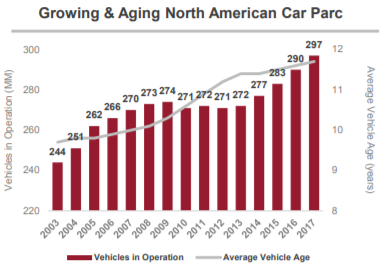
  1. Growing automotive car parc -- Industry speak for the total number of cars on the road, now just under 300 million, the average age of vehicles continues to rise, older cars getting into an accident are more likely to be a total loss.
  2. Increasing vehicle complexity leading to higher total loss frequency -- there are more electronic components and repair labor costs are rising making car repair more expensive, if the repair costs are more than the car is worth, it of course results in a total loss.
  3. Increasing accident frequency --  here they cite more cars on the road and more distracted driving (texting and driving, etc.).
The stated reason to spinoff IAA is to create a standalone company that compares directly with their competitor Copart (CPRT).  Copart maintains a similar ~40% salvage market share but has superior margins partially due to owning the real estate beneath their auction sites (IAA leases their sites), the rest of the margin difference is hard to parse out and might be an opportunity for improvement post-spin.  IAA has been managed separately from KAR (different auctions sites, different customer bases, separate headquarters) and the soon to be CEO, John Kett, has been running IAA since 2014, eliminating some of the risk of IAA stumbling out of the gate that we often see with spinoffs.

Valuation
New KAR Auction Services doesn't have a direct North American public competitor since Manheim is privately owned by Cox Enterprises, but it does have a peer in the leading wholesale auction provider in the UK, BCA Marketplace PLC (BCA.LN).  The combined KAR has $2.74B worth of debt and $345MM of cash, KAR is going to raise $1.3B of debt (not finalized) at IAA, sending $1.25B back to new KAR after gifting IAA with $50MM in cash, leaving new KAR with $1.145B in net debt.

Copart (CPRT) trades for 15.5x EBITDA, but its better run and has minimal debt so it should trade at a significant premium to IAA.  For the sum-of-the-parts, I'm going to use 10.5x for new KAR (1x discount to BCA) and 12x for IAA (2.5x turn discount to CPRT):
Adding to the two pieces together, I get a price of $60, not a ton higher than today's $52 share price.  Despite that I added a smallish position going into the spinoff, IAA in particular interests me as an interesting long-term spinoff:
  1. IAA doesn't have to make a significant change to its business model to succeed, instead there is both a discounted valuation and a margin gap, if both of these close it could be a home run; 
  2. Deleveraging, as mentioned, since IAA doesn't have to do anything transformational or reinvent the business, and its growing at a healthy clip, they'll have plenty of FCF to deleverage and/or return cash to shareholders via buybacks or dividends; 
  3. Management has been running this company as a separate unit, we should see some animal spirits unlocked now that their comp will be directly tied to the success or failure of IAA and the operating performance gap between IAA and CPRT will be on full display.
I'm not worried about autonomous cars eliminating all accidents and thus total losses, or Americans giving up their cars entirely for ride sharing services, both of these risks seem far off into the future and may only capture a small niche in the end.  I do worry that this thesis is too easy, KAR provides extensive and transparent segment reporting, investors should be able to see through the sum of the parts here?  And I prefer when spinoffs have different shareholder bases, that's not the case here, but the business model interests me and given that the combined company trades below where both pure play peers trade, I think there's some margin of safety going into the spin, its worth keeping on your watch-list.

Disclosure: I own shares of KAR

Wednesday, January 16, 2019

Spirit MTA REIT: ShopKo Files Chapter 11, Plan Accelerated

SMTA's primary tenant, ShopKo Stores, filed for bankruptcy protection today and thus the reason for SMTA's existence is coming to an end.  As a reminder, Spirit Capital Realty (SRC) spunoff their Shopko assets alongside their asset-backed securitization vehicle ("Master Trust A" or "Master Trust 2014") as SMTA in order to clean up the portfolio at SRC and make it comparable to peers in the triple-net lease space.  SMTA's stated mission was to workout the ShopKo assets and other non-core properties and use the proceeds to fund more Master Trust notes.

Back in November, SMTA entered into a $165MM non-resource mortgage collateralized by the Shopko assets to put a floor under the valuation.  That looks incredibly smart in hindsight as they mentioned in their press release today that they are "working with the lender under the non-recourse mortgage loan, including potentially to satisfy the loan by relinquishing to the lender the ShopKo Stores securing the loan."  They're going to mail back the keys, and for the most part sit out the bankruptcy process (other than their $35MM term loan B to ShopKo, likely worthless but was instrumental in getting timely financial statements and might have triggered the mortgage financing transaction), they'll be rid of their ShopKo exposure in short order.  As a result the company announced a process to explore strategic alternatives, so what's left?  In my year-end post, I laid out an NAV of around $13 a share, that appears to be close with what the company disclosed in their presentation accompanying today's announcement:
At the time of the Master Trust refinancing (end of 2017), the collateral value of the Master Trust assets was $2.596B, using the contractual rent number above, that's about a 6.8% cap rate, seems reasonable in today's environment, add in the restricted cash inside the securitization and the mortgage loans but leaving out the vacant properties nets us $690MM in equity value within the Master Trust.  Let's exclude the Academy distribution center, workout/vacant assets, and the ShopKo term loan, but obviously include the cash, gets us to $792MM of asset value, subtracting out the termination payment to SRC and preferred to SRC gets an NAV of $13.70 per share.  This number is highly sensitive to the cap rate used to value the Master Trust, at a 7.5% cap rate the NAV under the same methodology would drop below $9 per share.

Who will buy SMTA?  I think there's a wide range of buyers for the Master Trust (typical equity buyers in structured products: insurance companies, hedge funds, etc.), but there is a new public REIT that's run by former SRC executives and pursues a similar ABS funding strategy, Essential Properties Realty Trust (EPRT) that would make sense as a buyer.

I increased my position a bit first thing this morning, but still keeping it fairly small due to the leverage, plus SRC will be a beneficiary of any strategic transaction as it will further simplify SRC making clearly apparent its undervaluation compared to peers like O and NNN.

Disclosure: I own shares of SMTA, SRC