Showing posts with label Calamos. Show all posts

Friday, August 9, 2013

Summary of 2nd Quarter Results

Below is a brief round up of a few names I've mentioned on the blog before and their recent results.

American International Group
AIG had another nice quarter, exceeding expectations and announcing the initiation of a $0.10 dividend and another $1B in share repurchases.  These moves were surprising given the drama surrounding the ILFC sale to a consortium of Chinese buyers, which has seen several deadlines come and go.  They're still working with the consortium to see if a sale can be completed, the deadline has been pushed back to the end of August, but AIG is also preparing for an IPO of ILFC later in the year that would de-consolidate ILFC (meaning they'd sell at least 51%) from AIG's financial statements.

AIG's book value is now $61.25, and its recently trading for just under $49, so the discount to book value has been closing fairly quickly.  While I still view AIG as a long term hold, I would consider selling for around 95% of book value which is still a little while off.  In the meantime hopefully book keeps growing with retained earnings and gets accelerated with AIG repurchasing shares at below book.

Calamos Asset Management
Calamos Asset Management's (CAM, but CLMS is the ticker) market value hasn't moved much since I initially profiled the company a few months ago, but the assets under management have taken a 10% slide to $27.4 billion as of 7/31.  As a result, pre-tax earnings are down over 30% from last year's run rate, proving the operating leverage in the asset management business works both ways.  Their flagship Calamos Growth and Calamos Growth & Income funds are suffering large outflows due to poor recent performance; the Calamos Growth Fund is in the bottom 92% of its peer group over the last five years, according to Morningstar, making it a dreaded one-star fund.  What financial advisor wants to answer the "why am I in a one-star fund" question from a client?

Calamos has been countering their growth fund strategy issues by introducing several new value and alternative strategy funds to diversify their revenue business model.  The alternatives segment is the one strategy where Calamos is seeing net inflows, and I think that it has the most potential as its not a strategy that's easily replaced by an index or passive fund.  Financial advisors are moving assets to index and passive mutual funds, traditional managed A share type funds are at best out of favor and might be in a permanent secular decline.  Alternative mutual funds are an easy sell after the past decade of volatility and given their complexity, one where the management fee is a more justifiable, maybe.

The value in Calamos is still primarily in the odd corporate structure that causes the operating company to be consolidated with CAM, but where CAM only owns 22.1% of the operating company.  This consolidation hides the assets that are attributable just to CAM, which are worth roughly half the market capitalization.  Based on the same assumptions as my original valuation, I put the CAM's current value at roughly $16.39 per share today.

The Calamos family has the right to exchange their ownership for CAM shares based on a fair value approach.  The above is the quarterly reconciliation that Calamos publishes based on the accounting quirk that's the primary reason its undervalued, but it could also be used as the reason for the Calamos family to dilute the CAM shareholders out of that value under the guise of a fair value exchange.  The shares issued line under the no recognition of other assets assumption is almost twice the shares in the full recognition assumption.  That's been hard for me to get comfortable with, so despite the CAM shares being materially undervalued, it's remained on my watch list.

Ultra Petroleum
My natural gas pick, Ultra Petroleum, had another good/boring quarter as they continue to keep capital expenditures within cash flow and just tread water until natural gas prices fully recover to a more normalized level.

One interesting takeaway from the conference call was when CEO Michael Watford said the following about how they value their assets:

"So a quick reminder of how we view our assets. At $4 gas, we restore all the value and volume to our proved reserves. That puts us at 5 trillion cubic feet of proved reserves and PV-10 value of $5.25 billion, which is approximately our enterprise value today. Looking forward a bit to $4.50 gas and ignoring the 5-year limit on PUDs, Ultra would have 9.2 trillion cubic feet equivalents of proven light reserves, with a PV-10 value of $8.1 billion. This translates into a $20 per share increase in stock price."
$4.50 gas might be farther away than it sounds as prices have moved back down to under $3.50 in the past few weeks.  On my favorite slide in their presentations, Ultra doesn't forecast $4.50 prices until 2016, but its a comment that I wanted to keep highlighted for future reference.  The other management comment I liked was the possibility of a share buyback or dividend in the future with their free cash flow, versus all the talk of an acquisition last quarter.  Given the high returns of their Pinedale asset, I don't see why they'd be looking to dilute those returns unless it was an acquisition for acquisition's sake.

I picked up some shares in the $16-17 range earlier in the year, and recently sold an equal amount of higher cost basis shares to reduce my position size to a just above average weighting.  I wanted to take some risk off the table and with Ultra's share price increasing with natural gas prices decreasing, seemed like a good opportunity.

Disclosure: I own shares of AIG, UPL, no position in CLMS

Thursday, May 2, 2013

Calamos Asset Management is Cheap

As the market continues to make new highs it's getting more and more difficult to find value in mainstream equity securities.  Most potential investments that interest me have a bit of hair on them, one that has recently appeared on my radar is Calamos Asset Management (NASDAQ:CLMS, but I'll refer to it as CAM).  I should probably wait another week for their 1st quarter results to come out, but I haven't posted in a little while and wanted to get something out here.

John Calamos started what would become Calamos Asset Management in 1977 by taking out a home equity line of credit and focusing on convertible bonds.  Today Calamos is a vanilla multi-strategy asset manager with $30.6 billion in assets (as of 12/31/12) based out of Naperville, Illinois, a western suburb of Chicago.  After graduating college in the early 2000s, I actually interviewed for a position at Calamos and subsequently didn't get hired, probably ended up being a smart move on their part, no hard feelings.

Calamos was a darling of the late 1990s and early 2000s posting some stellar returns.  Management took advantage and went public in 2004, they had a couple of good years and peaked with the market in 2007, since then they've struggled with mediocre to poor performance in their flagship Calamos Growth Fund and the Calamos Growth and Income Fund.  Both have seen significant drops in assets due to both losses in the portfolios and investor outflows.  In 2007, Calamos Growth Fund had over $15 billion in assets, today it has $5.2 billion and has badly trailed the S&P 500 over the past 2 years (+9.33% vs +16.00% in 2012, -9.07% vs +2.11% in 2011) and continues that trend in 2013.

On the bright side to the poor performance of their growth fund, Calamos has been forced to diversify their business model and focus on a variety of strategies potentially making their go-forward revenue streams less sensitive to the fortunes of one portfolio.  And despite all the recent struggles, Calamos' operating margins have remained pretty steady in the 35-40% range, showing their ability to right size expenses as assets have come down since 2007 (also might shoot holes in the potential argument that if assets increase, Calamos would have a lot of operating leverage).

Corporate Structure
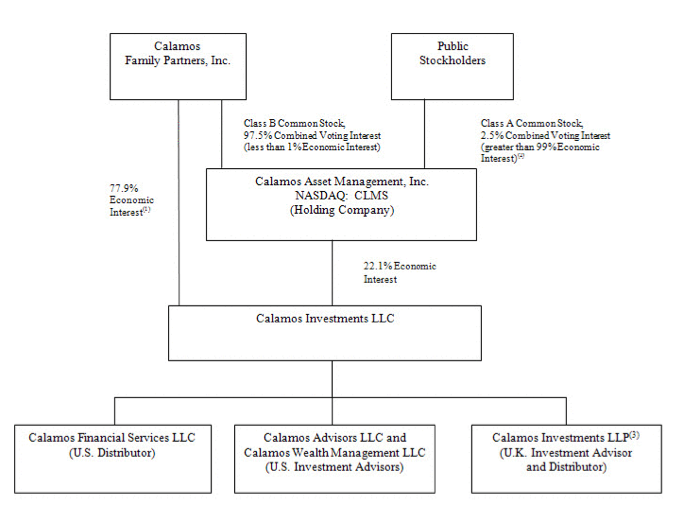
In addition to their poor performance, Calamos has a complicated corporate structure that obscures the true underlying value. The public stockholders have a 22.1% economic interest in Calamos Investments LLC, a partnership where the operations take place, and the remaining 77.9% is owned John Calamos and his family through Calamos Family Partners, Inc.  Additionally, Calamos Family Partners owns all the Class B Common Stock of Calamos Asset Management giving them 97.5% of the voting power, the family is fully in control of their namesake company.  Below is the graphic provided in the 10-K.
This structure makes it difficult for investors to fully capture what the entire Calamos Investments entity is worth as most financial software will list the market capitalization as just the 22.1% CAM interest, even though the family can convert their ownership position to Class A shares under certain circumstances.  The corporate structure also obscures the assets held at the CAM level because Calamos Investments is fully consolidated with CAM in the financial statements.  In addition to the 22.1% ownership in Calamos Investments, CAM has the below "Other Assets" as outlined in their filings:
Sorry if that's a bit hard to read, but to summarize, CAM shareholders have a sole interest in $67.6 million in cash and tax receivables, plus a net deferred tax asset of $55.3 million, discounting the DTA and the combine total is worth $105.4 million or $5.17 per share to CAM.  That's 46% of the current price of $11.20 per share, so it begs the question what's the 22.1% of Calamos Investments worth?

Valuation
First let's take a look at the balance sheet value of Calamos Investments' liquid assets, which is pretty straight forward:

Cash = $39.2 million ($106.8, netting out the $67.6 million attributable solely to CAM above)
Investments = $349.4 million
Partnership Investments = $60.8 million
Debt = $92.1 million
Net Position = $357.2 million
CAM's share = $357.2 million * 22.1% = $78.96 million = $3.87 per share

In 2012, the pre-tax operating earnings of Calamos Investments was $119.8 million (or roughly 1% of assets under management, in line with their historical results).  Most asset management firms trade for something close to 10x pre-tax earnings, but given the recent performance struggles and odd corporate structure, let's give them a discount of 8x pre-tax earnings.  At 8x $119.8 million, the fee income stream is worth $958 million to Calamos Investments, or $211.7 million to CAM, $10.39 per share.

Conclusion
Add up the three pieces, and CAM's fair value should be close to $19.43 per share compared to today's price of $11.20.  Another way to look at it, the market is only valuing the $26.47 million pre-tax annual CAM revenue stream at $44.03 million.  Or on an after tax basis, the market is giving the fee business a 2.5 P/E (($11.20-$3.87-$5.17)/($0.88 diluted EPS)).  Calamos also pays a $0.125 quarterly dividend (roughly ~4.5% annualized) to shareholders while you wait for the valuation gap to close.

The dissenting view on Calamos would ask why the valuation gap would ever close?  Calamos Family Partners is getting its pro-rata share of the taxable income from Calamos Investments and at this point the family doesn't appear to have a pressing need for CAM's valuation to catch up to intrinsic value.  However, I'm a believer that value can be its own catalyst and CAM is clearly undervalued.  Any signs of the "great rotation" into stocks by retail investors coming true could also improve investor sentiment around traditional asset management firms.

Disclosure:  No position in CLMS, but may add soon if I can free up some cash