Showing posts with label DigitalBridge. Show all posts

Friday, May 13, 2022

Radius Global Infrastructure: Tower Ground Leases, Rumored Sale

Now onto something that is a little more in my historical wheelhouse.

Radius Global Infrastructure (RADI) is a holding company that owns 94% of the operating company APWireless (but I'll just refer to the company as Radius/RADI going forward).  Radius is a wireless tower ground lease company (the legal structure can vary by country, but in each case works similar to a ground lease) that purchases rent streams mostly from mom and pops, individuals or smaller investors who own the underlying real estate.  Historically, before tower REITs really took off, the wireless carriers would build their own towers and lease the land/rooftop from individuals or building owners.  Today, tower companies mostly develop and own the land under their new structures, but there's a large fragmented global market of leases for Radius to rollup.

Radius checks a few other boxes for me:

  • RADI is not a REIT and doesn't pay a dividend, although the business model would lend itself well to both, thus limiting its investor pool today.  This would be a great YieldCo (see SAFE).
  • RADI doesn't really develop new towers, but they have a global originations team that scours the market to create new leases, as a result their SG&A looks high for their current asset base (it doesn't screen particularly well), but their SG&A could arguably be separated and thought of as growth capex (HHC or INDT are semi-similar, but RADI's distinction is probably cleaner).  Their origination platform would likely be valuable to someone with access to lots of capital, for example, an alternative manager like DigitalBridge (DBRG).
  • Bloomberg recently reported that Radius was exploring strategic options including a sale.  RADI has some financial leverage and given the stability of their lease streams could trade privately for a low cap rate juicing any returns to equity holders.
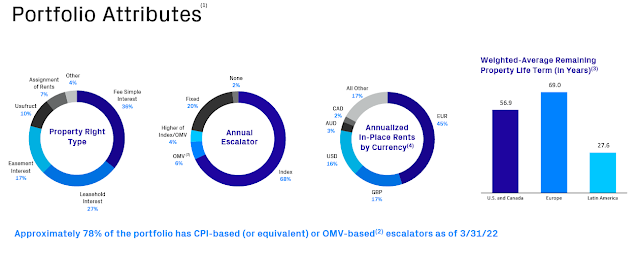
A bit more about the business, stealing slides from their latest supplemental:

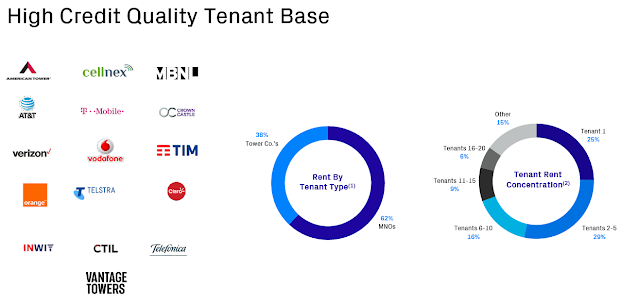
Radius has all the major tower companies and wireless companies as tenants, wireless infrastructure is an essential service that is only increasing in importance.  As a ground lessor, Radius is senior to the tower companies which are great businesses and have historically traded at high multiples.

In the current environment, everyone is concerned about inflation, Radius has inflation indexed escalators in 78% of their portfolio against a largely fixed rate debt capital structure, further increasing the attractiveness of their lease streams.

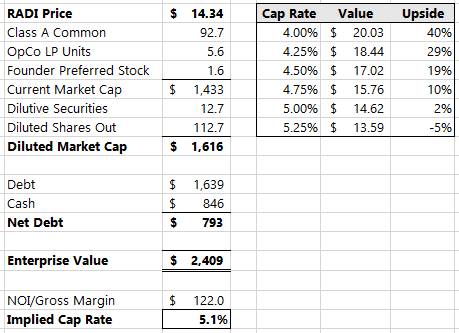
For a back of envelope valuation, I'm simply going to take the annualized in-place rents minus some minimal operating expenses to create an NOI for the as-is portfolio.  This portfolio should have minimal expenses other than a lockbox to cash the rent checks as there is no maintenance capex (these are structured as triple net leases).  Note the RADI share price below is my cost basis, things are moving around so much this week, don't know what the price will be when I hit publish.

The other challenging thing for RADI is all the dilutive securities.  There's also an incentive fee that is rebranded as the Series A Founder Preferred Stock dividend, I've left that out for now but may try to workout how much it would dilute any takeover offer, although I think there's enough room for error here either way.  As usual, I've probably made a few mistakes, please feel free to correct me in the comments.  But above is roughly the math if the acquirer buys Radius and fires everyone, sits back and collects the inflation-linked levered cash flows.

The piece I struggle valuing is the origination platform, but I have a feeling someone like DBRG (just as an example, any private equity manager really) would be very interested in it as they could deploy a ton of capital over time and generate pretty reliable returns.  RADI has guided to originating $400MM of new leases in 2022 at an average cap rate of 6.5% inclusive of origination SG&A and other acquisition costs.  Even using the current market implied cap rate of 5.1% above, the origination platform would create ~$110MM in additional value this year by putting the 5.1% public market valuation on the lease streams they originated for 6.5%.  RADI's management thinks they have a long runway for origination growth as they've just scratched the surface (low-mid single digit penetration) of this fragmented market.  Any value prescribed to the origination platform would be above and beyond my simple math in the Excel screenshot.

Interestingly, during the Q1 DBRG conference call, DBRG CEO Marc Ganzi said the below with regards to the digital infrastructure M&A environment (transcript from bamsec):

We do see public multiples retreating in some of these different data center businesses or fiber businesses or ground lease businesses. There's been a pretty sizable contraction and the window is beginning to open where we see opportunity. And I think by being once again by being ultimately a good steward of the balance sheet and being prudent in how we deployed that balance sheet last year, we've taken our shots where we have good ball control, and we've taken our shots that are candidly going to be accretive

And there's reason to take Ganzi's comments quite literally as DigitalBridge made a splashy deal this week in one of the three categories he called out by purchasing data center provider Switch (SWCH) for $11B.

I've bought some RADI common this week and also supplemented my position with some Aug $15 call options.  Similar to other ideas over the years, I like call options here, there's no reason to really think that RADI's business is deteriorating alongside the overall market, their leases are inflation linked and structurally very senior in an infrastructure like underlying asset.  There's financial leverage, low cap rates and an origination platform that could be valuable to someone, all of which could lead to a big takeout premium if they strike a deal.

Disclosure: I own shares of RADI (plus DBRG, HHC, INDT) and call options on RADI

Sunday, December 13, 2020

Colony Credit Real Estate: CLNY Moving Quickly, CLNC Sale Next?

Colony Credit Real Estate (CLNC) is a commercial mortgage REIT that is trading at 52% of undepreciated book value (their owned real estate is triple-net), Colony Capital (CLNY) owns 37% of the shares and is the external manager of CLNC.  CLNY is in the midst of a transition to a PE manager focused on digital infrastructures assets (they've hinted that they'll likely convert to a c-corp next year) and is quickly selling off their legacy traditional REIT assets, in recent months announcing the sale of their hospitality portfolio (a bit of a surprise versus handing over the keys) and more recently their remaining industrial assets.  CLNY CEO Marc Ganzi is everywhere, blitzing the virtual conference circuit, multiple TV appearances and selling assets left and right, the CLNY stock price has responded by roughly doubling in the last 5-6 months.  

CLNY has two large assets remaining (lots of smaller ones too), their healthcare real estate portfolio and CLNC, prior to covid they announced intentions to pursue an internalization transaction with CLNC where CLNY would presumably have gotten additional shares in CLNC as compensation for their management contract.  Post-covid, that internalization concept no longer makes sense as the bid-ask spread is too wide since CLNC trades at such a significant discount of book value, it makes it difficult for both sides to come to an agreement, CLNY would have to take a discount or CLNC shareholders would face dilution for an internalization transaction to work at current prices.

What do I think might happen?  Somewhat similar theme to MCC, most commercial REITs are externally managed and thus incentivized to grow/acquire --  I think we could see Ganzi push a sale of CLNC and CLNY's external management agreement to another commercial mREIT.  This would create a win-win for all sides, CLNY would get full immediate value for their external management contract, the buyer would acquire CLNC at a discount which benefits both its shareholders and adds AUM to the buyer's external manager, and CLNC shareholders would get a premium to current price and relieve the overhang of what might happen to CLNY's non-strategic 37% ownership position.  There is some transaction on the horizon, just a matter of the structure, here is Ganzi on the Q3 CLNY earnings call (courtesy of tikr.com):

Jade Rahmani (KBW)

Okay. Well, I applaud the swift actions the management team had taken. Definitely refreshing and very good to see the progress. I wanted to ask you about a particular -- as Tom Barrack might call it a Rubik's Cube, which is CLNC. There's an overhang in the mortgage REIT space because people are looking at commercial real estate as a long cycle to recover and potential impairments, loan losses on the credit front. So that's one thing that they have to address. Secondly, there's the liquidity that go into managing that. And finally, there is some access investment capacity. But when you look at stocks like CLNC and there's many others TRTX, LADR, to name a couple trading at 40% to 50% of book value. It means that investors are also potentially assuming an eventual dilutive capital raise.

So CLNY owns 37% of CLNC. And to me, that bodes for an opportunity, you can have CLNC buyback some of those shares at a premium to where it's trading, yet it still would be wildly accretive to its book value, wildly accretive to its earnings. It would reduce the overhang of CLNY's 37% stake because people do wonder when those shares will be liquidated, and yet it would provide CLNY with fresh capital to accelerate the digital transformation. How do you think about that as a potential option for both CLNY and CLNC to explore?

Marc Ganzi

Well, Jade, it's almost like you bugged our investment committee. So look, seriously, first and foremost, I want to applaud Mike Mazzei, Andy Witt, David Palamé. For those of you that had the chance to hear that earnings presentation, it's also another great story of transformation and execution.

When we brought Mike Mazzei on board to run that business unit, we couldn't have been more clear about what the objectives were: first and foremost, to make sure that we shored up our loans that had any issues with them, hit repo lines on 2 loans, gravitating to liquidity, and Mike's done an amazing job stabilizing that portfolio, returning cash to the balance sheet. And now that business is poised, as you heard yesterday, to play offense and be selective. And they'll play offense inside of their sandbox. And I don't get too involved in what Mike and his team does. I think they're doing a great job of executing and as one of their largest shareholders, we couldn't be happier with the progress that's happening at CLNC.

When you look at its peer group, CLNC got ahead of its issues quickly. Mike addressed those issues. He stabilized the story, he rotated the cash and now we have an enviable position where we can play offense, and we'll continue to recover book value.

You saw the shares perform well after market last night. They performed well today. We have a lot of confidence around that management team's capability. And in the meantime, we keep our options open, Jade. No option is off the table for CLNC. We've made that clear 2 quarters ago. We made it clear a quarter ago. I'll make it clear today. As we rotate to digital, if there's a good opportunity to harvest, the hard work that's been done at CLNC, we have an open ear, and we'll listen to whatever proposal comes across the table.

Seems pretty clear to me that a transaction will happen soon, given the pace of divestitures at CLNY, I would bet on Ganzi surfacing value here.  I doubt that CLNC would buy back CLNY's shares as suggested by the analyst question as it doesn't divest the external management contract, an outright sale of both CLNC and the management contract seems more likely, swift and bold, more in the Ganzi deal mold.

But let's take a look a CLNC a bit closer, I think its reasonably attractive as a standalone entity.  CLNC was created out of the threeway merger of old CLNY/NSAM/NRF, it was previously a non-traded product that was brought public in early 2018 and has since had a rough existence.  As expected with a non-traded REIT, their portfolio resembled an asset gatherer mentality without much of a cohesive strategy.  Here's what the portfolio looks like today, predictably they have a legacy segment ("LNS" = legacy non-strategic) where they house all the iffy stuff like their retail exposure.

The portfolio is a little bit of a grab bag, but back in March, Colony brought Michael Mazzei in to be the CEO of CLNC, Mazzei is an alumni of Ladder Capital (LDR, disclosure: long) where he served as the president until June 2017.  Ladder has a reputation has being a conservative credit shop, I personally like their style, so when Mazzei joined CLNC it was worth monitoring.

I've been surprised along with others, but commercial real estate loans have generally held up better than expected during the pandemic, whether the reason is modifications, interest reserve accounts, or the equity injecting additional cash into the deal -- their CLO for example hasn't experienced any credit events in the portfolio -- with a vaccine on the way, I tend to think all parties involved will continue to work together to salvage value and get to the other side.  Now is the time to get long some of these asset plays with a catalyst, the market exuberance hasn't quite made its way down to publicly traded private credit vehicles with actual real assets, but I think it eventually will.

CLNC has confidence in the future, I like when management at least acknowledges what the market is thinking, this is an external vehicle, so their options aren't ideal, but they've already hinted they'll reinstate their dividend in Q1 2021 and are making new loans today (tikr.com), you don't do that if you're on the ropes:

We also recognize that our current share price is a deep discount to our book value. This discount is also greater than that of our peer group. The current market valuation effectively implies that there are approximately $1.2 billion of future potential losses. We feel the best way to address this disconnect is by shifting the focus and momentum of the CLNC team beyond the challenges of COVID-19 and toward playing offense.

In our effort to close this gap, we are committed to continuing to protect the balance sheet while redeploying capital into new investments, building earnings and reinstituting a quarterly dividend.

In summary, while not fully out of the woods, we have accomplished many of our goals during this challenging time. We are now focused on executing our business plan to grow earnings. We have already begun to originate new loans while continuing to remain vigilant on asset, liability and cash management. The continued risks of COVID-19 can, by no means, be dismissed. However, through the efforts of the CLNC team and the support of our counterparties, CLNC is now in a position to lean forward.

CLNC does have a mix of financing, a CLO, repurchase agreements, they should have decent amount of flexibility to handle any problem loans.  Leaving out a lot here, but at 50-55% of book value, I think the setup is more important than the actual assets -- I trust Ganzi to make something positive happen here both for CLNY and CLNC.

Disclosure: I own shares of CLNC and CLNY

Sunday, August 16, 2020

Colony Capital: SOTP to Earnings, Digital Infrastructure Pivot

Back in April, I wrote up Colony Capital (CLNY) from the perspective of buying the preferred stock (read it for some background), today I'm going to take a shot at making the bull case for the common stock.  Colony has burned many real estate and value investors by going almost straight down since it merged with NorthStar Asset Management (NSAM) and NorthStar Realty Finance (NRF) in 2016. Back then it was going to be the next Brookfield Asset Management (BAM) by managing and co-investing in publicly traded REITs and private equity style real estate funds.  Last year, Colony announced a plan to focus on digital infrastructure, here's the quick new elevator pitch for Colony today:
  • Marc Ganzi took over as CEO (from Tom Barrack who is now Executive Chairman) of the company to effectuate the company's pivot from owning/managing traditional real estate to digital real estate (think towers, data centers, fiber, etc).  Ganzi has been a deal maker in the digital infrastructure space for a couple decades, in 2002 he co-founded Global Tower Partners, a private tower REIT, and ended up selling it in 2013 to industry leader American Tower (AMT) for $4.8B including debt.  Subsequently, Ganzi founded Digital Bridge Holdings ("DBH"), a PE fund with 6 digital real estate portfolio companies, which Colony invested/acquired DBH to bring him into the fold and lead the transition.  He has a good reputation as a deal maker with a legitimate track record, pair him with the tailwind of consumer demand for data being accelerated by work-from-home and other corona trends, the new strategy seems potentially promising.
  • Colony fits the "buy on the balance sheet, sell on the income statement" thesis that many investors (including me) look for, the value of the legacy assets today cover the market cap, as the company shifts to a manager/owner of more attractive digital infrastructure properties, the stock should earn a multiple on earnings versus languishing as a discounted sum of the parts story.
  • Colony doesn't have a natural investor base, many investors have been burned by the continual strategy shifts over the years. It is a REIT that doesn't pay a dividend, is overly complex and it is in the early days of their strategy shift -- so they're still a year or two away from being picked up by tower and data center investors.  The digital REITs dominate the top holdings of REIT index funds and trade at very lofty valuations.
On 8/7, Colony reported second quarter earnings and it was the first real chance for Ganzi to articulate his vision for the go-forward version of the company, and with it, released an investor day style presentation.  It's always a bit scary (be skeptical!) when you feel like a presentation was targeted directly at you, but Colony laid out the following few slides on why to invest in Colony:

During the quarter, the company took $2+B impairments to their legacy real estate holdings ("legacy" in this context means anything not digital, which is almost all of the balance sheet assets), basically kitchen sinked to reset the table for Ganzi, Colony spun it as covid accelerated the need for them to move quickly into their digital strategy given the demand on data/technology, but it also means potentially selling legacy assets in hard hit sectors to fund that pivot at an inopportune time.

At the top of slide is the digital pieces of the business, they primarily have two balance sheet investments in two separate data center business, the first is DataBank which they purchased for $186MM from Ganzi's DBH, possibly a less than arms length transaction but its also possible that they got a reasonable deal, who knows the business better than Ganzi?  The other thing to note is they've revalued their digital investment management company, Digital Colony, in this SOTP slide for the recent capital raise they did with institutional investor, Wafra, that bought 31.5% of Digital Colony for $250MM.  After that sale and a convertible bond offering which is now above the strike price, outside of the preferred stock, Colony has a net cash position at the corporate level.

The debt at the legacy assets is all non-recourse and generally asset specific, each asset/portfolio can almost be thought of as a call option in these times, the value of hotels or senior living facilities are clearly down, but depending on the pace of the economic recovery, these values post write-down might prove to be too low on certain assets.  In my preferred stock post, I wrote off the hotel assets completely and just assumed they'd hand back the keys, and that still might be the case as some industry rags have reported.  But Colony's hospitality portfolio is really divided into 7 separate entities (6 of which are reported under hospitality, 1 of which is under "Other Equity & Debt" as it was acquired through foreclosure), some of these are very likely going back to the lender, especially the 4 that have CMBS financing where their is little negotiating that can happen with the lender as the special servicer is generally bound contractually to foreclose.  The other 3 it's a bit murkier, but there's potential value there if things recover and Colony is able to hold on for another year or two before selling.  The healthcare facilities while down, seems salvageable to me, most of the properties in here are triple net lease and while covid has destroyed the senior housing sector (who in the right mind would place a love one in a senior housing facility right now unless that was the only option?), CLNY's rent collections have recently come in at 96%.

Another chunk of the legacy book is Colony Credit Real Estate (CLNC), a publicly traded credit REIT, they both manage the company and own 36% of it.  CLNC recently brought on former Ladder Capital (LADR, disclosure, still long) executive Michael Mazzei to take over the management of the company, I have a lot of respect for the Ladder Capital management team and see this hire as an important step in the turnaround of CLNC.  Historically, CLNC was originally thrown together from a pile of CLNY assets and a few NRF sponsored non-traded REITs, non-traded REITs are generally indiscriminate in what they buy in order to fund growth and increase the management fee to the external manager.  CLNC plans to eventually internalize although that plan is on ice for now as the stock trades for roughly half of book value (book value is a decent proxy for net asset value here).  CLNC has a large CRE CLO that they manage and use as balance sheet financing, to-date all the assets in that vehicle are current, its hard to tell if servicers are advancing funds or borrowers are using interest reserves to make payments, but given all the other assets and liquidity sources in CLNC, if a loan did go into default, they'd be able to buy the problem loan out of the CLO and maintain the coverage tests and all valuable cash flow to the junior tranches which CLNC owns.  Unlike other mortgage REITs, CLNC didn't have any securities portfolios liquidated due to margin calls, and given the current support credit markets are receiving, including possibly new supportive legislation, I can see a world where CLNC trades back up closer to current book value in the next 12 months.

Elephant in the room, most of the value in the legacy portfolio is in their "Other Equity & Debt" sleeve, they've slightly improved their disclosures here but its hard to know what's what and the overall value here:
Some of this portfolio seems like nonsense in a REIT, like the partnerships with Sam Zell in oil & gas, and the rest of it sounds risky and heavily levered to commercial real estate quickly recovering from the covid-crisis.  I'm taking a bit of a leap of faith here that management has indeed brought the carrying values down to market.

Moving to the future, Colony explicitly calls out the opportunity to eventually be valued off of an earnings multiple, again, be skeptical!:


*If* Colony can meet these management projections, the stock is a multi-bagger from the mid-$2s.  I don't know the digital infrastructure space well (possibly at all), but obviously part of the trick here is buying assets in the private space below what public market investors are paying for the same assets.  The math works better at lower valuations, but it still could possibly be attractive here as the Colony gets a little added leverage by the management fees.  For example, if they only invest in 20% of the company via their balance sheet (as with DataBank) they get the benefit of their management fees across 100% of the asset, thus bringing down the proforma multiple paid.  It's not clean and what public market investors will pay up for immediately, but makes some logical sense.

Another interesting, potentially irrelevant data point, the stock was around $5 when Ganzi came on, but you can get a sense of what the business plan looked like at the time when looking at his incentive package:
In addition, in connection with entering into the employment agreement, the Company granted Mr. Ganzi a sign-on performance-based equity grant (the “Sign-On Award”) in the amount of 10,000,000 long-term incentive units in CCOC (“LTIP Units”). The LTIP Units will vest if the closing price of shares of the Company’s Class A common stock, par value $0.01 (the “Class A common stock”) is at or above $10.00 during regular trading on the New York Stock Exchange over any 90 consecutive trading days during the five-year period beginning on the Effective Date. The Sign-On Award is generally conditioned on Mr. Ganzi’s continued employment until the performance-based condition is satisfied.
A cool $100MM (not Elon Musk incentives, but still a nice chunk of change!) if he can reach the projections outlined in the investor presentation at current market multiples, which initially seem pretty out there, speculative sure, but the transformation seems possible to me.  That upside is mostly a jockey play, Ganzi isn't super well known outside of the digital infrastructure space, but he can now sort of be viewed as the new founder of "Digital Colony" (likely only a matter of time before the company adopts that name), spent the last 7 years building out DBH/Digital Colony, sure he did cash out partially when Colony bought his firm but part of the consideration was OP units at $5+ share price equivalent, plus you'd assume he's got some reputational capital behind the proforma company.  At the end of the latest quarterly call (transcript from Tikr.com), in a bit of salesmanship and possibly a bit (or a lot) of hubris, Ganzi compared Colony's stock price today with industry leaders like American Tower and how it once traded at $2 as well, AMT now trades at $250+.  A bit crazy, but maybe not?
Well, listen, thank you. It's been an incredible first half of the year. Once again, I want to thank our Board. I want to thank our Chairman, Tom Barrack. I want to thank our team. This is an incredible team we have here at Colony Capital. I think we unveiled some of that to you today. But this doesn't happen without a great team focused on continuing to find the right home for our legacy assets and continuing to grow our business going forward. I think we've made the case today why this is a great moment in time to buy Colony. And I'd ask all of you who've been investing in the sector for 2 decades, who've watched my career, to remember those sort of seminal moments when American Tower and Crown and SBA were all trading sort of sub-$2. Those were really interesting points in time to buy digital infrastructure. Colony today trades slightly under $2. I'd encourage you guys to look at your history books, think about this management team, think about our business model and think about where we're going.
A good question to ask is how else does Marc Ganzi get paid? He gets a few different pieces of revenue like the 10% of the incentive fee allocation, are his equity grants too far out of the money to be meaningful? He's clearly a rich guy with a big monthly budget (big polo player, owns/founded a polo club); lives in Boca Raton and is managing the business from there, town has a bad reputation among investors for businesses headquartered there.  Colony's common stock is a bit speculative from here, but I flipped my preferred stock for the common after the earnings call.  It rhymes with a few other investments over the years that have worked out well, basically a complex grab bag of assets that's moving into an easy understand company in a sector public market investors adore.

Disclosure: I own shares of CLNY
Friday, April 10, 2020

Colony Capital: Preferred Stock, Non-Recourse Debt, Complex Mix of Assets

Colony Capital (CLNY) is a real estate private equity manager and real estate investment company that today fashions itself as a leader in the digital infrastructure sector.  However, it's mostly a complex mess of assets that have been left behind as the company has pivoted strategic directions several times, only to reclassify the old businesses as "legacy" hoping investors forget about them.  But the complexity and random assortment of assets might be beneficial to company today as its not reliant on one asset type (i.e., agency mortgages) or one funding source (i.e., repo agreements) that could subject the company to repeated margin calls and put them out of business completely.  The common stock might be worthwhile as a call option, but due to that complexity, I have a hard time valuing it in any credible way I'm willing to share, instead, the preferred stock seems cheap based on the unencumbered assets and is unlikely to be impaired through this crisis.

CLNY is the creation of Tom Barrack, he's a long time real estate investor and close friend of Donald Trump who is known for speaking at the 2016 Republican National Convention and more recently writing a blog post asking for a bailout of the commercial mortgage market.  Commercial mortgage REITs have recovered quite a bit in the last week or so, but prior to that they were hit with margin calls as the value of their CMBS assets fell and started a chain reaction of forced selling creating more forced selling as prices dropped.  CLNY is not a mortgage REIT, but is the external manager for one in Colony Credit Real Estate (CLNC) and CLNY owns 36% of CLNC's equity, but CLNY and its preferred stock declined alongside the commercial mREITs anyway.

CLNY's current strategy is to "focus on building the leading digital real estate provider and funding source for the occupancy, infrastructure, equity and credit needs of the world's mobile communications and data-driven companies."  They started down this path last July by purchasing Digital Bridge Holdings, a private equity firm that managed six separately capitalized digit real estate companies and a $4B fund it co-raised with CLNY, Digital Colony Partners Fund (which recently acquired ZAYO).  Along with Digital Bridge came a new management team that is slated to take over CLNY on 7/1 and move Tom Barrack to Executive Chairman.  This might be the right strategy, the tower and data storage REITs all trade at rich valuations, if CLNY can fully pivot maybe they'll get some of the benefit of that premium, but most of the value here is in the legacy assets.

Let's start with CLNY's capital structure as of 12/31/19:
CLNY's Q4 Supplemental
CLNY has a fair amount of liquidity following the sale of their light industrial warehouse assets to Blackstone in December and the sale of their equity interest in RXR Realty in February, leaving them with $520MM in cash as of the end of February, plus their undrawn credit facility.  All but $931MM of debt is non-recourse, and then a portion of the non-recourse debt is third party that CLNY consolidates on their balance sheet.

Their main assets are majority interests in two large portfolios (essentially REITs in their own right), one in an assortment of healthcare assets (but mostly senior housing and skilled nursing) and the other in select-service and extended stay hotels with brands associated with either Hilton or Marriott.  Both asset sleeves refinanced their debt in 2019 and pushed out maturities to 2024 and 2026, I haven't spent much time on the covenants, but the debt is non-recourse and under a worst case scenario, CLNY could mail back the keys to the lenders.  In hospitality, I do tend to think extended stay is performing better than other segments (still long some STAY) as its more of a residential replacement than true travel and then select service might recover sooner than destination resorts or convention heavy locations.  But again, non-recourse, a blow up in either or both would be a scary headline but wouldn't take down the entire enterprise, for the below, just going to assume both portfolios are zeroes.

The remaining assets are an interesting grab bag, cynically, it seems like CLNY was used as a way for Tom Barrack to invest with friends or in vanity projects whether it made sense for a public REIT or not:

1) Investment Management Business
When CLNY (originally CLNS) was formed in the three way merger with NSAM and NRF, I figured CLNY wanted to be the next Brookfield Asset Management (BAM), they would mostly be an asset management company and then would have "YieldCos" they would manage and partially own.  They've sort of done that, just not executed as well.  But with the acquisition of the digital business, they have a considerable management company arm that is essentially unencumbered and generates approximately $160MM a year in base fee revenue.
They have started down the path of internalizing the management at CLNC which they'll likely receive additional shares as consideration once the commercial mortgage market settles down a bit.  If you put a 35% margin on $160MM and give it a 10x multiple (just a swag), that's a $560MM business plus the non-wholly owned management companies listed above.  One of which is an interesting venture with Sam Zell (partnering with friends, not sure it fits in a public REIT vehicle), Alpine Energy, that is investing in distressed oil and gas like California Resources (CRC).  As mentioned earlier, they also monetized their investment in RXR Realty for $179MM, which implies a similar valuation I'm placing on the four wholly owned segments.

2) Colony Credit Real Estate (CLNC)
CLNC is mostly a commercial mortgage REIT but does own some net lease properties and other assets, it's suffered like the rest of the sector, but has generally limited CMBS exposure at under 7% of assets, recently closed a CRE CLO which termed out much of its debt, and has been current thus far on any margin calls.  Interestingly, I've only seen margin calls on RMBS or CMBS and not whole loans, whole loans are likely harder to price or more negotiable, might be worth focusing on mREITs with more whole loan exposure than to securitized products.
At Thursday's ~$5 close, CLNC has a market cap of approximately $665MM, trading at about 30% of the last reported book value (likely coming down).  But a 36% ownership at today's depressed prices is still worth $240MM to CLNY, plus the management fee contract but we're including that in the investment management business above.  They do account for their stake in CLNC via the equity method, so its grossly overstated at the moment compared to CLNC's market value, meaning an accounting impairment is likely on the way.  CLNY's long term plan with CLNC is to sell their position down over time once it is trading more inline with book value.  CLNC is interesting in its own right and might deserve a separate post, but for the purposes of CLNY let's say it survives and leave it here.

2) Other equity and debt portfolio
Here's the grab bag of other assets that includes some directly held real estate (sometimes the result of a foreclosure), their $186MM investment in DataBank which is one of the six companies that Digital Bridge manages, a stake in Albertson's which might be one of the few large companies to conduct an IPO this year (can't think of a better year for a grocery store to come public again), and all their co-investments in institutional funds they manage.


This sleeve is valued at $1.8B on the balance sheet and CLNY pre-corona intended to monetize $300-$500MM of assets this year.  That'll likely change, but even putting a significant haircut on the assets, let's say they're worth 30% less in this environment, making the net equity worth ~$900MM, that's probably overly punitive as a lot of this is at cost in their financials, but the exercise is to see how much value is left for the preferred assuming an extended crisis.

This modified SOTP is too severe, but just illustrating that I think the preferred stock is still money-good versus a trading price in the $16-17 range.
At Thursday's close, you also have about $1.2B in CLNY market cap beneath the preferred shares.  There are plenty of investment opportunities with more juice but here you don't have to worry about how much of the portfolio has been liquidated due to repo margin calls.  The preferred stock (there are 4 series, generally the same, some more liquid than others) has about 50% upside to $25 plus any dividends collected along the way as we wait for things to normalize.

Disclosure: I own shares of CLNY Preferred Series G