Sunday, November 3, 2024

ESSA Pharma: Another Broken Biotech

ESSA Pharma (EPIX) ($72MM market cap) is the latest addition to the broken biotech basket.  EPIX is a clinical stage pharmaceutical company that was previously focused on developing therapies for the treatment of prostate cancer.  On Thursday (10/31/24), the company announced they were terminating all of their clinical studies and an initiating a review of strategic alternatives.

In the press release the company gave us 9/30 cash numbers:

Liquidity and Outstanding Share Capital


·As of September 30, 2024, the Company had available cash reserves and short-term investments of $126.8 million and net working capital of $124.3 million (unaudited figures). The Company has no long-term debt facilities.
·As of September 30, 2024, the Company had 44,388,551 common shares issued and outstanding, and there were 2,920,000 common shares issuable upon the exercise of prefunded warrants at an exercise price of $0.0001.

This one is fairly clean, although we don't have a severance charge estimate (the company has 50 employees), EPIX hasn't been burning much cash, only approximately $7MM a quarter prior to the termination of their R&D program.  My back of the envelope math is pretty straight forward, I'm assuming about $20MM of the expenses to wind down the company from here or get it to a place where a reverse merger can be done, feel free to make your own assumptions.

My liquidation value is about 40% higher than where shares traded Friday following the news.

Disclosure: I own shares of EPIX

Wednesday, October 30, 2024

HomeStreet: Likely Deal Break w/ FSUN

Unfortunately, this year I'm getting crushed in a game of Battleship, every speculative merger or in this case announced merger gets blown up (TH & BOOM being the other recent ones).  An astute commenter on my original HomeStreet (HMST) post noticed that FirstSun Capital Bancorp (FSUN) left out any mention of their pending acquisition of HomeStreet in their Q3 earnings release that came out on Monday (10/28) as an ominous sign.  After the market closed on Tuesday (10/29), the two banks jointly announced the deal as-is will be rejected by FSUN's regulators:

DENVER & SEATTLE--(BUSINESS WIRE)-- FirstSun Capital Bancorp (FSUN) (“FirstSun”) and HomeStreet, Inc. (HMST) (“HomeStreet”) announced that, based on discussions FirstSun and its subsidiary, Sunflower Bank, N.A. (“Sunflower”) have had with the Federal Reserve and the Texas Department of Banking, that regulatory approvals necessary for the mergers with HomeStreet and its subsidiary, HomeStreet Bank to proceed have not been obtained and FirstSun and Sunflower have been asked to withdraw their merger applications. FirstSun and HomeStreet are discussing the pursuit of an alternative regulatory structure for the merger. The parties are also discussing terms on which they would terminate the merger agreement if no alternative structure is feasible. There can be no assurance that an alternative regulatory structure may ultimately be feasible.

Rewinding time six months, following Q1 earnings, the two re-traded their merger agreement due to HomeStreet not adequately hedging their loan book as interest rate expectations coming into the year were for many Fed Funds rate cuts, but those expectations were scaled back significantly.  In that revised deal, FSUN also disclosed they were changing the charter structure of the primary bank subsidiary, Sunflower Bank, to a Texas state chartered bank that would be regulated by the Texas Department of Bank versus the OCC. 

Presumably the motivation behind the change was to get easier treatment after the OCC was embarrassed following the failure of New York Community Bank (NYCB) this past spring due to their significant rent-controlled NY multifamily exposure that had fallen in value (HMST has a large Class B/C multifamily loan book in Los Angeles County).

In FSUN's own words:

Neal E. Arnold FirstSun Capital Bancorp – CEO, President, COO & Director

"Let me also briefly explain the regulatory shift for us. We will remain a Fed-regulated bank holding company as previous. However, we've also decided to proceed with an application to have the pro forma bank also be primarily regulated by the Federal Reserve and the state of Texas Department of Banking.

After discussion with our respective Boards, we decided this is a better long-term path for the combined organization. We believe the Fed and the state of Texas have a firm understanding of our business and the nature of our CRE risks.

In our discussions with the OCC in Washington, it became obvious that we would not gain near-term approval given their recent experience with multifamily and CRE positions. We believe their position also resided in the fact that they were not the primary regulator for HomeStreet. The Fed is taking a very different approach, in part due to the changes we have made through the transaction. Our belief is that CRE is not the same across all categories and all geographies. And it's particularly distinguished when comparing West Coast multifamily and East Coast, New York multifamily. We've had a significant interaction with the state of Texas and the Fed, and we believe there's a pathway for this merger application to be approved."

Following this news, HomeStreet stock is down by a 1/3rd today to $9.30 per share.  To be clear, HomeStreet is still a mess, the bank is zombie that is just treading water with minimal net interest margin that is fully eaten up by their non-interest expense.  However, the loan and securities book seems to be at least credit-good, they've had minimal losses and FSUN along with their advisors have had a few different looks at it and have agreed (from the 5/1 call) :
Robert A. Cafera FirstSun Capital Bancorp – Executive VP & CFO
"So Matt, thank you for the questions. And yes, we are reaffirming the credit mark here. We actually had an outside firm assist us independent third-party review the portfolio at HomeStreet, and actually a sizable percentage of the portfolio, 75-plus percent there. And we would echo, market had made some comments on the underwriting of the HomeStreet portfolio. We would echo those comments relative to everything that we found through the process, both upfront and post announcement in terms of the strength of the underwriting on the portfolio here.

So we remain encouraged by the performance here. And as a matter of process on the underwriting side at HomeStreet practices, there is sensitivity analysis. We actually utilized our independent third-party to revalidate the sensitivity analysis side of what the credits would look like in the current rising interest rate environment. And all that led us to the same conclusion on credit mark."
And in HomeStreet's most recent earnings release:
"In the third quarter our ratio of nonaccrual assets to total assets and our total loan delinquencies remained low at 0.47% and 0.69%, respectively. Our credit quality remains strong and we have not identified any potentially significant credit issues in our loan portfolio.”
And previously in the merger break press release:
“We are disappointed that the regulators are unwilling to grant the regulatory approvals necessary for the merger to proceed,” stated Mark Mason, Chairman, President and Chief Executive Officer of HomeStreet. “Importantly, HomeStreet has been advised by its regulators that there were no regulatory concerns specifically related to HomeStreet that would have prevented approval of the merger.”
So while the rate environment hasn't been kind to these loans, it doesn't appear on the face they're in any real trouble of permanent losses as long as HomeStreet is able to hold.  The multifamily loans have an approximate 2.5 year duration, some are reaching their pricing date, its not a super long duration portfolio that will leave them stuck for years.  In a slide deck, HMST provided the below update:


They've got a plan to sell some MF loans, hopefully prove out the marks, and the last bullet makes it fairly clear they'd be open to another M&A transaction.  I still think it makes an attractive acquisition target as they're in attractive retail/deposit markets and an acquirer could buy HMST at a significant discount to tangible book and enjoy that accretion over time as loans mature.

Other thoughts:
  • HMST puts out an "estimated tangible fair value per share" metric that attempts to fair value the loans and their debt (I might exclude the debt) to give a more mark-to-market look at book, it was $18.52 at 9/30, or about 2x the current share price.  GAAP tangible book value is $28.13 per share.
  • Mark Mason is still in charge, he's a controversial banking figure for good reason, so that adds some hair to situation, his capital allocation skills are bluntly terrible.  In reading the deal proxy, it also appears that an ongoing role for him was an important consideration.
  • Presumably, activist Blue Lion Capital (1.3% owner) is still around, they've been vocal about the deal, especially around change of control payments to Mark Mason.
  • FSUN did raise capital already to make the deal work, points to their commitment to make the deal work, I wouldn't fully count out another recut transaction that would be at a nice premium to today's share price.
  • In the original strategic alternatives process, HomeStreet did receive two other legitimate offers that made to the final round of bidding, one for $15.19 per share in cash and the other for $13.50 per share in cash.  Again, validating the idea that others have due diligenced this portfolio and that there should be buyers for HomeStreet if the deal with FSUN expires in mid-January without a newly structured deal.
While HomeStreet is certainly a far lower quality bank than First Horizon (FHN), the situation rhymes a bit in that regulators are blocking the deal for reasons largely outside of the target's control, as a result, the stock is forced sold by arbitragers possibly creating an opportunity to pick up shares on the cheap.  I bought a few more shares today.  But full warning, this is much riskier than FHN.

Disclosure: I own shares of HMST (also short some Nov $15 calls I wrote a few months back)

Monday, September 23, 2024

Aerovate Therapeutics: Broken Biotech, Shell Company? Potential Liquidation

I'm a little late posting this one, but as mentioned in the comment section of my Mid-Year update, I did add Aerovate Therapeutics (AVTE) ($55MM market cap) to my broken biotech basket.  Back in June, Aerovate, a one-shot-on-goal biotech, announced poor topline results from the Phase 2b portion of their AV-101 study for the treatment of pulmonary arterial hypertension (PAH).  A few weeks later, the company announced they were laying off 78% of their staff, costing them $5.6MM, $3MM of which will hit in Q3 and Q4.  Then another week later, AVTE officially announced they were exploring strategic alternatives:

Aerovate has engaged Wedbush PacGrow as the company’s exclusive strategic financial advisor to assist in the process of exploring strategic alternatives, which may include but are not limited to, an acquisition, merger, reverse merger, business combination, liquidation or other transaction.

Notably, they listed a liquidation as a possible outcome, generally we don't see a liquidation called out in the initial strategic alternatives announcement.  One reason might be they don't have any other product candidates, from their latest 10-Q:  

Overview

We are a biopharmaceutical company. Our initial focus was on advancing AV 101, our dry powder inhaled formulation of imatinib for the treatment of pulmonary arterial hypertension, or PAH, a devastating disease impacting approximately 70,000 people in the United States and Europe. On June 17, 2024, we announced topline results from the Phase 2b portion of our Phase 2b/Phase 3 Inhaled Imatinib Pulmonary Arterial Hypertension Clinical Trial of AV-101, or IMPAHCT. Topline data showed that, while AV-101 was generally well tolerated across all dose groups, the study did not meet its primary endpoint for improvement in pulmonary vascular resistance compared to placebo for any of the studied doses or show meaningful improvements in the secondary endpoint of change in six minute walk distance. We also reviewed data from several additional secondary endpoints of the Phase 2b portion of IMPAHCT, which also failed to show meaningful improvements. Based upon these results and in agreement with the independent study advisory committee, we halted enrollment and shut down the Phase 3 portion of IMPAHCT as well as the long-term extension study. AV-101 for the treatment of PAH was our only product candidate in development. At this time, we do not intend to resume development of AV-101 or any other product candidates. In July 2024, we announced the decision to conduct a comprehensive review of strategic alternatives focused on maximizing shareholder value. We also engaged Wedbush Securities Inc. (Wedbush PacGrow) as our exclusive strategic financial advisor to assist in the process of exploring strategic alternatives, which may include but are not limited to, an acquisition, merger, reverse merger, business combination, liquidation or other transaction.

I'm still trying to get my arms around how the new SEC shell company rule is going to play out after going effective July 1, 2024, but it appears that these one-shot-on-goal type biotechnology companies, like AVTE, without other assets might fall into the shell company bucket and could be pushed towards a liquidation as a result.  Others that are continuing development at the same time as pursuing strategic alternatives might make for better reverse merger candidates, which have generally worked out well this year.  But I'm not a lawyer, and thus not entirely sure if this new rule means much to this part of the market since biotechs generally don't make outlandish SPAC-like revenue projections regulators are trying to stamp out.  If others have more intelligent thoughts, as usual please share.

My back of envelope liquidation math:

AVTE is pretty clean, there are minimal dilutive securities outstanding, minimal operating lease remaining and likely the IP value is worthless.  I still struggle a bit with estimating wind down expenses, feel free to use your own estimate, but at today's price, AVTE seems to be relatively cheap compared to my estimate of liquidation value.

If they do go the reverse merger route, there's some nice option value, interestingly RA Capital owns ~32% of AVTE and engineered a successful reverse merger at ELYM with Tenet Medicines that's seen the stock go up almost 200% since that deal was announced in April.

Disclosure: I own shares of AVTE 

Wednesday, August 7, 2024

Howard Hughes: PSH Considering a Take-Private Offer

Just a brief news post, I'll use the comment section to update my thoughts as this situation develops.  Last night, 8/6, Pershing Square (37.5% owner) updated their 13D in Howard Hughes (HHH) ($3.2B market cap) disclosing the following change:
“The Reporting Persons are and intend to continue evaluating the possibility of various potential alternatives with respect to their investment in the Issuer, including a possible transaction in which the Reporting Persons and/or one or more of their affiliates (either alone or together with one or more potential co-investors) may acquire all or substantially all of the shares of Common Stock in the Issuer not owned by them and their affiliates and in connection therewith take the Issuer private (a “take-private”). Jefferies LLC began advising the Reporting Persons on August 6, 2024 in connection with this evaluation. The Reporting Persons may discuss their evaluation and the potential alternatives, including a potential take-private, with one or more prospective co-investors, which discussions are expected to be conducted on a confidential basis. In the event the Reporting Persons explore such a potential transaction, there can be no guarantee that an agreement regarding such potential transaction can be reached and/or consummated.

I find the timing rather odd so soon after the spinoff of Seaport Entertainment (SEG), the spinoff was designed to remove some of the complexity and cash burning assets from Howard Hughes, return it to a pure play master planned community developer story.  In theory, HHH then might re-rate closer to its NAV of $100+.  If the plan all along was really to dump Seaport Entertainment, come in to scoop up HHH on the cheap, why is Pershing Square backstopping the SEG rights offering?  Just strange to spend $30 million in cash expense to spin SEG, backstop SEG, and then take HHH private so soon after.  Should have just bought it before the spin and save the legal bills.

Possibly this is the result of Ackman pulling the IPO of his closed end fund after selling a stake in his GP raising expectations for growth, he could need an investment vehicle or non-securities assets to redomicile Pershing Square Holdings Ltd to the United States and avoid being under the 1940 Act.

As for the potential price or structure, I'm prepared to be disappointed, NAV is likely well over $100 per share, but is unlikely to be realized in a transaction.  As a reminder for those newer to the company, back in 2019, Howard Hughes did run a full strategic process that failed to produce a buyer willing to pay the asking price.  Have things changed much since?  Brookfield (who notoriously don't pay fair value) was involved in the GGP restructuring and was an HHC shareholder for a while, but otherwise, Pershing Square might be the only buyer so I'm not getting my hopes up for a large premium.  The language in the 13D suggests a cash offer to go-private, that's preferable in mind than some convoluted structure where Howard Hughes shareholders trade discounted HHH shares for discounted PSHZF in some share-for-share merger.

Disclosure: I own shares of HHH and SEG 

Wednesday, July 10, 2024

HilleVax: Failed Vaccine Trial, Pre-SA, Trading Below Cash

HilleVax (HLVX) (~$85MM market cap) is a clinical-stage biotech that focuses on developing vaccines, their initial focus has been on a vaccine (HIL-214) designed to treat severe acute gastroenteritis events in infants.  On Monday, the stock crashed below cash as HilleVax announced their HIL-214 trial did not meet its primary endpoint and showed no clinical benefit observed across secondary endpoints.  Unfortunately, little other disclosures were made; there was no announcement of seeking strategic alternatives, no workforce reduction and no estimate of current cash.  The only mention of a go forward strategy was the line:
The Company plans to discontinue further development of HIL-214 in infants and is exploring the potential for continued development of HIL-214 and HIL-216, HilleVax’s Phase 1 ready vaccine candidate, in adults.
The piece about continuing to explore the potential development of HIL-216 is slightly concerning as broken biotechnology companies go.  HIL-214 (the failed vaccine) was licensed from Takeda (which owns 14% of HLVX), HIL-216 was a separate licensing agreement with a Chinese pharmaceutical company, Kangh, and thus management might make the argument the HIL-214 failure shouldn't cloud the potential for HIL-214.  However, as we've seen with many others, often the board along with their advisors determine that the cost of capital is too high to continue on their own and they'll likely decide to pursue strategic alternatives.

Running through my typical back of the envelope liquidation math:
HilleVax does have an ATM in place they leaned on pretty heavily in Q1 to raise approximately $15MM, if they continued into Q2 (which you can tell they did a bit based on the change in share count from 3/31 to 5/6 when the last 10-Q was published) it would only add upside to the math.  The risk is really in the burn rate going forward from here (also note, my Q2 number above is an estimate based on Q1) since we don't have any indication from management on their plan, my $50MM in a total guess but using some experience from the last dozen or so of these, hopefully it is directionally correct.

There could be two catalysts here, one on the announcement of strategic alternatives and another on the ultimate conclusion, but HLVX is a bit riskier than others that are further along in their wind down process.

Disclosure: I own shares of HLVX

Sunday, June 30, 2024

Mid Year 2024 Portfolio Review

** Note, I'm a little late in posting my mid-year review as I was unplugged a bit for the last couple weeks.  Back dating the post to its usual spot.**  

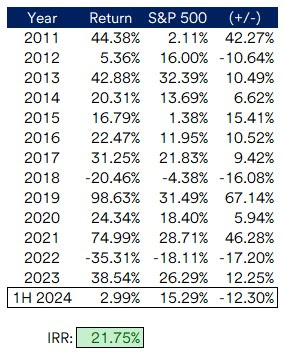
My blog portfolio is essentially flat year-to-date with a gain of 2.99%, well behind the S&P 500 with a gain of 15.29%.  The broken biotech basket performed well but was generally offset by declines in a lot of my legacy holdings and just malaise in my speculative M&A ideas (crossing my fingers that M&A picks up in the second half).  Long term performance remains solid at a 21.75% pre-tax IRR.

Closed Positions:
  • Quite a bit of churn happened in the broken biotech basket, I sold Eliem Therapeutics (ELYM), Homology Medicines (FIXX), Graphite Bio (GRPH), Kinnate Biopharma (KNTE), Reneo Pharmaceuticals (RPHM), Cyteir Therapeutics (CYT), AVROBIO (AVRO) and Theseus Pharmaceuticals (THRX) as each of these had some sort of buyout or reverse merger transaction.  If there was a CVR component, I held through the merger and sold shortly after.  Some of these rallied significantly post reverse merger, but in attempt to stick to the original thesis, I generally sold after the shareholder base turned over a bit.
  • I got spooked out of both Instil Bio (TIL) and Aclaris Therapeutics (ACRS) -- although I made a nice profit on ACRS -- as both management teams don't appear to be following the reverse merger and/or buyout with a CVR strategy.  Instil Bio has yet to sell their new manufacturing facility and I don't have confidence in the property valuation, plus TIL included the line of their intention of "Exploring opportunities to in-license/acquire and develop novel therapeutic candidates in diseases with significant unmet medical need."  Aclaris announced alongside their Q1 results "we have decided to progress ATI-2138 into a proof-of-concept Phase 2a trial in patients with moderate to severe atopic dermatitis", however this one might be worth looking at as BML Capital Management has accumulated a significant stake and could push ACRS to revisit their go-forward strategy.
  • Sio Gene Therapies (SIOX) made their liquidating distribution and is now pushed into the non-traded bucket.  Similarly, Merrimack Pharmaceuticals (MACK) made its liquidating distribution, the remaining penny or two is now in a non-traded liquidating trust.
  • Pieris Pharmaceuticals (PIRS) announced they are pursuing a similar strategy as MACK did, minimizing corporate expenses in an effort to extend their cash runway long enough to capture any milestone payments among their disparate portfolio of development partnerships.  I sold to capture a tax loss, but will continue to monitor this one for a re-entry, if any of their milestones do hit, the return could be a multiple of the current market cap.
  • MariaDB (MRDB) and Asensus Surgical (ASXC) were similar situations, cash burning companies with potentially valuable IP that was subject to a non-binding tender offer, if the tender fell through, both could be worthless.  Luckily for me, both deals went to a definitive agreement and I sold each as the spread tightened to a normal range.
  • First Horizon (FHN) was added shortly after their transaction with TD Bank broke in middle of the short lived bank crisis last year, this spring FHN passed over the long-term capital gains mark for me and I booked the profit.  I could see FHN being an acquisition target for one of the super regional banks trying to use an acquisition as a springboard into a higher regulatory tier category.
  • I should probably leave the traditional merger arbitrage trades to the experts, I exited Spirit Airlines (SAVE) after the judged ruled against the merger on anti-trust grounds, Albertsons (ACI) hasn't gone to court yet, but under the current administration, likely faces a similar result.  Unlike Spirit, Albertsons is cheap on a standalone basis and their PE sponsor Cerberus is likely to seek liquidity in other ways if their merger with Kroger (KR) fails.
  • NexPoint Diversified Real Estate Trust (NXDT) and Transcontinental Realty Investors (TCI) both fall into a similar bucket for me, real estate companies trading at very wide discounts to their NAV, but with management in no hurry to close those gaps (or simply unable to in the current interest rate regime / real estate market).  NXDT has seen some recent insider buying that improves the story, but it has been several years since the old closed end fund converted to a REIT and little has been done to simplify the portfolio or tell the story.
Previously Undisclosed Positions:
  • I've initiated a small position in DMC Global (BOOM) which owns three separate and distinct industrial businesses.  The company has announced a strategic review to sell two of the three businesses, leaving behind a multi-family residential building products business (Arcadia).  I didn't buy earlier in the story because it is unclear to me why Arcadia is chosen one to remain in the public shell, but the situation changed when Steel Partners (savvy, NOL maximizing conglomerate) lobbed in a $16.50/share offer (shares currently trade sub $14).  BOOM has acknowledged the offer and stated they'll consider it as part of their greater strategic alternatives process.
Current Portfolio:
I will be doing some reshuffling of my personal balance sheet, likely withdrawing cash from this account in the near future so keep that in mind when I post the year end results.

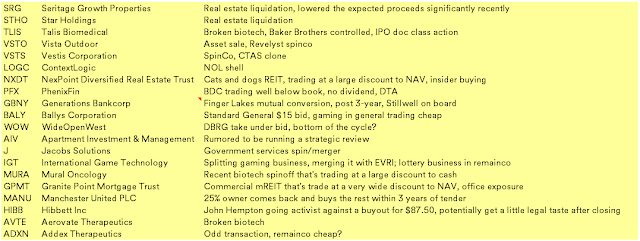
Since this is a pretty brief update, thought I'd include my current watchlist with a little blurb on each, as always, feel free to share any ideas or provide any pushback.

Disclosure: Table above is my taxable account/blog portfolio, I don't manage outside money and this is only a portion of my overall assets. As a result, the use of margin debt, options or concentration does not fully represent my risk tolerance.

Tuesday, June 11, 2024

Vanda Pharmaceuticals: 2 Bidders, Entrenched Management, Upcoming Business Catalysts

Vanda Pharmaceuticals (VNDA) (~$365MM market cap) is a biopharma company with a number of drugs either already being commercialized, on the cusp of commercialization or in late stage trials.  I have no idea if any of these are valuable franchises (as always, if you have any insights, please share them):

  • Hetlioz -- commercial treatment for the treatment of Non-24-Hour Sleep-Wake Disorder in the U.S., it is facing generic competition as of December 2022 and has a few legal battles in its attempt to get additional approved indications
  • Fanapt -- recently approved for biopolar disorder, launching commercialization in Q3 2024
  • Ponvory -- recently acquired from Johnson & Johnson (this came from Actelion Pharmaceuticals) for $100MM, treatment for multiple sclerosis, launching commercialization in Q3 2024
  • Tradipitant -- treatment for gastroparesis, PDUFA date set for 9/18/24
  • Misaperidone -- treatment for schizophrenia and bipolar disorder, new drug application expected to be submitted in early 2025
On top of that grab bag of drugs (to my untrained eye, they don't appear to have a coherent strategy), Vanda has approximately $5.40/share of net cash and marketable securities on the balance sheet after subtracting out all liabilities (shares currently trade under $6/share).  Where things get a bit interesting, Vanda has received two unsolicited bids from potential buyers, both of which have received the cold shoulder from the board, as a result the buyers went public trying to get shareholders to exert pressure:

5/7/2024: Vanda Pharmaceuticals Confirms Receipt of Revised Unsolicited Takeover Proposal from Future Pak -- offer was for $7.25-$7.75 in cash per share, plus a CVR.  Future Pak seems like an odd buyer as the company is a privately held pharma contract manufacturer and packaging business that has the financial backing of private credit provider Colbeck Capital Management.  The board rejected the proposal:

Vanda Pharmaceuticals Inc. (Vanda) (Nasdaq: VNDA) today announced that the Company’s Board of Directors (the “Board”) carefully reviewed the revised unsolicited proposal from Future Pak, LLC (“FP”) to acquire the Company for $7.25 to $7.75 per share in cash plus certain Contingent Value Rights (“CVRs”) and, after having consulted with the Company’s independent financial and legal advisors, unanimously concluded that the proposal substantially undervalues the Company, creates significant risk and uncertainty and is not in the best interests of the Company and its shareholders. Accordingly, the Board has rejected the proposal.
In reaching its conclusion, the Board evaluated all aspects of Vanda’s business, including its clinical development pipeline, expanding commercial presence and significant cash balance, as well as the speculative nature of the CVRs given the uncertainty surrounding the achievement of the commercial milestones under FP’s management. The Board believes the revised unsolicited proposal is yet another opportunistic attempt to purchase the Company’s shares at a discount to Vanda’s intrinsic value.
The Board and management team remain confident that Vanda’s robust revenue, strong cash position and efficient operations position the Company well for significant long-term growth and value creation far in excess of the consideration offered by FP.
6/6/2024: Vanda Pharmaceuticals Confirms Receipt of Unsolicited, Non-Binding Indication of Interest from Cycle Group Holdings -- offer is for $8 in cash per share with no CVR component.  Cycle seems a little more credible than Future Pak, they have a few commercial drugs in the market already, in their press release, they included the following explanation for making their bid public:

Cycle issued the following statement regarding its proposal:

“Our proposal for Vanda delivers immediate, compelling and certain cash value for Vanda shareholders with a highly attractive premium. Cycle’s proposal represents a better outcome for shareholders, who would receive all-cash upfront value exceeding that of Future Pak’s cash portion of its latest offer announced May 7, 2024. It would also benefit patients, as Cycle has a proven commercial strategy in the U.S., a strong distribution footprint and an established track record of delivering medicines and individualized support to patients suffering from conditions with high unmet medical need.

While we would have preferred to reach an agreement privately, Cycle is publicly disclosing our proposal for the benefit of Vanda shareholders and to encourage Vanda shareholders to express their views on this proposal to the independent directors of the Vanda Board of Directors.

Given our familiarity with Vanda, its brands and our extensive knowledge of the industry, we believe we can efficiently and quickly complete our diligence. Once we receive access to the required information, we believe that we can complete our due diligence within 2-3 weeks and reach a definitive agreement shortly thereafter.

We stand ready to work immediately with Vanda’s Board and management team to reach an agreement that would provide a compelling premium and certain cash value today for all Vanda shareholders.”

Vanda has acknowledged receipt of the offer, but as of this writing haven't rejected it yet.

Why isn't the board engaging?  Management seems very entrenched here, the co-founder (Mihael Polymeropoulos) is the CEO and Chairman of the Board.  He employs a number of family members at Vanda and does own 3+% of the stock.  Given the near term regulatory catalysts, it could be argued that these are opportunistic bids, but if they run a full a process, maybe they can get an even higher number or Polymeropoulos could partner with a firm that would back a bid for him to take it private.  I've sized this relatively small, it could be more attractive at a higher price if VNDA's board does the right thing and engages with the bidders.

Disclosure: I own shares of VNDA