Showing posts with label iStar. Show all posts

Thursday, March 23, 2023

Star Holdings: iStar Spin, Familiar Monetization Strategy

Star Holdings (STHO) (~$225MM implied market cap) is the upcoming spinoff of the merger of iStar (STAR) and Safehold (SAFE) targeted to be completed on 3/31/23.  Similar to other real estate spinoffs, STHO will be stuffed with legacy assets with a stated strategy to monetize the portfolio over time and return sale proceeds to shareholders.  

iStar was a commercial mREIT prior to the great recession, during '08-'09 many of their commercial mortgage loans went bad and the company ended up foreclosing on various property types across the country.  In the years since, they've run off much of that legacy portfolio (I previously owned it for the legacy assets) and then several years back launched a new ground lease strategy under the Safehold (SAFE) banner, a REIT that is externally managed by iStar.  As the SAFE strategy succeeded in the low rate environment (a ground lease is typically 99 years, about the longest duration asset you'll find) and iStar's legacy portfolio ran off, there was little need to maintain two separate public companies with related party arrangements.  iStar with its management contract and SAFE shares was basically an asset backed tracking stock of SAFE.  Last August, iStar and SAFE announced a merger transaction where SAFE would internalize management and iStar would spinoff its non-ground lease assets into STHO.  Similar to other real estate spins (SMTA, RVI, etc), the new combined SAFE will be the external manager of STHO.

As usual in spinoffs now, iStar will be receiving a dividend back from STHO, the use of funds is to pay down iStar's debt and leave primarily just SAFE shares to then swap for new SAFE.  In order to facilitate that dividend, STHO is receiving $400MM in SAFE shares that they will then take a $140MM margin loan out against and send that, plus a $115MM term loan collateralized by all of STHO's assets back to iStar.  The term loan will amortize down quickly as all cash above $50MM will sweep to pay down principal and the margin loan will be in place at least 9 months per a lockup agreement on STHO's SAFE shares.  The proforma STHO looks something like this (note, the STHO share count will be approximately 13.3 million, or 0.153 shares for every STAR share):
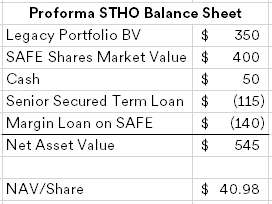
The legacy portfolio is a mix of assets, the two largest ones that account for roughly half of the book value are smaller master plan communities, one is Asbury Park Waterfront (a collection of developed and pre-development mixed use properties) on the Jersey Shore and Magnolia Green (a golf course centered 1900 acre single family home community) just outside of Richmond.  STHO will also have some legacy commercial real estate loans and a parcel of land in Coney Island NY, they anticipate it will take 3-4 years to monetize most of the legacy assets.

The trickier, and possibly scarier part of STHO is the SAFE shares, as mentioned, its basically a perpetual bond masquerading as an operating company.  But with the rate curve substantially inverted, the market is pricing in quite a few rate cuts that would be beneficial to SAFE shares.

On March 17th, iStar put out a press release estimating the consolidation ratio with SAFE (it will be finalized immediately prior to the merger using a VWAP calculation) at 0.15 shares of SAFE for each share of STAR.  Using that ratio we can back into the implied price of STHO:
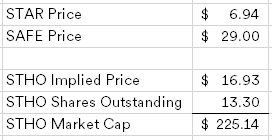
At today's close, unless I made a dumb error (always possible), STHO shares are trading at roughly 40% of book value.  Shares could potentially get even cheaper after the spinoff occurs, STAR is a REIT and included in REIT indices, STHO will be a c-corp and will likely get sold by any REIT index funds (although the largest ones like VNQ now include non-REIT real estate companies as well) and it won't pay a dividend.  Owning real estate right now is a bit scary, but STHO's chunkier legacy assets are tied more to residential markets and we continue to have a shortage of housing in this country.

The management agreement is also worth calling out here, they've designed it to be a fixed fee versus a bps fee on assets, with the fixed amount going down each year to reflect the intention to liquidate over a 4ish year period.  Many externally managed entities will trade at a wide discount because the assets inside the holdco will never make it back to the shareholders, here the discount should narrow overtime as the assets are monetized and proceeds are used to either paydown debt or distribute back to shareholders.
Management Fees and Expense Reimbursements
We do not maintain an office or employ personnel. Instead, we rely on the facilities and resources of our manager to conduct our day-to-day operations.
We will pay our manager an annual management fee fixed at $25.0 million, $15.0 million, $10.0 million and $5.0 million in each of the first four annual terms of the agreement, and 2.0% of the gross book value of our assets thereafter, excluding the Safe Shares, as of the end of each fiscal quarter as reported in our SEC filings. The management fee is payable in cash quarterly, in arrears. If we do not have sufficient net cash proceeds on hand from sales of our assets or other available sources to pay the management fee in full by the original due date of the management fee, we will pay the maximum amount available to us by the original due date and the remaining shortfall will be carried forward and be paid within 10 days after sufficient net proceeds have been generated by subsequent asset sales to cover such shortfall in full; provided that in no event may such shortfall in respect of any fiscal quarter remain unpaid by the 12 month anniversary of the original due date.
I went synthetically long STHO this week by shorting out 0.15 shares of SAFE for each share of STAR.  You could also go one step further and short out the SAFE shares that STHO will own. 

Disclosure: I own shares of STAR and short shares of SAFE (synthetically long STHO)

Tuesday, April 11, 2017

Safety, Income & Growth Inc: iStar's Ground Net Lease REIT

This is a pretty ridiculous name/logo right?  It's pretty clear the target market is yield hungry dividend investors who are looking "to sleep well at night".
Despite the awful name, I think iStar (STAR) has a chance to make this work (for iStar) as its a good sales pitch and would be a unique REIT in the market, plus they're selling 12 of their assets for $340MM or a ~5% cap rate.

This week, iStar filed the registration statement for a new REIT, Safety, Income & Growth Inc (SFTY), they've been kicking around quietly since last August.  According to the filing, it would be the first REIT targeted at ground net leases, a structure where the company would own the land, but not the building/improvements, and enter into very long term leases (30-99 years) with the building owner.  The safety part comes from the ground net lease structure, in the event of a default, despite only owning the land, the lessor can foreclose on both the land and the structure built on it.  The leasee and the mortgage lender (if there is one) on the property have every incentive to make the lease payment.  In effective, there's a significant overcollateralization built into the lease, the value of the lease is worth 30-45% of the combined value of the land/buildings, so often times in a foreclosure scenario a ground net lessor can make more than a full recovery.

At first I thought this was a public listing of the net lease JV iStar has setup with a sovereign wealth fund (GIC), however it appears to be a separate portfolio, but with investors in that fund participating in the SFTY IPO.  Safety, Income & Growth Inc will start out life with 12 assets from iStar's net lease portfolio, all 12 are either ground leases or at least look/function similarly if you squint.  The two primary assets will be One Ally Center which is the largest office building in Michigan, leased out to Ally Financial and PwC, and a portfolio of 5 Hilton branded hotels leased to the recent spinoff, Park Hotels & Resorts.
A good strategy in recent years has been buying net lease REITs that are discounted because of concentrated tenant exposure (GPT, FCPT, CSAL)  before they make deals to diversify their rent roll.  iStar says they're looking at a pipeline of over $500MM ground net lease deals, so expect them to diversify fairly quickly after listing.  They're starting with $227MM in debt at a rate of 3.773%, after the deal is done they'll enter into a new $300MM credit facility giving them additional room to add ground leases.

iStar will be the external manager of SFTY, it'll have one of the more unique external management agreements I've seen: 1) waiving their fee altogether for the first year, 2) no incentive fee or termination fee, 3) base management fee of 1% on equity up to $2.5B and 0.75% above, 4) the management fee will be paid in stock.  Granted, there's little work in managing a lease that expires in 2114 (doesn't even look like a valid year), but it's another reason this entity should be an easy to sell to the masses.

Safety, Income & Growth is paying about a 5% cap rate for iStar's assets (combination of cash and stock), the company argues that ground net leases should trade even lower than that:
This seems somewhat reasonable given the overcollateralization built into the structure, if it trades anywhere near a 4.5% cap rate, iStar should be able to source a lot of deals that make sense, especially early on when they can do small individual deals that still move the needle.

We're still waiting on an IPO date, but again, I think this has potential to do well and gather a decent amount of assets.

What does this all mean for iStar?
At year end, they had a $1.5B net lease portfolio (includes accumulated depreciation added back) that generated an NOI yield of 9.1%, in my initial post last summer I argued the net lease portfolio should be valued at 6.5% cap rate, which adds about $600MM mark-to-market above the carrying value on iStar's balance sheet.  It's probably incorrect to assign a 5% cap rate to the entire portfolio, but that would produce a $1.2B mark-to-market gain, quite significant for a company with a market cap of $1B.  But now iStar monetizes some assets at an attractive valuation by putting them in a simpler vehicle the market will be able to digest and assign a higher multiple to -- all while earning a (small) carry on their remaining investment going forward.  It's hard to argue iStar is anything but very cheap, hopefully they use some of the proceeds to buyback stock.

Thanks to the commenter in the original iStar post for bringing this deal to my attention.

Disclosure: I own shares of STAR

Thursday, August 25, 2016

iStar: Non-Dividend Paying REIT with Significant Development Assets

iStar (STAR), f/k/a iStar Financial, is an internally managed former commercial mortgage REIT that ended up foreclosing on a variety of land, development projects, and operating assets (office, hotel, condo projects) across the country following the financial crisis.  Over the last several years iStar has poured money into these foreclosed assets to reposition them for an eventual exit, much of that investment should start showing up in asset sales over the next 1-3 years.  Cash from the sales could then be recycled into their core commercial mortgage and net lease business making the company easier to understand and value.

iStar is an odd REIT that doesn't pay a dividend, REITs are generally under-invested in by institutional investors (although that may change now that REITs have recently been carved out of financials into their own S&P sector) but are generally favored by retail investors because of their high dividends.  iStar misses both investor bases.  iStar is a unique pass-through entity that has NOLs from the financial crisis (similar to ACAS in the BDC industry) and are using their tax asset to shield taxable income (bypassing the 90% distribution rule) in order to reinvest in their business and repurchase shares.  They're not getting credit for this strategy as it doesn't immediately result in higher dividends or in a clearly articulated higher NAV value.  Instead, iStar uses a gross book value metric in their press releases which adds back depreciation on their real estate but does not give any credit to the increase in real estate values since they acquired the development assets via foreclosure or the additional value created above cost as they've deployed capital into those properties.

iStar breaks out their business into four main buckets: 1) Real Estate Finance, 2) Net Lease, 3) Operating Properties, and 4) Land and Development.  Real Estate Finance and Net Lease are complementary businesses as a triple net lease property is essentially a financing transaction.  The Operating Properties and Land and Development segments are the assets iStar acquired through foreclosure, over time these segments should shrink from 36% of assets to become a smaller part of the pie.
2015 10-K
Their asset base is pretty well diversified across geography and real estate subsectors, although the public market likes clean pure-play REITs, diversification still reduces risk, especially in the land and development asset class.  If one area of the country is seeing a slowdown, they can pull back their development plans and focus on other opportunities (seeing this with HHC shifting capital away from their Houston assets).
Q2 16 10-Q
There's a lot of noise in their Operating Properties and Land and Development businesses as earnings are lumpy based on when assets are sold.  iStar breaks out their commercial Operating Properties between stabilized, those that are leased up at prevailing market rents, and transitional, those that have low occupancy and need to be re-positioned.  I think it makes the most sense to value iStar's core Real Estate Finance, Net Lease business lines and the stabilized Operating Properties as if it were a typical straightforward REIT that pays a dividend.  The below is a bit of a crude back of the envelope valuation, but it shows that the market is giving little credit to the value in iStar's transitional operating properties and in their land and development holdings.

On an FFO basis:
iStar has quite a bit of leverage, so a pure FFO multiple probably isn't appropriate but still shows the value embedded in iStar's complicated structure as the shares currently trade for $11.00, less than 14x FFO of just the core Real Estate Finance and Net Lease portfolios.

On an NAV basis:
The above analysis assumes a 6.5% cap rate for the net lease and stabilized operating property assets and values the rest of iStar's assets at book value despite many of the land and development assets being valued at 2010-2012 cost basis on the balance sheet.  One way to look at iStar's valuation, the market is hair-cutting the foreclosed assets by 70% despite significant progress made in recent years to entitle and further develop these assets.  It's likely that these assets could be worth 1.5-2.0x what they're carried at as value is realized over the next 1-3 years.

Land and Development Assets
iStar's Land and Development assets are quite extensive but there's not a lot of disclosure around the specifics of each asset in the 10-K, maybe something for the new CFO to implement?  In total they control land that will eventually contain over 30,000 residential units, not an insignificant number.  Management expects the back half of 2016 and into 2017 to be big realization years, with $500MM in exits targeted from the Land and Development and Operating Properties segments.  Below are a few projects that are currently in production or under development:
  • 1000 South Clark: 29 story, 469 unit luxury apartment complex located in Chicago's South Loop.  iStar partnered with a local builder in a JV, its both an equity investor and a lender in the deal, it will likely be sold after stabilization early next year.
  • Asbury Park Waterfront: iStar recently opened an "adult playground" hotel, The Asbury, in Asbury Park, NJ (Jersey Shore), the hotel/entertainment venue is meant to spur additional development in the surrounding 35 acres of land iStar owns that will eventually support over 2,700 residential units.  iStar is currently finishing up a small condo project, called Monroe, which is 40% sold and has plans to revive an uncompleted high rise construction project called Esperanza that was abandoned after the financial crisis.
  • Ford Amphitheater at Coney Island: iStar just recently completed construction on a 5,000 seat amphitheater along the boardwalk in Coney Island, the amphitheater was built to spur additional development around it, which iStar has 5.5 acres and plans for 565 residential units.
  • Grand Vista: 5,500 acres of mostly raw land on the outskirts of Phoenix that has plans for 15,000 residential units, this was a large failed project before the financial crisis and it may take a while before Phoenix builds out to this site.
  • Highpark: Formerly known as Ponte Vista, Highpark is a 62 acre former naval shipyard in San Pedro, California which will house 700 new residences.
  • Magnolia Green: A classic master planned communities outside of Richmond, VA with a golf course and room for 3,500 residential units.  It has an estimated sellout date of 2026 and another 2.400 units remaining to be sold.  Richmond is becoming a hot market, the city itself is pretty vibrant and it's in a good geographic weather location, it should attract both millenials and retiring baby boomers.
  • Marina Palms:  Two luxury towers along with a marina in North Miami Beach, the second tower is currently under construction and slated to be finished in December 2016.  The company partnered with a local builder and contributed the land for a 47.5% interest in the JV.
  • Spring Mountain Ranch Place: 785-acre master planned community located in the Inland Empire.  For the first phase of the development, iStar partnered with KB Homes and retained a 75.6% interest in the JV, the first phase calls for 435 homes, 200 of which had been sold as of 12/31/15.  Additional phases of the MPC will bring a total of 1,400 home sites.
NOLs
iStar has $856MM of net operating loss carry-forwards at the REIT level that can be used to offset taxable income and don't expire until 2034.  The NOL allows iStar to utilize retained earnings to grow rather than tap the capital markets constantly like traditional REITs.  This is a plus for iStar as they trade for a significant discount to my estimate of NAV, if forced to pay out market rate dividends they might not be able to access enough capital to fully realize the value of their development assets.  Additionally, they have more available free cash flow to buyback shares which should ultimately be a better use of cash at these prices than paying out a dividend.

Share Repurchases
The company is a large net seller of real estate, they will be selling down their portfolio as time goes on using the proceeds to pay down debt and repurchase more shares.  In the past twelve months iStar has repurchased 19% of their shares outstanding, after the second quarter they approved another $50MM increase to their repurchase program.  The combination of selling their non-core assets above book value and buying back shares below NAV is powerful and could lead to some substantial returns.

Risks
  • Jay Sugarman is the CEO of iStar, he's been in that position since the late 1990s and thus led iStar into the financial crisis, he has a lot of the trappings of a NYC real estate guy (owns a sports team, Philadephia Union of the MLS, and a massive home in the Hamptons).  But like Michael Falcone at MMAC, sometimes you need the guy who led you into the abyss to lead you out because they know each asset intimately and where the bodies are buried.
  • Does iStar go back to the "boring" business of real estate finance and net lease after diving into the glamorous development world?  Their website and headshots don't look like your typical REIT or credit shop, I worry the management team has fallen in love with real estate development and the portfolio won't ever resemble a clean REIT until iStar exhausts its NOLs.
  • Timing of asset sales, a few of iStar's land and development assets have long tails (10+ years), if they intend to do the development themselves versus selling to a local builder it could push out the value realization time frame.
  • Leverage, convertible bonds/preferreds, development assets all make iStar more vulnerable to a recession and a downturn in real estate prices.  They have some near term debt maturities and are generally dependent on the capital markets on an ongoing basis for both debt refinancing and asset sales.
iStar reminds me of a combination of HHC (hard to value development assets, atypical for a public vehicle), MMAC (real estate acquired through foreclosure that's difficult to piece out, cannibal of its own shares), and ACAS (pass through entity that doesn't pay a dividend due to its NOL assets).  Over time I think can generate similar gains as those previous ideas.  Thanks to the reader who pointed it out in a previous comment section.

Disclosure: I own shares of STAR