Showing posts with label SPAC. Show all posts

Monday, January 6, 2025

23andMe Holding: Busted SPAC, CEO Wants Go-Private Transaction

I put out the call for reader ideas and as usual, received many good ones.  A couple intrigued me enough to start small positions, one of those is 23andMe Holding (ME) ($100MM market cap).  23andMe is a well known direct-to-consumer DNA kit company that went public in 2021 via a Richard Branson SPAC at a $3.5B valuation.  It came public with lofty expectations and a lot of hoopla, but it failed to create a sustainable business model beyond the one time novelty nature of getting your DNA sequenced.  The stock price has fallen 95+%.

23andMe was co-founded by Anne Wojcicki, she has an interesting backstory as a high profile Silicon Valley founder who enjoyed the spotlight when the company was a venture darling.  I imagine the fall has been challenging, her identity is tied to the company.  Back in April 2024, Wojcicki disclosed in an amendment to her 13D that she was exploring taking the company private:

On April 13, 2024, Ms. Wojcicki notified members of the special committee (the “Special Committee”) of the Board that she is considering making a proposal to acquire the Issuer in a potential go-private transaction. Ms. Wojcicki indicated that she was working with advisors and intended to begin speaking to potential partners and financing sources. Ms. Wojcicki stated that any proposal by her would be conditioned irrevocably upon the approval of the Special Committee and a majority of the unaffiliated stockholders of the Issuer. Ms. Wojcicki also indicated that she wishes to maintain control of the Issuer and, therefore, will not be willing to support any alternative transaction. There can be no assurance that the foregoing will result in any transaction or any other strategic alternative and or whether or when any of the foregoing may happen.

In July, she submitted her non-binding proposal for $8/share (split adjusted, the company did a 1-for-20 reverse split in October, trades for $3.75/share today).  The WSJ reported "directors wrote in a letter few days later they were disappointed because it offered no share-price premium and lacked committed financing.  The directors threatened to engage a consultant to find a sustainable business model if she didn't revise her offer quickly."  Then in September, the drama (its not often a $100MM market cap company gets repeated coverage in the WSJ) ratcheted it up further when the entire board (other than Wojcicki) resigned in unison:

Dear Anne,
We, the independent directors of the 23andMe Board, hereby tender our resignations, effective immediately.
After months of work, we have yet to receive from you a fully financed, fully diligenced, actionable proposal that is in the best interests of the non-affiliated shareholders. We believe the Special Committee and the Board have provided ample time for you to submit such a proposal. That we have not seen any notable progress over the last 5 months leads us to believe no such proposal is forthcoming. The Special Committee is therefore unwilling to consider further extensions, and the Board agrees with the Special Committee’s determination.
While we continue to wholeheartedly support the Company’s mission and believe deeply in the value of the personalized health and wellness offering that you have articulated, it is also clear that we differ on the strategic direction for the Company going forward. Because of that difference and because of your concentrated voting power, we believe that it is in the best interests of the Company’s shareholders that we resign from the Board rather than have a protracted and distracting difference of view with you as to the direction of the Company.
We are proud of what 23andMe has achieved in pioneering direct access to genetic information, and we have been honored to have had the opportunity to be part of those efforts.

 A few weeks later, Wojcicki amended her 13D again to include the below language:

In response to a request from the then-current Special Committee of the Board, I stated that I would consider third party takeover proposals for 23andMe. Whether I would ultimately accept such a proposal remained within my discretion. In the interim period, based on subsequent developments, it has become even clearer to me that the best path forward for the Issuer is for me to take the company private. Accordingly, in order to update my prior statement and avoid any confusion in the market, I am no longer open to considering third party takeover proposals for the Issuer. I remain committed to completing an acquisition of 23andMe. Towards that end, the Issuer is working diligently to repopulate the Board of Directors so that any proposals to acquire the Issuer can be properly considered.

Wojcicki likes to tout that she's unconventional, but this is very direct language and surprising to see in an SEC filing.  To help facilitate this potential go-private offer, three new independent board members were appointed at the end of October, none of which appear to own any shares.

In November, 23andMe shut down their drug discovery and development business (one business model they've tried out is that of a regular-way biotech, they had two clinical trials running) and laid off 40% of their workforce in order to meet their goal of getting to cash flow positive in their traditional consumer DNA kit business.  Progress is being made, but potentially not fast enough, in their 9/30 10-Q, the company had a going concern disclosure, they need to raise capital in order to fund operations for the next 12 months.  This is a time sensitive trade, although 23andMe doesn't have any conventional debt (they do have a fairly big fancy operating lease), they're running out of cash quickly.

The bet here is that Wojcicki is able to take the company private with the re-constituted board presumably picked as friendly.  Dealing with public shareholders and the bad press associated with a stock down so substantially is bad for the brand (both her and 23andMe).  I'm sympathetic to the view 23andMe might have some valuable data, brand (they own one of countless online pharmacies getting into compounded GLP-1s) and IP that might be valuable to someone, especially in the current artificial intelligence hype cycle.

Other thoughts/notes:

  • Anne Wojcicki rolled over all of her equity into the SPAC, contributed $25MM to the PIPE at $200 (split adjusted) per share and hasn't sold any of her shares since.  She appears to be a true believer in the company and its mission, although she's likely fabulously wealthy after previously being married to Google co-founder Sergey Brin for years.
  • She owns 22.8% of the stock and 49.9% of the vote due to the dual class share structure, Class A (the publicly traded class) has 1 vote and the Class B shares have 10 votes.  No other significant holders remain, Branson is long gone, etc. 

Disclosure: I own shares of ME

Monday, April 1, 2024

MariaDB plc: In Default, Highly Speculative, 3 Bidders

This is highly speculative, but I wanted to bring the discussion out of the comment sections of my BFIN post as I found the situation interesting enough to initiate a small position.

MariaDB plc (MRDB) ($32MM market cap) offers enterprise and premium functionality on top of the open sourced (free) MariaDB Community Server database management system ("DBMS").  To distinguish between the company and the open sourced DBMS, I'll refer to the for-profit company itself as MRDB and the DBMS as MariaDB.  The lead developer of MariaDB is Michael "Monty" Widenius who was one of the original developers of MySQL, which was sold to Sun Microsystems, Widenius developed MariaDB in response to concerns following Oracle's acquisition of Sun Microsystems in 2009.  Widenius owns less than 1% of MRDB and is no longer a director/employee of the company itself.

MRDB was a 2022 deSPAC, it announced the definitive agreement with Angel Pond Holdings (POND) on 2/1/22, valuing MRDB at a headline $672MM or a lofty 14x revenue.  Between deal announcement and closing, the market's appetite for risky SPACs changed, upon closing in December 2022, the trust delivered minimal cash to MRDB as over 99% of POND holders redeemed.  Unsurprisingly, cash flow negative MRDB quickly ran into trouble and as of this January, MRDB was in default of their $26.5 promissory note to RP Ventures.  RP Ventures put restrictive covenants in their loan documentation that prevents MRDB from doing almost any major corporation action, including a change of control, without their consent.  Fortunately, MRDB does have several bidders circling looking to acquire the company in whole for cash:

Here are the players, shares trade for $0.45/share today:

  1. Runa Capital (a related party to RP Ventures, also a 7.8% stockholder) made an offer for $0.56/share, later withdrew the offer and provided debt financing instead
  2. K1 Investment Management (PE firm, SaaS focused) made an offer for $0.55/share
  3. Progress Software Corp (PRGS, $2+B market cap) made an offer for $0.60/share
Basic timeline thus far:

The entry of Progress Software as a late bidder somewhat validates that there is value here, but RP Ventures/Runa continue to be hostile to this process, potentially trying to force the company into bankruptcy where as the senior lender they'd be there to pick up the pieces on the cheap.  This is a situation similar to Armstrong Flooring (AFI) from a couple years back where the company's lender gave it a few months to find a deal, there appeared to be equity value (to me at least), but ultimately AFI was zeroed out in bankruptcy.  The appointment of a CRO flags to me that MRDB could face a similar fate.  Either way, due to Irish takeover rules (MariaDB is Ireland domiciled), we should find out soon.

Disclosure: I own shares of MRDB

Monday, April 3, 2023

Pardes Biosciences: Failed Biotech/SPAC, Trading Below Cash

Pardes Biosciences (PRDS) ($90MM market cap) is another biotech for the basket, this morning the company announced poor clinical results, an 85% reduction in their workforce and the decision to pursue strategic alternatives.  The company has a questionable history, it was founded shortly after the covid pandemic began in 2020 to pursue new treatments for viral diseases that lead to pandemics, they entered into a merger agreement with a SPAC in June 2021 and completed the deSPAC process in December 2021.  Luckily for them, this was before we started seeing heavy trust redemptions, with almost all of the SPAC cash being delivered to Pardes plus a $75MM PIPE investment.  Pardes has one asset, Pomotrelvier, a covid treatment that just failed to meet its Phase 2 primary endpoint, thus triggering the halt of their development program.  Even if trial was successful, it seems like society has moved on from covid and the share price reflected the skepticism that this could be a commercial product.

What makes Pardes slightly more interesting is their limited history, unlike others, they haven't had time to build up significant NOLs (only have $66MM) that might be attractive to a reverse-merger partner.  Pardes also doesn't have a significant lease or other major shutdown costs, so while a reverse-merger is likely still the first option, this one might be a strong candidate for a fairly clean liquidation.  I do wonder when we see a shift towards more liquidations, as we get more and more of these pursuing strategic alternatives, there can't be enough reverse-merger deals to go around (we still have dozens of SPACs doing the same too).

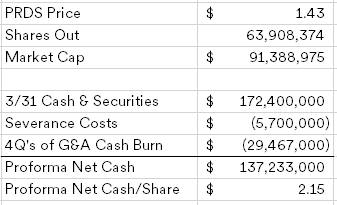
In their 8-K released today, Pardes disclosed a current cash balance of $172.4MM and $5.7MM of severance related costs to be incurred in the second quarter related to the workforce reduction. For the margin of safety swag, I included a year's worth of G&A, it won't be that high but should give plenty of room for unforeseen expenses. I bought a small position today.

Disclosure: I own shares of PRDS

Friday, September 16, 2022

Digital Media Solutions: Broken deSPAC, MBO Offer

Another quick idea -- hat tip to Writser again for pointing me in this direction -- Digital Media Solutions (DMS) ($135MM market cap) is a "technology-enabled digital performance advertising solutions" company that came public in July 2020 through a SPAC, Leo Holdings Corp (LHC).  From what I can gather, DMS gets allocated marketing spend from their clients, runs a digital campaign and then delivers warm leads or actual customers to their client depending on the arrangement.  DMS gets paid a percentage of that customer's lifetime value ("LTV") based on the advertising client's models.  While this isn't a great business, DMS is cyclical based on marketing spend (having a down year in 2022), it doesn't seem to be a scam or puffed up science fair project like other deSPACs of recent vintage, DMS is more a marginal-to-average business with potential long-term tailwinds.

Like just about every other deSPAC, DMS came to the market with inflated expectations, they originally guided to $78MM EBITDA in 2021, but only delivered $58MM.  DMS started 2022 with flat guidance of $55-60MM EBITDA, but now only expect $30-35MM due to wage inflation hitting their cost structure (500+ employees), marketing budgets getting slashed and LTV models being adjusted down in their core auto insurance market (Allstate and State Farm are two of their largest customers).  Management expects to return to growth in 2023.

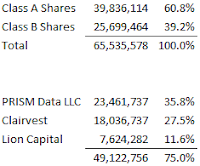
DMS is founder led, the company was started in 2012, the three co-founders are still in the c-suite today and own 35.8% of DMS through their "Prism Data LLC" investment vehicle. In 2016, DMS took on a PE investment from Clairvest, who still owns 27.5% of DMS, and rounding out the top 3 holders is Lion Capital at 11.6% ownership, Lion was the sponsor of the SPAC.  In total, these three firms own 75% of DMS, the remaining 25% has very little institutional ownership and is likely held by retail holders who were caught up in the SPAC mania.
Essentially no difference between A and B shares
On Monday 9/8, via Prism Data, management made a non-binding offer to acquire all of the publicly traded Class A shares for $2.50/share, a 121% premium from where the stock closed the previous Friday.  In their letter, they indicate that Clairvest and Lion "are likely to agree to participate" alongside Prism, leaving only 25% of shares needing to be purchased, or about $40MM.  The offer is not subject to a financing condition (important in today's market), but DMS does have $26MM cash on its balance sheet and Prism has $50MM in pre-committed financing from B. Riley (RILY) to complete the transaction.  

The offer values the minority interest at somewhere around ~10x potentially trough EBITDA, again management expects to return to growth in 2023 (they're the best positioned to know if there is indeed an inflection) so this could be an opportune time for them to take it private again.  In August 2021, the company announced they were exploring strategic alternatives, on the last two conference calls, CEO Joe Marinucci (the signatory on the Prism offer letter), has stated they were "hoping to have an update today" regarding strategic alternatives, this offer is likely the end result.  Marinucci would know where third parties offers were for the business before offering $2.50 to the board, this is likely the best offer and the independent board members will take it given there are no vocal or significant minority shareholders.

Shares closed today at $1.94/share, a 28% spread to the Prism offer.  Yes, there is significant downside given where DMS traded before the offer, but there are no shareholders to put up a fight and likely this is the best offer after the company ran a process.  Otherwise, I think the spread is wide because it is a low float former SPAC.  I bought a smallish position.  Given the number of deSPACs, I anticipate this being a similar fruitful hunting ground as the "broken/busted biotechs", please send me any others that sound or feel like this one.

Disclosure: I own shares of DMS

Tuesday, December 3, 2019

Accel Entertainment: SPAC, Distributed Gaming in IL

I did it, I finally fell for a special purpose acquisition company ("SPAC") pitch -- Accel Entertainment (ACEL) came public via a merger with TPG Pace Holdings (TPGH) and is one of the largest distributed gaming companies in the United States, although currently they only operate in Illinois, where my family and I reside.  Distributed gaming is where a bar or a truck stop (technically anyone with a liquor license) contracts with a company like Accel to place video gaming terminals ("VGTs" but kind way of saying slot machines) in their establishment with a revenue share agreement between the two parties.  Accel owns and operates the machines, but in an asset-lite fashion as the local business owner has all the real estate, operating risk and expense of running a bar/restaurant/truck stop.  You can think of distributed gaming as an operating casino but without the capital intensity of owning the real estate or the capitalized lease of operating a large casino.  Here's the basic business model:
Illinois is a fiscally challenged state that has gone all-in on gambling as a tax revenue source, recently approving 5 additional casinos plus 1 mega-casino within the Chicago city limits (where there currently are no casinos or VGTs in bars/restaurants), a 60% increase from the 10 commercial casinos that have been in operation historically.  As part of this gambling expansion, lawmakers also increased the maximum bet size from $2 to $4 and increased the number of VGTs a liquor license holder can have from 5 to 6 machines.  While the legislation was passed in July, neither the increase in the number of machines nor the increase in hold percentage has been meaningfully rolled out yet.  Each municipality in Illinois is additionally strained for tax revenue and competition among bars is intense, thus it's increasingly becoming necessary for a local dive bar to have gaming terminals on their premise.  If your town doesn't allow VGTs, chances are the town over does and customers may follow (alongside the food/beverage sales tax that local governments survive on).  The state needs revenue, local bar and restaurant owners need new sources of revenue especially with rising labor prices, all setting up a nice tailwind for continued distributed gaming growth in Illinois that was only legalized in 2012.

Distributed gaming is disrupting regional casinos, it is more convenient for gamblers to drive to a local bar they might already frequent than to drive an hour to one of the first generation riverboat style casinos that doesn't provide much more in terms of experience than a typical bar.  Gaming tax revenue via VGT surpassed that of the casinos in Illinois for the first time last year, giving them a possible lobbying advantage for continued expansion in the future.  The big wildcard is Chicago, which currently does not allow VGTs within the city limits, given Chicago's fiscal situation (it's not good) that will likely change in the future as well which would provide a massive boost to the distributed gaming industry.  VGTs, like the lotto, are an easy short term fix for politicians looking to avoid raising property taxes.

The new gaming law isn't all positive for operators, the Illinois tax rate on VGTs is increasing from 30% to 34% in 2020, the VGT operator (Accel) and the business owner by law must split the revenue 50/50, essentially the government (mix of state and local) gets 1/3rd, VGT operator gets 1/3rd and the business owner gets 1/3rd.  Since VGT operators can't compete on price in Illinois, it means they must compete on service, machine quality, and other areas where scale will give Accel an advantage over smaller competitors that can't spread those costs over a larger base, have buying power with suppliers or don't have the accumulate data that Accel has built up to help improve operations.  Fixing the pricing also creates sort of a unnatural oligopoly structure to the industry in Illinois (this is not the case in other markets like NV or MT), there won't be pressure to reduce their split or lose a contract and the gambling customer base isn't price sensitive (the hold rate on Accel's machines is about 8%, meaning it'll pay back about $0.92 of every dollar played) creating a pretty durable margin.

Scale matters, this is a fragmented industry with a lot of potential to roll-up the smaller players in the state and enter into new jurisdictions as more states legalize distributed gaming as a way to increase their tax revenues.  Accel has been a serial acquirer of smaller Illinois competitors, they've completed 9 deals since distributed gaming was legalized in 2012, and now that they have a public stock as currency, I would anticipate them doing more in the future.  Smaller operators in Illinois or elsewhere in the country might find it attractive to sell to Accel yet retain some equity upside in a liquid public stock.  Rolling up an industry like this seems less risky as the end product and pricing is generally the same, its a fairly standardized product and since pricing is fixed, you're not expected to share any synergies with the customer.  Accel also has a conditional license to operate in Pennsylvania, where lawmakers recently approved VGTs located in truck stops, a potential first step before a broader roll out to other liquor license holders, it will be a small market initially, but like Illinois, Pennsylvania has really pushed gaming as a tax revenue source.

Accel is projecting about $115MM in EBITDA for 2020, after their most recently closed acquisition, they have over 10,000 VGTs and representing about 1/3rd of the Illinois market.  Maintenance capital expenditures are pretty limited, mostly just servicing existing machines occasionally, creating a pretty attractive free cash flow conversion rate.  Using management estimates (its a SPAC, these could be wildly ambitious and include a lot of assumptions from the new gaming expansion and recent acquisitions), I'm coming up with ACEL trading around 9.2x EBITDA or a just sub 10% free cash flow yield (pre-growth capex).
There aren't any great public peers (seems to be the case with all SPACs, that way they can always comp themselves against inappropriate peers) but on an absolute basis that doesn't seem particularly expensive for what should be a pretty durable, growing and recurring revenue stream.  Boyd Gaming (BYD) did buy a Illinois distributed gaming peer for 8x EBITDA in 2018 and Golden Entertainment (GDEN) which is a mix of Las Vegas local casinos and distributed gaming trades quite a bit cheaper but also has significant debt and is more capital intensive.  I would imagine Accel performing better through a recession than casino peers as gamblers choose the hyper-local option over making a day out of traveling to a regional casino.  That along with their asset-lite model, lower leverage, and growth profile means Accel should trade for a decent premium over gaming peers.

I bought a small toehold position, could be a mistake as the SPAC aspect makes me nervous, but I like the business.

Other Thoughts:
  • There's some poor counterparty credit risk aspect to their business model, they partner with small local mom and pop type operators, you're not likely to see VGTs at a Buffalo Wild Wings for example, but you will in the beat up corner bar.  Bars and restaurants go out of business regularly and their 7 year contracts aren't enforceable if the business in question closes down.
  • No one is going to include Accel in an ESG portfolio, it's about the opposite of ESG, VGTs are an eye sore (often they're in a separate room with a seedy looking saloon door entrance), encourages addictive gambling and just not a great productive use of time/money for society, truly a tax on the addicted and often poor.  But it's a proven business model and the hold percentage is much better to players than say the state lotto industry.
  • Accel currently doesn't have a players rewards program that many gaming companies utilize to market to and retain customers.  Given distributed gaming is a natural competitor to the regional casinos, could it make sense for someone like PENN to acquire Accel, roll out their rewards program and link the two customer bases together to drive people to the regional casinos?  It's unclear if current regulations would allow Accel to have a rewards program, but an eventual combination with a regional casino player could make sense.
  • Accel also does similar arrangements with other bar equipment like pool tables, darts, jukeboxes, sort of an open a bar out of the box type arrangement, but the non-gaming side is just sub-5% of total revenues.
  • Like every other SPAC, Accel does have warrants that will dilute equity at $11.50 and above, the capital structure is a bit confusing but that's par for the course for a SPAC, I imagine they'll attempt to buyback some of the warrants.
  • They pitched themselves as a "gaming-as-a-service" company in the SPAC investor decks, thankfully that's been removed in the latest post-merger presentation on their website, seemed a little scuzzy even for a distributed gaming SPAC.
  • Every SPAC needs a story on why it went the SPAC route versus the traditional IPO route -- Clairvest is a Canadian PE firm with a solid track record in gaming (they own a chunk of the highly successful Rivers Casino just outside O'Hare Airport) that owns a piece of Accel, they had some board and governance rights if the company went IPO but not if the company merged with a SPAC.  Clairvest ultimately sued and recently the two sides came to an agreement with Clairvest remaining equity owners in Accel and getting a board seat.  Unclear to me what the dispute was between Clairvest and Accel that started the SPAC route, but in the end its been resolved somewhat amicably, make with that story what you will.
Disclosure: I own shares of ACEL