Showing posts with label INDUS Realty Trust. Show all posts

Friday, November 25, 2022

INDUS Realty Trust: Potential Offer from Centerbridge

On a quiet Black Friday, private equity firm Centerbridge Partners filed a 13D on INDUS Realty Trust (INDT) ($590MM market cap) stating they "anticipate submitting a Potential Proposal" to acquire all the outstanding shares they don't own.

Item 4. Purpose of Transaction

The Reporting Persons initially acquired the shares of Common Stock for investment purposes. From time to time since the date of original investment in the Issuer, the Reporting Persons have engaged in evaluations of the Issuer and its business, including engaging in discussions with management, other shareholders and other persons. In connection with their regular review of their investment in the Issuer, and based on current market conditions and other factors, the Reporting Persons have changed their intent. On November 14, 2022, Centerbridge determined to explore possible strategic transactions involving the Issuer, including pursuing a proposal to acquire the outstanding shares of Common Stock not currently held by the Reporting Persons (a “Potential Proposal”) and to communicate with, among others, management, the Board of Directors of the Issuer (the “Board”), stockholders and other stakeholders of the Issuer, potential acquirers, service providers and debt and equity financing sources, and/or other relevant parties regarding the foregoing. The Reporting Person may exchange information with any such persons, which may be effected pursuant to one or more confidentiality or similar agreements which may include customary standstill provisions.

While the Reporting Persons have engaged in evaluations of the Issuer and its business, including engaging in preliminary discussions, the Reporting Persons have not definitively determined to make a Potential Proposal or otherwise with respect to any specific actions regarding the acquiring, holding, voting or disposing of any securities of the Issuer. However, based on the status of their evaluation of the Issuer and its business to date and based on current market conditions, the Reporting Persons anticipate submitting a Potential Proposal to the Issuer. Any such action may be made alone or in conjunction with stockholders and other stakeholders of the Issuer, potential acquirers, service providers, debt and equity financing sources and/or other relevant parties and could include one or more purposes, plans or proposals that relate to or would result in actions required to be reported herein in accordance with Item 4 of Schedule 13D.

The Reporting Persons have not yet determined what the terms of any such Potential Proposal may be and no assurances can be given that any Potential Proposal will be made, that any Potential Proposal, if made, would be accepted or that any transaction contemplated by the Potential Proposal with the Issuer will be consummated. No binding obligation on the part of any of the Reporting Persons will arise unless and until mutually acceptable definitive documentation has been executed and delivered.

INDUS is a pretty simple REIT, they own, develop, purchase industrial/logistics properties and lease them out on a triple net lease basis.  Despite concerns that Amazon is pulling back on their warehouse spending spree, demand for industrial properties remains high and cap rates low, according to INDT CEO Michael Gamzon (from BamSEC) on their recent Q3 earnings call:

William Thomas Catherwood BTIG, LLC, Research Division – Director & REIT Analyst

Appreciate that, Michael. And can I stick with that cap rate comment that you made. Obviously, you're in a select targeted set of markets. But with the comment that the cap rates on transactions would be below kind of what the market is expecting right now, do you have a sense of how much cap rates have moved in your specific markets?

Michael S. Gamzon INDUS Realty Trust, Inc. – CEO, President & Director

Yes, I think, akin to that comment, it's really hard to pick a number because it's sort of -- there's so few deals. They just feel almost your cherry picking. I can give you an example. In Charlotte, there was a nice portfolio located near the airport. It had 3.5 years of weighted average lease term. We thought the rents were kind of 25% to 30% below market, about a 600,000 square foot portfolio. We've heard that's been awarded, went through kind of a multiple round process -- and so this is real time last month, and we've heard it's kind of a 4.2%, 4.3% cap rate, which I think feels pretty low. I'd say peak of the market, maybe I would have guessed that would be kind of a 3.8. So has that moved 40 basis points. That seems pretty tight compared to where debt spreads have widened and other things, but that's where that's traded.

We know there's been a closed deal in Savannah with not a lot of mark-to-market and 5 years of lease term that traded at a 4.25% Again, it's not a market we're in. We've mentioned in the past, we look at it, so we track it a little bit. That feels pretty low. There is a deal kind of in the Berks County, which is kind of the Western submarket of the Lehigh Valley. We feel the core of the 2 Eastern counties. But -- this is further West. So we think it's not as good a location typically is traded wide of the Lehigh Valley, and that closed, I think, 2 months ago at 4.25%.

So it's really hard to say exactly how much things have moved. Some things that are going to have a very, very long 15 or 20-year single-tenant net lease with not a lot of bumps. That's going to be typically wider, probably 100 to 125 basis points wider. These other deals are anywhere from, call it, 25 to 75, but it's really hard to put a pin on it.

Those numbers seem difficult to believe in the current market, especially when INDT's shares were recently trading with an implied cap rate in the high 6%'s, higher than where they're currently acquiring and developing new industrial/logistics properties.  With their equity trading where it is, raising future equity after completing their current pipeline (2023) seems temporarily off the table.  It makes sense that private equity would come knocking on their door, so what might Centerbridge be willing to pay?

It is a little bit tricky, because of INDT's small size and growth posture, they're growing over 20% based on their acquisition and development pipeline in the next year.  Relying heavily on their recent Q3 earnings supplement (particularly pages 23, 24 and 27):
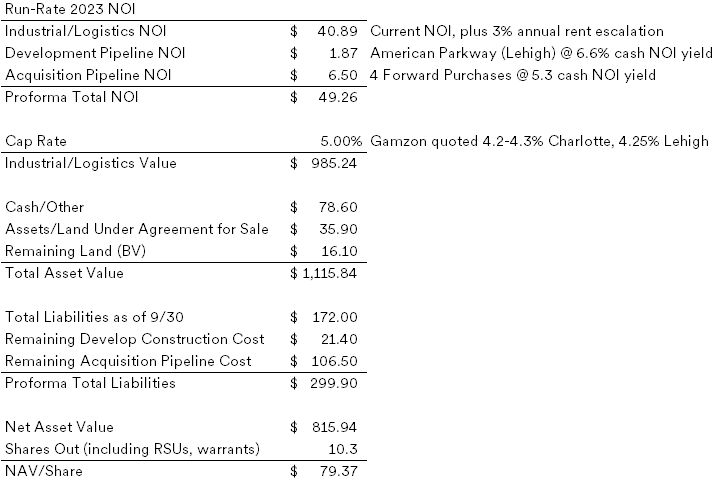
At a 5% cap rate, again, sort of hard to believe that industrial/logistics cap rates haven't moved higher recently, I come up with ~$79/share value, or 38% higher than Friday's $57.28/share closing price.  Centerbridge initially invested in INDT during the 2021 capital raise, they know the company/asset base well and should be seen as a legit buyer.  At a minimum, maybe they're trying to put INDUS in play and Blackstone enters with their unlimited checkbook to roll INDT's assets alongside Gordon DuGan's (chairman of INDT) GPT assets he sold to BX a few years back.

I've gotten a lot of speculative M&A wrong this year so I'm not rushing to add here, but optimistic the value of INDT's real estate will be realized one way or another.

Disclosure: I own shares of INDT

Wednesday, November 24, 2021

Sonida Senior Living: Out of Court Restructuring, fka Capital Senior Living

Sonida Senior Living (SNDA, fka Capital Senior Living under the old symbol CSU) recently completed an out of court restructuring led by Conversant Capital, the same investor that has been instrumental in institutionalizing and providing growth capital to INDUS Realty Trust (INDT).  While clearly different, the industrial/logistics asset class has covid tailwinds versus senior housing having covid headwinds, the results could rhyme with each other longer term as this micro cap "grows up" (to steal a tweet from "Sterling Capital" @jay_21_, also h/t for the idea). Sonida is now positioned to use their reset balance sheet to take advantage of a fragmented senior housing market with plenty of distress (looking over at our friend RHE), but also with long anticipated demographic tailwinds finally being realized with an increasingly large population aging into senior housing.

Below is the standard investor relations overview slide.  Unlike some others in senior housing, SNDA is not a REIT (more similar to BKD), but owns and operates the vast majority of their facilities as they exited locations the company formerly leased from others (VTR, WELL, PEAK etc) in recent years.  There's embedded real estate value at SNDA as a result, which may someday lend itself to some kind of REIT transaction.  They also have a small management business that resembles Five Star's (FVE) business model (got there in a similar way too when SNDA restructured their leased properties) that helps offsets some G&A in the meantime.


The restructuring agreement took a few twists and turns, including heavy opposition from 12+% shareholder Ortelius Advisors, but was eventually approved by shareholders in October and closed earlier in November.

A total of $154.8MM (net $140.8MM) was raised through a combination of:
  • $41.25MM in convertible preferred stock (11%, conversion price of $40) to Conversant plus an additional $25MM accordion to the convertible preferred stock if needed for growth capital 
  • $41.25MM in common stock at $25/share to Conversant, plus warrants to purchased an additional 1 million shares at $40/share
  • $72.3MM through a rights offering at $30/share to all company shareholders
  • Conversant previously provided a $16MM rescue bridge loan to the company, it was repaid in full upon closing of the transaction on 11/3/21.
Most of the capital is going to be used to stabilize the company's balance sheet and take care of some deferred maintenance capex the company likely punted on the last two years.  The capital basically allows the company to recover and get back to some kind of normalized operating environment.  Senior housing has had the unfortunate position of getting hit by covid from both the revenue and expense side.  It's not fun to mention but obviously covid caused a lot of deaths in this age group and likely prevented a lot of move ins as family members stayed home and turned into caregivers to avoid subjecting love ones to senior housing during a pandemic.  On the expense side, first they had PPE expense and now a tight labor market which is squeezing their margins.

But attempting to look through to what their results could look like in a year or two as the world normalizes, the key numbers to run a scenario analysis are the occupancy and NOI margin (I'm going back to YE 2017, no good reason just seemed "normal", for their owned properties they did 88% and 38% respectively):
To be clear, they're a ways away from normal, as of their last earnings report, occupancy was 82.3% and NOI margin was 21%.

For the cap rate, it's a bit tricky too, senior living is similar to hotels where if you're the owner operator it's less of a real estate business and more of a service business.  But Ventas (VTR) recently purchased Fortress controlled New Senior Investment Group (SNR) for $2.3B:
"The transaction valuation is expected to represent approximately a 6% capitalization rate on expected New Senior Net Operating Income ("NOI").. the acquisition price implies a 20% to 30% discount to estimated replacement cost on a per unit basis.. the transaction price represents a multiple of <12 times estimated 2022 New Senior normalized FFO per share including full synergies."  
It's not an apples-to-apples comparable, New Senior didn't operate their properties, just leased them out which is arguably less risky (although a lot of senior housing REITs have had to take back properties) but at least allowed them to be a REIT and lower their cost of capital.

The proforma debt and share count is a little messy, I've probably made some errors here, so those who know better, please feel free to correct me.
That compares favorably to today's share price of ~$32 per share, but that's an asset/takeout value (doesn't include corporate overhead, etc.) and assumes a full recovery.  But also doesn't include any additional growth or deal making which will likely come in the future, based on who they've brought in, the re-branding, it all signals that this is going to be more of a growth platform (similar to the GRIF to INDT rebrand).  
On sort of a going concern basis, using normalized numbers, including the convert but excluding the effects of the warrants, I have it trading at 12.5x normalized EBITDA (below where other senior housing companies trade, but to be fair, they'd trade lower on a normalized number too).  Not screaming cheap on an absolute standalone basis, they probably need additional scale to create some operating leverage on the G&A and corporate expenses.

Other thoughts:

  • I don't have the stats to back it up at my finger tips, but the dynamics in senior housing appear to be similar to those in single family residential.  There was significant overbuilding of senior housing in the middle of the last decade, then it dropped off a cliff, now we're finally seeing the long promised demographic wave moving into the 80+ cohort which could cause supply to tighten and rent/occupancy to rise.
  • I like the new board of directors.  The new Chairman is Dave Johnson, he was previously the President of Wyndham Hotels (WH) and is a board member of Hilton Grand Vacations (HGV), two companies I've followed/respected for several years.  Then to repeat the tie in with INDT, Conversant is bringing in Ben Harris as a board member, formerly the president of Gramercy Properties Trust (fka GPT) which was a blog favorite, most of the other key members of that team are at INDT now.
  • While not as great of an inflation hedge as multi-family due to the greater percentage of variable/labor costs in senior housing, inflation should be able to be mostly passed onto to the residents.  SNDA disclosed in a recent call that they were increasing rents by 5+% next year, VTR is targeting 8% in their owned properties, etc.
  • Sonida has a fairly high concentration in Texas, Wisconsin, Indiana and Ohio.  Their facilities tend to be smallish and on the older side, about an average age of 23+ years.
  • The company recently announced they'd be managing an additional 3 properties for Ventas starting 12/1, while not material yet, perhaps the managed segment could be a growth business for Sonida.  It's a fee business, not exposed to lease expense or capex of an operator, etc.
  • The company is going to restart giving guidance for 2022, presumably with Q1 earnings, which could give some needed visibility to investors as I fully admit my back of the envelope math is mostly a guess at this point.

Disclosure: I own shares of SNDA (plus INDT and RHE-A still too)

Thursday, March 4, 2021

INDUS Realty Trust: GPT 2.0

I'm about a year late on this post, thank you to Sterling Capital (@jay_21_) -- one of the best follows on Twitter -- for pointing me back to the idea.  Also deserves a belated hat tip for collaborating on the ACR idea.  

One of my early successes was Gramercy Property Trust (GPT), originally a busted up commercial mREIT (favorite theme of mine) which following the financial crisis transformed itself into an industrial triple net lease REIT before eventually selling itself to Blackstone in 2018.  The architect of that transformation and value creation story was Gordon DuGan, one of the few CEOs I've kept a Google alert to keep tabs on where they go next.  Last March, DuGan popped back up as the new Chairman of Griffin Industrial Realty (GRIF is the old symbol), Griffin was an accidental real estate company, a 1997 spinoff from an operating company, Griffin spent the following two plus decades operating in the relative shadows slowly building out an industrial portfolio -- first in Hartford on historical land holdings and later expanding to PA, Charlotte and Orlando.  Bringing in DuGan signaled a transition for the company, late last year Griffin announced they would be rebranding as INDUS Realty Trust (INDT) and converting to a REIT.  On the investor day last fall, DuGan admitted to have never heard of the company prior to meeting the CEO at a REIT conference, but today I think the company is interesting (more of longer term value investment than event-driven) because:

  • This is a jockey play, Gordon DuGan is a proven capital allocator, he did this once before, I have confidence he can do it again.  This is a somewhat similar playbook to GPT, take a small-cap industrial REIT (~$450MM) that is small enough to do one-off deals, institutionalize it, in the process the valuation re-rates up to the more liquid large-cap peers.
  • Industrial REITs are richly valued, they trade for ~4-5% cap rates and have been major covid beneficiaries as ecommerce "last-mile" logistics and inventory management have become more critical.  INDT's growth is not in acquiring assets, but rather acting as a developer, industrial/logistics buildings are relatively cheap and quick to build, the arbitrage between yield on development costs and market cap rates is wide at this time.
  • INDT raised a significant amount of equity this week in a secondary offering at $60, possibly weighting on the trading dynamics in the short term and creating a buying opportunity.  The equity raise is accretive to the long term value as that capital is put to work into new projects at attractive yields and it also helps improve the liquidity of the shares.

The current industrial portfolio is heavily skewed to the Hartford market where INDT had much of its undeveloped land, purchased long ago and some of that land is still held on its balance sheet at historical cost.  The company's strategy to diversify away from Hartford, instead focusing on their other markets of Lehigh Valley (PA), Charlotte and Orlando.

They point to the age and size of their assets as a differentiator, their buildings are newer and focused on the mid-sized market which provides them a lot of flexibility in the types of tenants they can attract while still being economical from a cost perspective.  I don't have a lot to add to their current portfolio, seems reasonably high quality with a diverse tenant mix.

Why INDT is unique is their ability to grow through development versus needing to rely on making sizable portfolio acquisitions to move the needle.  I'm generally a sucker for real estate development companies, my view is the market has a hard time valuing development assets correctly as they're non cash generating and thus not great for the REIT structure or investor base.  The problem with development companies is typically the long construction cycle, if for instance you're HHC, its 2018 and makes perfect sense to build a beautiful high rise office building on the Chicago River, by the time its complete in 2020, there's a pandemic and people are questioning if they'll ever go back into the office again.  A lot can happen in those two years before construction is complete and even longer to bring it to stabilization.  With industrial warehouse type properties, the construction is pretty quick and simple, 9-12 months, the product type is pretty homogeneous, you don't need a fancy architect to attract top tenants.  The timeframe from shovels in the ground to stabilization is shorter and the certainty of projected cash yield is firmer on construction costs.  This is a less risky form of development with much of the same upside.

INDT has historically been able to earn 7.7%-8.1% cash yields on their development costs, their current projects are estimated more in the 6.0%-6.5% range (guessing the difference is land cost, historical cost versus current market in their new developments), but with stabilized assets trading in the 4%-5.5% range, there's a lot of margin available to INDT's development platform to create shareholder value.

This week, the company issued equity at $60 per share giving them ample capital to pursue additional development opportunities later this year.  To illustrate what I think the company could be worth once this capital is put to work, I created the below back of envelope math.

The company still has a fair amount of non-core assets to be sold, so I assume those are sold at the price they're currently contracted at or book value which might be conservative, especially for the land holdings.  As part of their recent REIT conversion, they'll have a purging dividend that will be paid in part cash and part shares.  Then I also assume they'll sell the additional greenshoe shares, but maybe that's not a guarantee if the market's slide continues.  But then all that cash, plus incremental debt gets pushed into development projects at a 6.5% yield on cost, revalued by the market at a 5% cap rate.  The end result is roughly $82 per share, think of that as a target price a year out.  Probably a few mistakes in there, feel free to point them out.  One thing I am ignoring for now is the warrants that were issued last year as part of a private placement, those have a strike price of $60 which would raise additional capital as well.

My estimate is highly dependent on the market cap rate for industrial properties and their yield on cost for development, I ran a quick scenario analysis that shows what the math looks like at various assumptions.  Across the top is the development yield and down the left side is the market cap rate.

As you can see, the market is roughly valuing INDT at a 6% cap rate with little value being given to their development pipeline.  The math could really go in INDT's favor if they're able to issues shares closer to NAV or even above (many industrial REITs trade at a premium to NAV) creating that virtuous cycle that all REITs strive to get.  In summary, you have a proven capital allocator in a subsegment of the real estate market that should have continued tailwinds post-covid with a decently long but safe development pipeline to create significant value. 

Disclosure: I own shares of INDT