Friday, September 15, 2023

Homology Medicines: Strategic Alternatives, Potentially Valuable JV

Homology Medicines (FIXX) (~$70MM market cap) is a clinical stage genetics biotech whose lead program (HMI-103) is meant to treat phenylketonuria ("PKU"), a rare disease that inflicts approximately 50,000 people worldwide.  In July, despite some early positive data, the company determined to pursue strategic alternatives as FIXX wouldn't be able to raise enough capital in the current environment necessary to continue with clinical trials.  Alongside the strategic alternatives announcement, the company paused development and reduced its workforce by 87% which resulted in $6.8MM in one-time severance charges.

Outside of approximately $108MM in cash (netting out current liabilities), FIXX has a potentially valuable 20% ownership stake in Oxford Biomedia Solutions (an adeno-associated virus vector manufacturing company), a joint venture that was formed in March 2022 with Oxford Biomedia Plc (OXB in London).  As part of the joint venture, FIXX can put their stake in the JV to OXB anytime following the three-year anniversary (~March 2025):

Pursuant to the Amended and Restated Limited Liability Company Agreement of OXB Solutions (the "OXB Solutions Operating Agreement") which was executed in connection with the Closing, at any time following the three-year anniversary of the Closing, (i) OXB will have an option to cause Homology to sell and transfer to OXB, and (ii) Homology will have an option to cause OXB to purchase from Homology, in each case all of Homology's equity ownership interest in OXB Solutions at a price equal to 5.5 times the revenue for the immediately preceding 12-month period (together, the "Options"), subject to a maximum amount of $74.1 million.

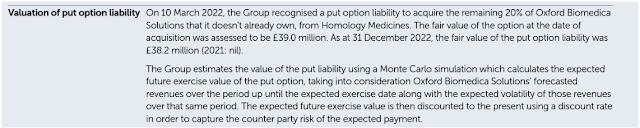
 Poking around OXB's annual report, they have the below disclosure:

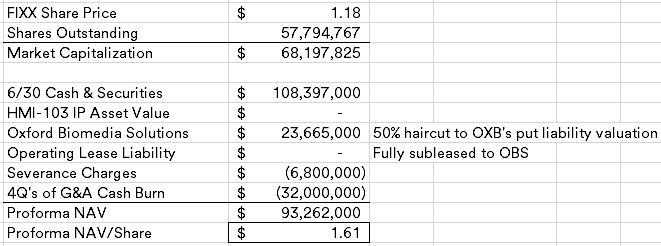
Using the current exchange rate, that's approximately $47MM in value to FIXX.  Now OXB isn't a large cap phrama with an unlimited balance sheet, so there is some counterparty risk that OXB will ultimately be able to make good on this put.  In my back of the envelope NAV, I'm going to mark this at a 50% discount to be conservative.

Unlike GRPH, the operating lease liability at FIXX is mostly an accounting entry as the company's office space is being subleased to Oxford Biomedia Solutions, but doesn't qualify for deconsolidation on FIXX's balance sheet.  I'm going to remove that liability, feel free to make your own assumption there.  Additionally, even though HMI-103 is very early stage, it wasn't discontinued due to a clinical failure and might have some value despite me marking at zero since I can't judge the science.

It is hard to handicap the path forward, maybe OXB buys them out, they could do a pseudo capital raise with FIXX's cash balance while eliminating the JV put option liability.  Or FIXX could pursue the usual paths of a reverse-merger, buyout or liquidation.

Disclosure: I own shares of FIXX

Friday, September 8, 2023

Manchester United: Glazers Under Pressure to Sell, Dual Share Class Concerns

Similar to the Albertsons post, not a lot of original thoughts here other than the spread to the rumored takeout/private market value is too wide and could close shortly if all goes right.  If not, the current valuation isn't too demanding.

Manchester United (MANU) ($3.25B market cap, $4.15B EV) is one of the most popular soccer/football franchises in the world.  Since 2005, the English Premier League mainstay has been owned by the Glazer family (originally Malcolm Glazer, he died in 2014 and distributed his stake evenly to his six children) who purchased the team via a controversial (at the time) LBO that saddled the team with debt.  In the eyes of Manchester United supporters, due to debt incurred, the team was forced to divert cash flow from improving the team/facilities to debt service.  It took a few years, but the team's performance has suffered as a result, the team last won the Premier League in 2012-2013, a long drought for the storied club.  With the influx of foreign money, especially from the Middle East into the Premier League, Manchester United is no longer the club with the most resources and faces stiff competition for talent, including from their cross town rival, Manchester City, which is owned by members of the UAE royal family.  Again, in the eyes of supporters, the Glazers either don't have or won't spend the resources necessary to compete at the highest levels in Europe and ManU's millions of fans want them out.  Pressure has built to a significant level, protests and criticism from the notoriously difficult British press, partially led the Glazers (who also own the NFL's Tampa Bay Buccaneers) to announce they were open to sale nearly a year ago.

My primary concern with publicly traded sports teams is that they're almost always controlled companies with dual share class structures, probably rightly so as it would be potentially chaotic for the leagues if not.  There has been plenty of ink spilled on how great of an investment sports franchises have been, the number of billionaires continues to go up while the number of marquee sports franchises (the ultimate status symbol) has remained relatively flat, pushing the value up each time one comes on the market.  However, since the appeal to sports team ownership is mostly as a status symbol, the value in being the owner is being the controlling owner and face of the franchise.  Team owners aren't investing in the team for the cash flow (there generally isn't much, otherwise that would anger fans, thus reducing the asset value of the franchise), in order to be the recognized as the team owner, a would be buyer only needs to acquire enough shares to be the majority shareholder.

Manchester United has a dual share class structure where the Glazers own 100% of the Class B shares and 4-5% of the Class A shares.  Class B shares carry 10 votes, while Class A shares get 1 vote, giving the Glazers 95+% of the vote.

What happens if a buyer only buys the Class B shares from the Glazers?

In the original offering document from the 2012 IPO, the Class B shares automatically convert to Class A shares if they're no longer owned by an affiliate of the Glazer family:

Conversion

Each Class B ordinary share is convertible into one Class A ordinary share at any time at the option of the holder of such Class B ordinary share. Each Class B ordinary share shall be automatically and immediately converted into one Class A ordinary share upon any transfer thereof to a person or entity that is not an affiliate of the holder of such Class B ordinary share. Further, our Class B ordinary shares will automatically convert into shares of our Class A ordinary shares upon the date when holders of all Class B ordinary shares cease to hold Class B ordinary shares representing, in the aggregate, at least 10% of the total number of Class A and Class B ordinary shares outstanding.

But given the above Excel snip, even if the Class B shares were fully converted to Class A shares, a buyer of the Class B would still have a majority of the economic ownership and the vote.  This is the primary risk one has to get comfortable with in this sale situation, that MANU shareholders might not see the same economic benefit as the Glazers (the Glazers could also get a premium for the Class B over the Class A).  This is not a situation where a buyer would be potentially acquiring a majority voting stake for less than a majority economic stake that could be challenged in court.

However, the good news is the leader bidder, Sheikh Jassim bin Hamad bin Khalifa Al Thani ("Sheikh Jassim") of the Qatari royal family (brother of the Emir of Qatar), wants to buy the entire club outright for a reported £6B or ~$7.5B.  Subtracting out the $900MM in debt, that's roughly ~$40/share, about double where shares trade today, around ~$20/share for the Class A.

Why does it trade at such a wide spread to the rumor deal price?

  1. The Glazers appear reluctant to sell (the process has almost dragged on a year, there's some deal fatigue here) and have been reported to be looking for a £7-10B price tag.  If they don't get it, they're willing to wait a couple years (could be a negotiating tactic) until new media rights packages have been signed, the FIFA Club World Cup expansion is closer and other bidders emerge.
  2. The other bidder, British billionaire Sir Jim Ratcliffe (a big ManU supporter) has bid between £5-5.5B for just more than 50% of the shares (the initial risk outlined) that would also potentially keep the Glazers involved in the club.
Despite these risks, I'm comfortable owning MANU shares at ~$20 given the 50% discount to the report Qatari bid.  The Glazers are going to face increasing pressure from a notoriously rabid fanbase that is dying to return to top form, the Glazers have limited ability to monetize or dividend out their incredible capital gain in the franchise, and the Qatar royal family have a near unlimited budget (plus a clear desire to sportswash - see the 2022 World Cup).  Manchester United's stadium needs renovation, the team needs to reinvest in their players, only a new owner with an unlimited pocket book (and potentially a cultural/political rival with crosstown Manchester City) will placate fans.  Whether it happens this fall at £6B or in 2025 at £7-10B, current prices seem attractive for a trophy asset that's clearly in play.  Other recent sports franchises, Chelsea for $5.25B and the Washington Commanders for $6.1B, have been sold for prices far exceeding the stock market price of MANU, despite being less popular teams.

Disclosure: I own shares of MANU

Albertsons: Merger w/Kroger, Divestiture News

Apologies, this post is mostly for my benefit (I try to post on all new positions), there likey aren't any new thoughts below on combination of the country's two largest traditional grocery chains, Albertsons (ACI) and Kroger (KR), but I just wanted to acknowledge that I bought into the merger arb earlier this week.  Partially after hearing Andrew Walker and Daniel Biolsi discuss it in a recent Yet Another Value Podcast episode.

Nearly a year ago, the two announced that Kroger (~2700 stores) was buying Albertsons (~2300 stores) for $34.10/share in cash (the merger consideration has been adjusted down to $27.25 for a $6.85 special cash dividend ACI paid in early 2023), shares closed on Friday for $23.63, offering 15% upside to the adjusted closing price for a deal that is expected to close in early 2024.  Potentially a juicy IRR.

On its face, the merger appeares to have a significant anti-trust hurdles, but when you examine the industry, traditional grocers like KR and ACI are facing competitive pressure from big box stores like Walmart, Target and Costco, plus competition on the high end from specialty grocers like Sprouts and Whole Foods.  They've been share losers to both sides.  Although others don't always see it that way, regulators took a narrow view of the office supply industry and rejected the attempted Staples and Office Depot 2014 tie up, despite many alternative channels (notably Amazon) to buy office supplies.  Both companies have struggled since, hopefully regulators take a more holistic view here and realize that traditional grocery chains need a strong competitor to the big box concepts (Walmart, Target) that use grocery as an enticement to get shoppers into their stores to buy higher margin non-grocery goods.

From a Chicagoan's point of view (they have overlap significantly here), I was a bit surprised by the relative lack of overlap in the two chain's store map nationally.  Kroger has significant concentration in the midwest and southeast where Albertsons is generally absent, and Albertsons is more focused on the west coast and northeast where Kroger has less of a presence (other than Denver, Seattle, Southern CA):


To address the areas where they do have overlap, when the deal was initially struck, the two set the stage for a divestiture SpinCo that would house between 100 to 375 grocery stores.  In addition to the adjustment for the special dividend (since paid), the cash consideration was to be dropped by 3x the four-wall (store level, pre corporate overhead) EBITDA of the stores assigned to the SpinCo.  Traditional merger arbitrage investors don't like uncertainty in the total consideration, the ACI SpinCo (in the initial docs, it appeared that SpinCo would be ACI stores only) would have likely traded poorly or at had some uncertainty as to its public market valuation.  This uncertainty (in my view) has partially led to the wide merger arbitrage spread, along with concerns around regulatory approval.

Today's news that Kroger and Albertsons had reached a deal to sell 413 stores for $1.9B to C&S Wholesale Grocers ("C &S") should help in a couple ways:

  • Divesting the overlap stores in an arm's length transaction should help calm fears that a SpinCo would be filled with the worst stores and be destined to fail.  A spin would not have been arms length and could have been the ultimate garbage barge, but now the divested stores will be plugged into an established operator who has done their due diligence and should be ready to compete against the combined KR/ACI following the closing of the deal.  That couldn't be said for a spin structure.
  • If required by regulators, KR/ACI has also setup an option for C&S to buy an additional 237 stores if needed.  In the initial merger proxy, the two parties speculated that up to 600 stores would need to be divested in total, this option would firm that up and fully eliminate the need for a spinoff of uncertain value.
  • The original spin appeared to only for ACI shareholders, this divestiture package includes both ACI and KR stores, again highlighting that a third party fully evaluated the competitive position in each market, versus a dump into a SpinCo that might have failed.
  • Similar to above, but grocery stores are heavily unionized, by selling in an arm's length transaction versus a spin, this structure likely helps dispel fears that a SpinCo would fail or that stores would be closed.  C&W has committed to keeping stores open as-is which should help political perceptions around this combination.

That's pretty much my thesis, the divestiture firms up the merger consideration (shouldn't need the SpinCo any longer) and should appease regulators that a strong third party (versus a helpless SpinCo) has done their due diligence and purchased the divested stores in an arm's length transaction, thus ensuring proper competition.  Assuming this deal closes in mid-February, even after this week's run up, it is offering a 15% absolute return and a ~38% IRR.

If the merger is blocked or otherwise doesn't occur, Albertsons is valued at 8x earnings (roughly inline with peers) and is a semi-controlled company by Cerberus and other PE investors with capital allocation expertise.  The downside doesn't appear too significant.

Disclosure: I own shares of ACI

Thursday, August 24, 2023

Banc of California: PacWest Merger, Get in Cheaper than Warburg & Centerbridge

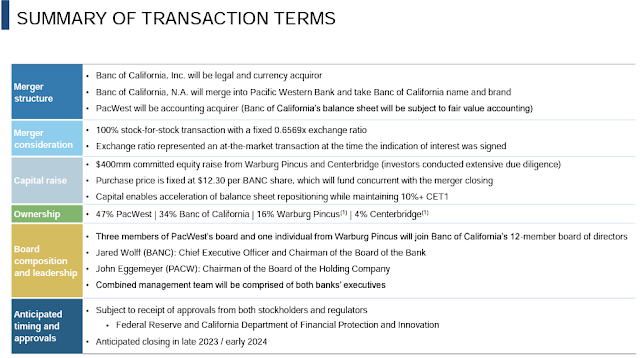
Banc of California (BANC) and PacWest's (PACW) merger is a bit old news at this point, but initial excitement has worn off and shares are now priced below $12.30/share, where PE firms Warburg Pincus and Centerbridge are making their PIPE investment (originally at a 20% discount, it will close with the merger).  This is less of a short-term special situation trade and more a medium-to-long term investment as we wait for the skies to clear in the regional bank industry and bet on the merged bank extracting a massive amount of synergies.  The merger is a complicated transaction, the basic terms are below, all of this is designed to clean up the larger distressed PacWest:

PacWest was one of the rumored next dominos to fall in this past spring's banking crisis.  Their strategy was to use low cost California deposits (including a venture capital deposit clientele) and then lend those deposits out across the country to CRE and commercial borrowers.  When their depositors fled, PacWest was forced to load up on expensive wholesale funding to plug the hole.  Part of the problem was their customers (both depositors and borrowers) didn't see them as their primary bank, borrowers weren't depositors and depositors weren't borrowers.  Banc of California contrastly operates more like a large community bank, they gather deposits and lend in the same geographic area, southern California.

The accounting here will be a bit quirky, in an acquisition or a merger, a bank needs to mark-to-market the assets of the acquired bank on their balance sheet.  As everyone is well aware, where current rates are, banks have large unrealized losses that aren't included on their balance sheet in both the loans held for investment and securities held-to-maturity portfolios.  Since Banc of California is in relatively better shape, PacWest will be the acquirer here so that BANC's assets are marked-to-market rather than PACW's.  There's a lot of moving pieces here (BANC is selling their residential mortgage and multi-family portfolios among other asset sales to plug the wholesale funding problem), but in the interest of brevity, Warburg Pincus and Centerbridge's investment was designed to plug the capital ratio hole created by this mark-to-market merger accounting, keeping the merged bank's capital ratios in the healthy 10+% CET1 range.

My high level core thesis here is mainly two fold:

  • Pre-regional bank crisis, bank mergers were highly scrutinized.  Back in the summer of 2021, President Biden released an executive order that "encourages DOJ and the agencies responsible for banking (the Federal Reserve, the Federal Deposit Insurance Corporation, and the Office of the Comptroller of the Currency) to update guidelines on banking mergers to provide more robust scrutiny of mergers."  What this meant in practice, banks had to convince regulators/politicians to approve a merger by limiting branch closures and job cuts, make grants into the community, etc.  That's not the case here, regulators are rolling out the red carpet to ensure that the contagion doesn't spread.  The two parties are guiding to only a six month merger timeline as they've already previewed this deal with regulators.  While they'll be careful not to explicitly say it, but the two banks have a ton of geographical overlap that will get rationalized in the coming year or two post closing, likely blowing past their projected synergies.
  • Banc of California previously had a reputation as a bit of a renegade fast growing bank under Steven Sugarman (brother of SAFE's Jay Sugarman), they entered a lot of risky lines of business and even plastered their name on a new soccer stadium in LA for $15MM/year, quite the marketing expense for a small regional bank.  However, four plus years ago Sugarman was pushed aside, in came Jared Wolff to lead the bank, he grew up at PacWest (with a stop in between at City National, another LA bank) and knows it and its management team very well.  Wolff shed many of the risky lines of business, ditched the stadium licensing deal, instead focused on being a community commercial bank.  BANC has performed reasonably well since, trading between 1.1-1.4x book value.  This is a bit of a jockey bet that he can draw on both his experience turning around BANC and being the former president of PACW to merge these two organizations optimally.
In terms of valuation, BANC put out the below estimate for next year's EPS.  This is a full year view and not a run rate, one can assume the exiting run rate is likely above this range going into 2025.
Using an admittedly fairly simple analysis, but I think it works, using the $12.30/share price number where the PE firms are coming in and the EPS guidance mid-point of $1.72/share, BANC is trading for approximately 7.2x next year's earnings and even cheaper on a year end 2024 run rate basis.  The bank also gave a $15.13/share proforma tangible book value, or it is currently trading at 81% of book, compared to historically around 1.1-1.4x.  Book value doesn't include the mark-to-market losses on PacWest's loan portfolio or held-to-maturity portfolio, but with a bank run largely off the table, those losses will eventually burn off.  At 10x $1.80/share in EPS, BANC could be a ~$18/share stock by the end of next year.

Other thoughts:
  • This deal doesn't solve two issues the market has been worried about, geographic concentration and deposit concentration risk, the combined bank will still be commercial focused (lacking significant retail deposits) and in California.  But maybe neither should be a concern going forward?  Market could be fighting the last war, but something I've been thinking about and don't have a strong rebuttal.
  • One of BANC's pitches is there is a void to fill because many of the largest California headquartered banks have either failed or been merged away in recent years.  I don't entirely buy that as the money center banks have a large presence in California, banking is a relative commodity, while relationship community banking can be a good profitable niche, I struggle thinking there's massive growth opportunity here.  This is a merger execution story, not a growth one.
  • Proforma, 80% of deposits will be insured, like to see that a bit higher, but this is a commercial focused bank.  They'll still be a pretty small bank with only 3% deposit share in southern California.
  • Outside of the current bank environment risks, this situation does carry a fair amount of execution risk.  I've been apart of a few acquisitions before, things always take longer and are hairier than it appears to outsiders, need to have some patience.

Disclosure: I own shares of BANC and PACW

CKX Lands: Micro-Cap Land Owner, Strategic Alternatives

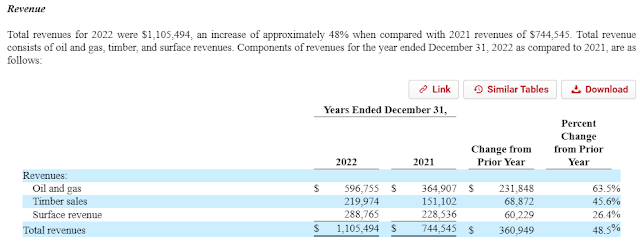
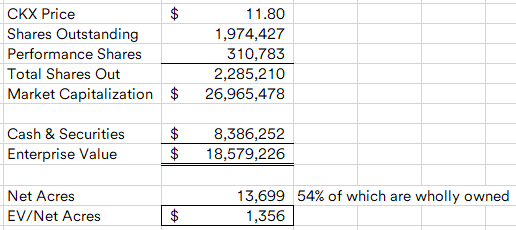
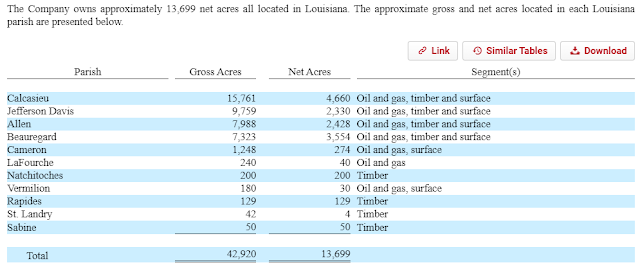
CKX Lands (CKX) (~$27MM market cap) is a sleepy micro-cap that goes back to 1930 when it was spun from a bank.  CKX owns 13,699 net acres (about half is wholly owned, the other half is through a 16.67% interest in a JV) in southwest Louisiana which it earns royalties from oil and gas producers, timber sales and other surface rents it collects.  Revenue skews towards oil and gas revenues, but the value of the land is likely more in its use as timberland (they don't give oil and gas reserve numbers). 

On Monday, CKX put out the below press release:

CKX Lands, Inc. Announces Review of Strategic Alternatives


LAKE CHARLES, LA (August 21, 2023)—CKX Lands, Inc. (NYSE American: CKX) (“CKX”) today announced that its Board of Directors has determined to initiate a formal process to evaluate strategic alternatives for the company to enhance value for stockholders. The Board of Directors and the management team is considering a broad range of potential options, including continuing to operate CKX as a public, independent company or a sale of all or part of the company, among other potential alternatives.


The company has engaged TAP Securities LLC as financial advisor in connection with the review process. Fishman Haygood, L.L.P. is serving as legal advisor to the company.


There is no deadline or definitive timetable set for the completion of the review of strategic alternatives and there can be no assurance that this process will result in CKX pursuing a transaction or any other strategic outcome. CKX does not intend to make further public comment regarding the review of strategic alternatives until it has been completed or the company determines that a disclosure is required by law or otherwise deemed appropriate.


CKX Lands, Inc. is a land management company that earns revenue from royalty interests and mineral leases related to oil and gas production on its land, timber sales, and surface rents. Its shares trade on the NYSE American market under the symbol CKX.


TAP Securities is an affiliate of TAP Advisors, an investment bank providing financial advisory, mergers and acquisitions and capital-raising services. TAP Securities is located in New York City, phone number (212) 909-9034.

The company's disclosures lack much detail, it is challenging to value this asset from the outside.  Management here has a significant informational edge over public market investors, but with this, they are signaling that CKX is likely worth considerably more than the current trading price.  Having read a few of these announcements over time, if I had to guess, the highlighted part sounds like management wants to take it private.

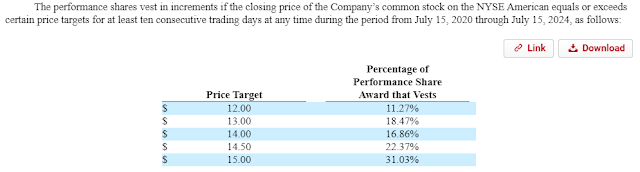
Additionally, management doesn't take any cash salary and instead the board granted them a generous stock incentive package that vests over time as CKX hits certain share price targets.

Presumably these are reasonable targets, the $12 threshold was previously met, but the shares currently trade at approximately $12/share.  To see if that's reasonable, on a quick back of the envelope, I have the shares trading for approximately $1350/acre.
To be worth $15/share, the acreage (mostly timberland) must be worth closer to $1900/acre.  By poking around Land Watch, for the below parishes, it does appear that $1900/acre is within reason.

I don't really have a good sense of how much CKX is worth, other than I like the setup, I'd be interested in hearing more complete thoughts from others that have done more work on CKX, please feel free to comment below.

Disclosure: I own shares of CKX

Wednesday, August 2, 2023

HomeStreet: Stressed West Coast Small-Regional Bank, Pursuing a Sale

HomeStreet (HMST) ($180MM market cap) is a small regional lender based in Seattle that flew a bit too close to the sun in 2021-2022 and is now facing increased borrowing costs as they rely heavily on wholesale funding (loan-to-deposit ratio above 110%).  Their net-interest margin has been squeezed, as a result, they're a barely profitable enterprise despite minimal credit issues (ROE currently ~3%, versus 11.5% in 2022).  I first came across HomeStreet after it was briefly mentioned on the Value After Hours podcast by the team at Seawolf Capital.  Last night it moved up my watchlist because Bloomberg reported that HomeStreet is pursuing a sale, but also open to an asset sale or capital raise.  The speed of these troubled bank tie-ups seems to be increasing and regulators appear more open to mergers (BANC/PACW is guiding to a quick 6-month close).  I would expect this process will have an expedited timeline.  The simple/quick thesis that would make HomeStreet attractive to a buyer capable of fixing their funding problem:

  1. HMST trades for 1/3rd book value (~$9/share versus tangible book value at $27.50/share), despite having virtually no held-to-maturity portfolio and thus far, minimal issues in their loan book.  The tangible book number does include -$5.37/share of unrealized losses in the available-for-sale portfolio that will eventually burn off too.
  2. HMST has an attractive footprint across Seattle, southern California, Portland and a few branches in Hawaii where the deposit market is dominated by local players.  A larger regional bank could come in and realize significant synergies, especially in the current environment where regulators/politicians are once again more worried about shoring up the financial system than saving jobs or blocking branch closings.
  3. HMST is one of ~20 banks that has a license to originate and service multi-family loans under Fannie Mae's Delegated Underwriting and Servicing ("DUS") program.  This is an attractive franchise as Fannie Mae bears 2/3rds of the credit risk on a pro-rata basis while the lender maintains the relationship and associated servicing fees.

Other thoughts/risks:

  • 36% of their loan portfolio is multi-family lending in California.  Multi-family has held up reasonably well, we're starting to see some cracks in transitional bridge loans that mREITs fund, but too early to tell if troubles will work their way up to the MF CRE bank debt.  Typically, a transitional bridge loan is taken out with long-term financing by a bank when a property is stabilized.
  • Uninsured deposits were down to 7% of total deposits on 6/30, from 14% on 3/31, making a bank run here less worrisome (no venture or start up deposits), this is more a zombie bank that can't turn a profit or originate new loans.  HomeStreet is currently limiting lending to more niche floating rate products like construction loan and HELOCs.
  • Capital allocation has been exceptionally poor, HomeStreet has been a big buyer of their own shares in recent years, typically at prices well above book value. In 2022 alone, HomeStreet bought back 7.3% of their shares at an average price of $50.97/share.
  • HMST was recently kicked out of the S&P 600 small cap index which could have caused some forced selling pressure on the shares.  They also slashed the dividend significantly in April.

When a stock trades this cheap on a tangible book basis, the buyer can swoop it up for a huge discount, let's say 50% of book and still would be a 50% gain for the HMST equity.  I'm guessing this will be a stock-for-stock deal, so the realized premium might not be that big.  I bought some shares this morning.  Any other banks that need to make a deal?

Disclosure: I own shares of HMST 

Tuesday, August 1, 2023

Esperion Therapeutics: Litigation Special Situation, Potential Blockbuster Drug

This one is speculative, outside of the broken-biotech basket, but I still think it could be interesting in a small position size or LEAPs.

Esperion Therapeutics (ESPR) ($182MM market cap, ~$700MM EV assuming cash is fully burned) is a pharmaceutical company focused on developing non-statin medications for high cholesterol.  Statins (e.g., Lipitor, Crestor) are cheap and effective, but many people are statin intolerant, muscle pain is the number one complaint and as a result, patients either don't take the necessary dosage amount or falloff altogether (WSJ article discussing ESPR and other statin alternatives).  Esperion has FDA approved treatments utilizing bempedoic acid under the brand names Nexletol and Nexlizet that are currently only labeled for a narrow use case.  Following the success of their completed study ("CLEAR Outcome"), Esperion is set to significantly broaden their addressable market by 8-10x with a new label for cardiovascular risk reduction.  Nexletol/Nexlizet could be a "blockbuster drug" with the new label, meaning annual sales above $1B.  In Q2, the company officially submitted their expanded label applications in the U.S. and Europe, Esperion expects to receive approval in ~April 2024 (approval likelihood appears high, but open to pushback there).

Like many other biotech firms, Esperion has burned through a lot of money to get this point.  To raise cash they've partnered with larger pharmaceutical companies that will market and distribute their drugs outside the United States.  As part of these arrangements, Esperion received upfront fees and negotiated milestone payments, while also retaining a royalty on sales.  Daiichi Sankyo, the second-largest pharmaceutical company in Japan, is the largest of these partners, with agreements to distribute throughout Europe and Asia ex-Japan.  Following the release of the CLEAR Outcome study results, the two are in dispute over a $200-$300MM milestone payment tied to the range of relative cardiovascular risk reduction.  Obviously, it's not a great situation to be in a dispute with your largest commercial partner (reminds me a tiny bit of RIDE/Foxconn) when you're a cash burning enterprise.

Below is the contract language at the heart of the dispute:

I'm not a lawyer, but I do stare at a fair amount of legal agreements in my day job, this is certainly poorly written and vague language.  Relative risk reduction is not a defined term, a $200-$300MM payment left up to interpretation looks poorly on Esperion management and their legal counsel.  If they meant any endpoint would trigger the payment, they should have included that clarification.

Anyway, the results of the CLEAR Outcome study are viewed positively by the scientific community, Esperion's drug reduces:

  • 27% reduction in non-fatal heart attacks
  • 23% reduction in the composite of nonfatal and fatal heart attacks
  • 19% reduction in coronary revascularization (sever blockage of the arteries)
  • 15% reduction in fatal and nonfatal strokes
  • 15% reduction in MACE-3 (a composite of cardiovascular death, nonfatal heart attacks, or nonfatal stroke)
  • 13% reduction in MACE-4 (a composite of cardiovascular death, nonfatal heart attacks, nonfatal stroke, or coronary revascularization)

Esperion argues that their drug reduces "cardiovascular risk" because of the first two results, Daiichi Sankyo is pointing to the last one, MACE-4 which is the broadest goal post and misses the 15% minimum level for a milestone payment altogether.  Esperion is in a precarious financial position, they currently have $138.5MM in cash and securities, projected to get them to mid-2024, leaving a tight opening to turn cash flow positive assuming the new label is approved a few months earlier.  This milestone payment is key to Esperion's future, otherwise they may need to do dilutive financing or auction themselves off in a firesale.

The smoking gun might be Esperion's claim that Daiichi Sankyo ("DSE" in the below) put MACE-4 in a draft of the document but then agreed to take it out:

 11. The Negotiating and Drafting History of the Agreement. Because the language of Section 9.2 is unambiguous, there is no need to go beyond the four corners of the Agreement.  In any event, the extrinsic evidence is fatal to DSE’s reading of the Agreement. During the negotiation and drafting of the Agreement, DSE proposed making Esperion’s regulatory milestone payment contingent on a reduction in the specific MACE-4 endpoint—the contract term DSE now says was agreed to. But Esperion expressly rejected this proposed contractual term and DSE agreed to remove it. In other words, the parties specifically considered adding language to the Agreement to make MACE-4 risk reduction a specific requirement for Esperion to receive the full milestone payment and decided not to add this requirement. DSE’s position that MACE-4 is the contractual north star is a naked attempt to re-trade the parties’ deal and obtain through bad-faith repudiation what it failed to achieve at the negotiating table.

12. DSE’s motive is clear. At the time of DSE’s bad-faith repudiation, Esperion was on the eve of closing an offering to raise capital. DSE knew that given the materiality of the $300 million payment, Esperion, a publicly traded company on NASDAQ, would be required to publicly disclose DSE’s repudiation of its payment obligation to the investing public. On information and belief, DSE timed its repudiation to put maximum financial pressure on Esperion, in a transparent attempt to drive down Esperion’s stock price and pressure it to re-negotiate the financial terms of the parties’ license agreement.

13. DSE’s repudiation inflicted immediate and substantial harm to Esperion. When DSE’s repudiation became public, Esperion’s stock plummeted, dropping 54% in a single day. The harm to Esperion is ongoing and its stock price remains below $2 per share.

Assuming this is all true, which it appears to be as Esperion provides screenshots in their response, it'll come out during the discovery phase of the trial that is set for April 2024, around the same time Esperion expects to receive approval for the expanded label.

I expect them to settle for some discount prior to the trial as it would lift a big cloud from Esperion and allow themselves to sell to a larger pharma company that isn't starting a sales and distribution operation from scratch like Esperion.  Esperion does also have a similar $140MM milestone payment tied to their partner in Japan where the labeling date is a little farther out (1-2 years).

I don't really have a price target for ESPR, but would anticipate a positive outcome could be a multi-bagger from today's prices.  Open to any opinions on this situation, especially from those with more experience in biotech/pharma disputes or the science behind Esperion's drugs.

Disclosure: I own shares of ESPR