Thursday, February 17, 2022

Regional Health Properties: Revised Pref Exchange Offer

Last June, Regional Health Properties (struggling skilled nursing real estate company) proposed an exchange offer where the company's Series A preferred stock holders (RHE-A) would receive 0.5 shares of common stock (RHE) for each share of preferred stock.  At the time of my post, RHE was trading at $12/share, today it trades sub-$5 as all speculative trading sardines have generally come down substantially over the past several months.  Last Friday after hours, with no corresponding press release this time, Regional Health snuck in a new exchange proposal whereby Series A preferred stock holders could exchange their shares for new Series B preferred stock.  The Series A preferred stock trades for $4.50/share.

The proposed Series B preferred stock has some interesting terms that I haven't seen before:

  • First to nudge Series A holders to exchange, if the proposal passes (need 2/3rds) then anyone who rejects the exchange or is just too lazy to exchange gets pretty severely penalized.  The Series B becomes senior to the Series A, the liquidation value of Series A goes from $25 to $5 and all the accumulated but unpaid dividends get erased.
  • The headline dividend rate is 12.5%, but it will not be payable or start accruing until the fourth anniversary of the issuance/exchange date.
  • The liquidation preference starts at $10 and increases back up to $25 at the fourth anniversary.  If all Series A holders exchange, the liquidation preference will initially drop to $28.1MM, there's $55MM of debt ahead of the preferred stock, last June I estimated the value of their owned real estate at $87MM (9.5% cap rate), so that might cover the preferred stock at a $10 liquidation preference.
  • Instead of the typical 6 quarters of missed dividends penalty to nominate a preferred stock board member, since the Series B won't be paying a dividend for the first four years, the Series B terms call for a "cumulative redemption" where Regional Health has to repurchase or redeem a certain amount of preferred each calendar year.  It starts with 400,000 shares in 2022, then 900,000 shares by year end 2023 (again, cumulative, so an additional 500k shares in 2023), then 1,400,000 shares by year end 2024, and then finally 1,900,000 shares by year end 2025.  If they fail to do so, then the preferred shares will have director nomination rights.
  • Additionally, if Regional Health doesn't redeem or repurchase 1,000,000 with 18 months, Series B holders get common shares in a pro-rata fashion to make up the difference.  Interestingly for both this penalty and the cumulative redemption penalty, the threshold is a specific Series B share amount, so if only 2/3rds of the shares are exchanged, each of these milestones becomes a greater percentage of the Series B.
  • They then throw in a little game theory to encourage Series B holders to participate in early repurchases or redemptions, once there are less than 200,000 Series B preferred shares outstanding, the liquidation preference drops back down to $5 (for reference, there are 2,811,535 Series A preferred shares currently outstanding).
  • Like the last exchange offer, this offer requires both the preferred (2/3rds) and common shareholders (majority) to approve.  The common vote might be hard to obtain, they didn't get many shareholders to vote in the last annual shareholder meeting, these shares are likely mostly in retail hands.
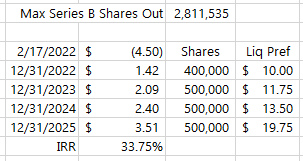
Regional Health's plan following this exchange is to grow their way out of this mess, issue new stock, attempt to take advantage of the distress following covid (similar to SNDA, but without the creditable board/support) in the senior housing sector and redeem the preferred over time along the way.  My initial thoughts are this is a pretty attractive deal for the Series A owners, certainly better than the initial offer.  In my typical fashion, just penciling out what the returns might look like if Regional Health actually kept to that redemption schedule.
Now this is far too simplistic, but assuming that everyone exchanges (unlikely given that this hasn't paid a dividend in many years and is probably sitting in the forgotten corners of retail brokerage accounts), and Regional Health keeps that redemption schedule at the liquidation value (I had to average the liquidation value table since they don't line up perfectly) pro-rata for all shareholders which they probably won't and instead try to repurchase shares or tender at a discount, then they orphan it again afterwards and its worthless (which it wouldn't be).  The cash flows won't look like this, it is just a sketch out of the redemption schedule, but I get a 30+% IRR if all works out.  The biggest assumption is management can actually get out from under this, raise equity, gain creditability, etc. and that's pretty unclear, but it is a situation that deserves a second look.

Disclosure: I own shares of RHE-A
Wednesday, February 16, 2022

Bally's Corp: Standard General Go-Private Offer

Bally's Corporation (BALY) is the old Twin River Worldwide Holdings (old ticker, TRWH) that began with two casinos in Rhode Island, then really starting in 2019 through an aggressive series of complicated acquisitions created a sprawling omni-channel gaming company that appears well positioned to benefit from the long term growth in iCasino and online sports betting.  The architect of this transformation is Soo Kim of Standard General, he is the Chairman of the Board and his investment firm owns more than 20% of the shares.  On 1/25/22, Standard General submitted a non-binding offer to buy Bally's for $38 per share (shares trade for $35-$36).  

The offer appears very opportunistic as the economy is reopening, the pieces of Bally's serial acquisitions are starting to come together but before their true earnings power are fully apparent, all while the market has sold off gaming stocks.  Likely Kim is simply highlighting the shares are cheap, he's best positioned to understand the value of the company, and nothing further comes to fruition on the management buyout front.  However, now that the acquisition strategy is maturing and the need for a public currency might not be as important, he could actually want to take it private and negotiate a higher price with the board.  But at current prices, I agree shares are cheap and would be happy to own the stock absent a deal.

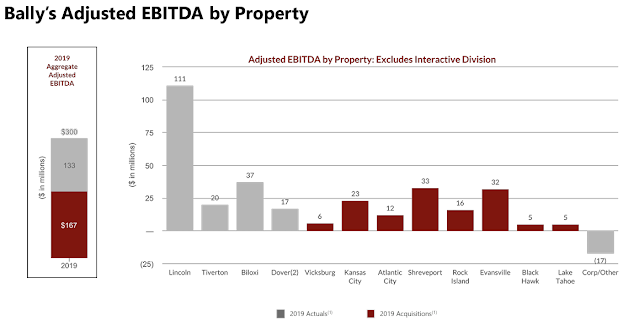
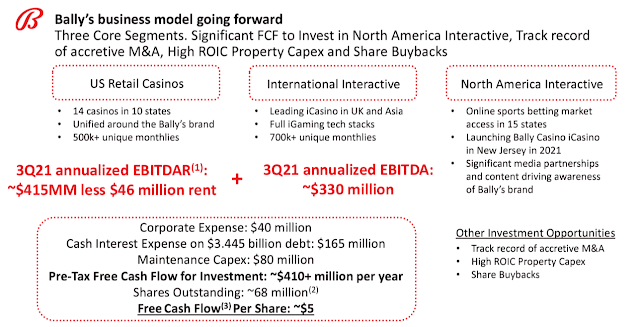
Here's a slide from their investor presentation showing the pace of acquisitions, almost all of the regional casinos were acquired in 2019-2020, many the result of forced divestures when larger gaming peers consolidated.  This allowed Bally's to pick properties up on the cheap and build a nationwide footprint in which to standup a mobile gaming presence.  I generally prefer the regional casinos to destination ones as they're more stable and proved that throughout covid.  Bally's Corp bought the "Bally's" brand name from Caesars (CZR), they're in the process of rebranding all of their regional casinos to the Bally's brand, the old CZR's owned Bally's in Las Vegas (the original MGM Grand) is being rebranded to a Horseshoe property (and Bally's Corp is buying the Tropicana Las Vegas from GLPI).

The two non-physical casinos deals really worth calling out are:
  • On 11/19/20, Bally's entered into an agreement with Sinclair Broadcast Group (SGPI) to rebrand their regional sports networks (the 21 they acquired from FOXA in the DIS deal) from Fox to Bally's, in exchange Sinclair got stock and warrants in Bally's, Bally's also must commit a certain percentage of marketing spend on Sinclair's networks.  The cord cutting trend is well known, RSN valuations are down  (Sinclair's RSN's debt trade at distressed levels), sports is generally the reason cited for cord cutting because their content is so expensive.  But from Bally's angle, this deal puts their brand right in the face of the most engaged sports fans, even if RSNs are losing subscribers, they're unlikely to be losing the ones that Bally's is targeting.  While Caesars, MGM or Draft Kings are spending big on the NFL at the national level, Bally's has instead targeted the more engaged local fan, one that might have a more frequent/year-round betting cadence than just the NFL season.
  • On 4/13/21, Bally's announced a combination with Gamesys Group (GYS in London) for cash and stock, the deal closed on 10/1/21.  Gamesys is a UK based online gaming company (casino strategy versus sports betting, mostly UK and Asian markets) that does both bingo and iCasino games, the idea is to pair the successful Gamesys iCasino offering (where legal in the U.S.) with the Bally's sports betting/Sinclair offering to create an integrated experience.  Generally you need a physical presence in a state to get an online license, so in order for Gamesys to fully access the U.S. market they needed to partner with someone like Bally's who thanks to their acquisition spree, have a presence in most of the desirable gaming jurisdictions.  To fund the rollout of iCasino and online sports betting in the U.S., both the existing Gamesys international business and the U.S. regional casino business are highly cash generative.  Bally's expects to spend 20% of FCF for the next several years on the rollout, but they're taking a more measured pace than other competitors when it comes to promotions, etc.
Interestingly, the CEO of Gamesys became the CEO of Bally's, signaling an emphasis on bringing the successful Gamesys model to the United States.  Also, the management of Gamesys elected to take stock in the merger instead of cash, at current prices that appears to be a mistake as the value of those shares is roughly half what the cash offer was a few months ago, but shows their confidence in being able to replicate their success here.

Valuing Bally's is a little tricky, it was a covid beneficiary but hard to tell how much (margins will come in as service levels are restored to pre-covid levels), the capital structure is messy due to their acquisitions and the net leases on some of their physical casinos, and we've yet to see the inflection point in their omni-channel strategy.  All reasons why Soo Kim is probably best positioned to value the company versus outside investors.  Here's Kim explaining his offer on CNBC.

Below are all the contingent equity securities that have been issued in conjunction with various acquisitions over the last two years (note the Gamesys acquisition shares are in the share count today, the others generally aren't in reported numbers):
Here are their Q3 2021 numbers annualized (Bally's hasn't reported Q4 numbers yet or provided 2022 guidance):
And to show possibly more normalized numbers, here are what the Bally's regional casinos did in 2019:
If we back out the corporate expense on the above for an apples to apples with the Q3 numbers, we get $317MM versus the $359MM (post rent) done in Q3, for simplicity, let's just say normalized is somewhere in between there, an average would be $343MM.  Add Gamesys (pretty consistent grower over time) and subtract the corporate expense gets us $633 of EBITDA against a $5.9B EV (using 68 million shares, $3.445B of debt excluding capitalized leases) for an 9.4x EBITDA multiple (or a 14% levered FCF yield using management's estimate) that gives no value to the mobile app opportunity in the U.S. (currently loss making).  Again, there are a lot of moving parts, I could be wrong, please double check, but I think that's a pretty reasonable price to pay for a company that is potentially in play and/or at an inflection point in their business model.

Disclosure: I own shares of BALY

Armstrong Flooring: Distressed Situation, Pursuing a Forced Sale

This is potentially a horrible idea, it is only a teeny tiny tracker position, it could go to zero, but I wanted to throw this out there in case others know more about situation and are kind enough to share.

Armstrong Flooring (AFI), the 2016 spin from Armstrong World Industries (AWI), designs and manufactures resilient flooring products and sells through distributors or you might walk by their vinyl tile displays in big box home stores like Home Depot.  Armstrong is a recognizable name but they're much smaller than market leaders Mohawk (MHK) and Shaw (owned by BRK), since the spin they've had a challenging time and now due to covid supply chain disruptions and resulting inflation (some of their raw material costs are up 100%), find themselves on life support.  

The company has tried to implement price increases to offset inflation but seem to be a step behind resulting in gross margins being squeezed to near zero and the company burning cash.  Their term loan lender, Pathlight Capital, recently extended Armstrong Flooring another $35MM to repay their ABL facility and shore up the near term balance sheet.  A stipulation of the term loan amendment was the company has to try to sell itself ASAP.  From the 8-K:

The Company also announced it retained Houlihan Lokey Capital, Inc. (“Houlihan”) to assist with a process for the sale of the Company and with the consideration of other strategic alternatives. Based on all the factors deemed relevant by the Board of Directors of the Company (the “Board”), the Board determined this process to be in the best interests of the Company and that a sale of the Company or another strategic transaction are the best means to maximize value for the Company’s stockholders and other stakeholders.

Houlihan is known for their restructuring business, so that's a bad sign and the "and other stakeholders" language at the end is another hint that a restructuring is a real possibility here.  Later in the same 8-K:

The Amended ABL Credit Facility includes certain milestones (“Milestones”) related to the Company’s consideration of a sale of the Company or other strategic alternatives. These milestones include: (i) a requirement that the Company deliver a confidential information memorandum regarding the sale process to potential buyers, investors and/or refinancing sources by January 14, 2022, (ii) a requirement that the Company cause Houlihan to provide a summary to the ABL Agent by February 18, 2022 of all written indications of interest regarding the acquisition of the Company or an alternative transaction that are received on or before that date, (iii) a requirement that the Company notify the ABL Agent by February 28, 2022 whether any binding letter of intent for the acquisition of the Company has been entered into prior to such date and, thereafter, providing copies of any such letter of intent entered into after such date (subject to any necessary redaction), (iv) a requirement that the Company enter into a definitive agreement for the acquisition of the Company by March 31, 2022 which provides for a purchase price in an amount sufficient to repay in full the outstanding loans under the Amended ABL Credit Facility and the Amended Term Loan Facility and otherwise be in form and substance reasonably satisfactory to the ABL Agent, and (v) a requirement that the Company consummate the sale of the Company or a similar transaction by no later than May 15, 2022.

While the company is bleeding cash, the balance sheet doesn't look terrible, they own almost of their real estate and manufacturing facilities.  Last March, they sold one of their production and warehouse facilities in South Gate, CA for $76.7MM (likely the one with the most significant value) which they partially used to pay down debt and then burned through the rest.  I read a comment somewhere that this company is great at selling assets, but not running the company, back in 2018 they sold their wood flooring segment for $90MM or 7.2x segment EBITDA at the time.  They went on to use most of the proceeds to do a Dutch tender offer at $11.10/share, the stock trades below $1.50/share today.

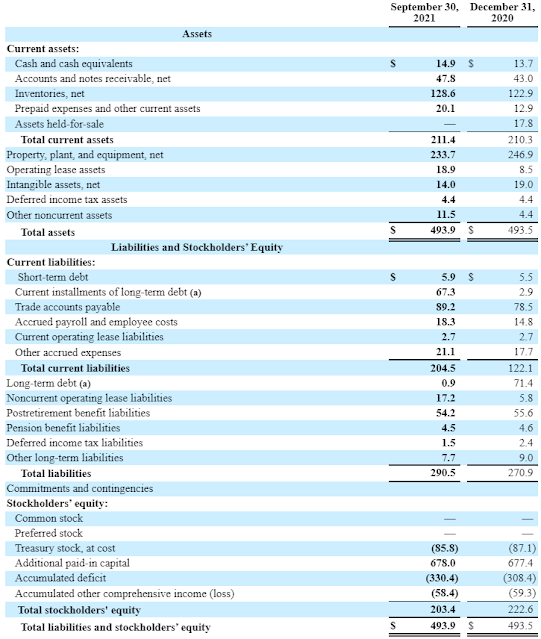
This is prior to the additional liquidity injection, but even proforma, AFI trades a significant discount to book value.


New management, Michel Vermette (formerly a division head at MHK), arrived on the scene in late 2019, started to implement a new strategy, invested heavily in a sales force, but they've run out of liquidity at the wrong time.  The brand name is worth something and so are the property, plant and equipment on the balance sheet, the flip side of inflation is the replacement cost of these manufacturing facilities must be significant and possibly in excess of what they're carried at on the balance sheet.  But AFI is not negotiating from a position of strength (no kidding!) and equity could get completely wiped out.  Equity holders are basically relying on the kindness of others (or PE flooded with dry powder) to bail them out.

Other thoughts:

  • Their old hardwood flooring segment, now called AHF Products, recently changed hands between PE sponsors (I didn't find a price or multiple disclosed anywhere), and the debt raised early this month was on less than favorable terms, SOFR + 625, which means the credit market is rather cautious on flooring companies today.
  • They previously guided to 10% EBITDA margins in a normalized environment, on LTM revenues that would be ~$60MM against a enterprise value of $114.5MM ex-pension liability or $168.7MM with the pension liability.
  • The market is moving towards "luxury vinyl tile" or LVT, MHK on a recent earnings call said they're going to invest $160MM this year to expand their LVT production capacity.  Two of AFI's owned manufacturing facilities produce LVT today, these facilities plus the brand could make it worth for MHK or another strategic buyer to take out AFI.
Again, this is a bad idea, do your own due diligence.

Disclosure: I own shares of AFI

ALJ Regional Holdings: Partial Liquidation Below Proforma NCAV

ALJ Regional Holdings (ALJJ) is likely a familiar name to many readers (and thanks to those that pointed it out to me), it was an NOL shell that Jess Ravish (former Drexel, Jefferies and TCW executive) used as a holding company to buy and sell several various unrelated businesses over the last 10-15 years to soak up the tax assets. The vast majority of the NOLs expire in 2022.  It has functioned as Ravich's mini-PE fund, he owns ~47% of the stock (management owns 56% as a group).  As of 9/30/21, ALJ had two operating businesses: 1) Faneuil, a business processing outsource provider and; 2) Phoenix Color, a specialty book printer that manufactures education materials, heavily illustrated books, etc.

Likely due to the upcoming NOL expiration, ALJ has made two significant asset sales in the last two months:

  • On 12/21/21, ALJ sold a large piece of the Faneuil business to TTEC Holdings (publicly traded as TTEC) for $140MM cash ($15MM of which will be escrowed) and a $25MM-earn out.  The remaining pieces of Faneuil are expected to generate normalized revenue of $80-$90MM.  The sale is expected to close in Q1, and TTEC gets a 3-year option to buy the remaining business.  The transaction is structured as an asset sale, so ALJ will receive all the economics of the business performance up until the closing date.
  • On 2/4/22, ALJ sold the entire Phoenix Color business to Lakeside Book Company (subsidiary of LSC Communications, the disaster spin from RRD) for $135MM cash.  The sale is expected to close in Q2.

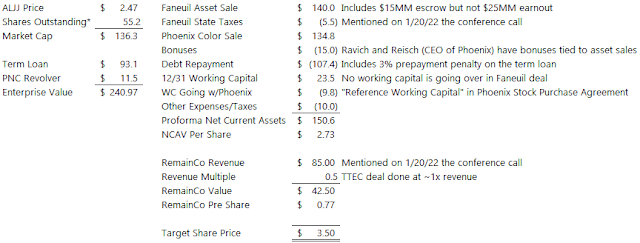
Following the closing of both of these transactions, I estimate ALJ will have roughly $150MM in net current asset value plus the remaining business at Faneuil, versus a current market cap (including the conversion of converts and warrants) of $136MM:

The main reason the stock is cheap is Jess Ravich, the market doesn't trust him, one good example is he participated in a financing round during covid and got convertible debt at a $0.54 conversion price that PIKed for a year (further diluting minority shareholders) before it was amended.   Another is he's also been facing legal trouble over the last few years regarding his time at TCW.  Now that the NOLs are burned off and/or expiring, maybe he no longer wants to deal with public shareholders and uses the cash proceeds to take out the minority shareholders.  There is precedent, he did a large cash tender back in 2012 following the sale of a business, the Alpha Vulture blog covered it well back then.

Full disclosure, my cost basis is closer to $2.10, the stock ran up last week and I didn't have time to write it up but still think the shares are pretty cheap.

Disclosure: I own shares of ALJJ

Friday, January 7, 2022

Odonate Therapeutics: Cash Shell, Delisting, Forced Selling, Possible Liquidation

Quick one today, this idea has been mentioned sporadically in my comment sections.  Odonate Therapeutics (ODT) is a failed biotech, it was a one shot on goal lottery ticket, their only asset was texetaxel, a oral/pill form of chemotherapy.  Last March, the company announced they were discontinuing development and would "wind down the operations of the company".  Since then they've eliminated most of their staff, settled a shareholder lawsuit and brought their cash burn rate down to a minimal amount.  

As of 9/30/21, the company had cash of $95MM and a book value of $71MM, ~$1.85/share.  This is where the story gets a bit weird, the CEO of ODT is our old friend Kevin Tang (he is the one that offered $50/share for APVO, which now trades for $7.45), on November 17th the company announced a share buyback of 20 million shares, oddly the buyback plan specified a share amount and not a dollar amount.  Prior to the buyback announcement, the shares were trading at ~$3.20/share, maybe the market was assigning some value to the company's $290MM in NOLs and possibility of a reverse merger (there was meme/speculative fever around these last year, CATB was an example), after the buyback news it dropped below $2.00/share.  Suspiciously, Tang Capital Management sold about 2.7 million shares into the buyback news at prices above the book value.

Then today, the company announced that NASDAQ would be delisting them due to their cash shell status and ODT will suspend their reporting obligations (meaning they'll likely end up in that dark/expert market status making it uninvestable for many), the stock dropped 30% at the open to ~$0.90/share, again against a book value of ~$1.85 as of last reporting.  Cash burn should be minimal, and if the company didn't run through their buyback in the first few days after their announcement, then the buybacks should be accretive to book value, potentially offsetting any additional cash burn.

From here, the company either straight liquidates and returns the cash to shareholders as the initial "wind down operations" suggests, or it does a reverse merger to try to monetize the NOLs.  I'd be fine with either, most of the time a biotech has an initial pop on a reverse merger, Tang still owns a third of the company and may want to reverse merger another investment into the ODT shell.  There's some ugliness here and questionable governance (nothing new for this blog!), at half of book value which is primarily all cash, I couldn't help but add small position on today's forced selling.  But please do your own research, and make sure you're comfortable owning stock in a non-reporting company.

Disclosure: I own shares of ODT

Friday, December 31, 2021

Year End 2021 Portfolio Review

Thank you for reading, hope you're having a good holiday season and thanks to those who have reached out with ideas, commented on write-ups, told me I'm stupid, or corrected me over the years, I genuinely appreciate it.  Again, I don't manage outside capital, the blog portfolio is my personal taxable account and is managed as such, my results aren't comparable to any professional's performance and I simply use the S&P 500 as a reference point, not a real benchmark.  I have a good stable day job, I don't live off of this portfolio (never pulled money from it, although I will likely have to withdraw funds early next year to pay taxes), so my risk tolerance is going to be naturally higher than others.  

With that preamble out of the way, my account returned 74.99% in 2021 versus 28.71% for the S&P 500, and an IRR since inception of 29.12%.  
Some of my biggest dollar weighted winners were BRG calls, LAUR (mostly also via calls that have since expired), and then holdover ideas written up in previous years like FRG, DBRG, and MMAC.  My biggest dollar weighted losers were LYLT (caught that falling knife post spin a little too quick), APVO and CMCT.

Surprised myself on how much I wrote/posted this year, maybe not exactly a good sign as its lead to a lot of turnover, possibly overdiversification, but I just found so many interesting special situations (or at least I thought so at the time) and continue to do so. It can't be this easy in the future, there's a lot of speculative activity in markets, some could (rightfully) accuse me of that as well.  Great results never really feel "real" until the next downturn, but I'll keep my strategy going and continue to push forward.

Thoughts on Current Holdings
I wrote these intermittently over the last two weeks, if some of the share prices/valuations are stale, I apologize but they should be directionally right, mostly just in random order in just quick elevator pitch style:
  • BBX Capital (BBXIA) continues to look too cheap despite surly management, proforma for the recent private market purchase of Angelo Gordon's shares (slightly disappointing since they might have been keeping management honest here), I have the book value somewhere around $21/share and it trades for $10/share.  For that price, even after all the buybacks, you get ~$6.50 in cash plus another ~$4.80 in the receivable from BVH which should be money good, that more than covers the market price without all the Florida real estate and other businesses.  They recently put out a new investor presentation that shined light on the Florida real estate that's worth looking at, but again, market cap is covered by cash and securities here.
  • Accel Entertainment (ACEL) is the best part of regional casinos, the slot machines without the worst part, all the capex and lease payments.  Their acquisition of Century Gaming unfortunately didn't close this year, to me it sounded like a management misstep or unfamiliarity with cross state border acquisitions.  But ACEL announced a big buyback ($200MM on a $1.2B market cap), it trades at roughly 8x EBITDA proforma for the acquisition, wage inflation should put more discretionary dollars in their client's pockets, a few more states are talking about legalizing VGTs, the shares seem pretty cheap to me.
  • Howard Hughes Corporation (HHC) is my perennial value trap, but the pitfall of their diversified real estate model is also a benefit, the company is attempting to reposition the narrative back to a land developer for home builders and building sunbelt apartments.  They recently purchased a massive plot of land west of Phoenix that apparently has a 50 year development life and will add potentially logistics/warehouse and single family rentals (they're also building these in their Bridgeland MPC) to their product mix.  In disposition news, this week the Wall Street Journal is reporting that they've sold 110 N Wacker in Chicago for more than $1B (HHC has JV partners here, the property has debt, but that exceeded my expectations for a covid office sale).  They're still too heavy on office for my liking (about 50% of NOI) but have essentially stopped new development in that sector in favor of covid beneficiaries.
  • PhenixFin (PFX) is frustrating to me, this company shouldn't exist, activists won control of the company last year (then called Medley Capital or MCC) and internalized the BDC.  Since then, they've mostly let their legacy investments roll off and invested the proceeds into mREITs.  My original thesis was me speculating that this would be sold to another BDC, that hasn't happened, in their recent FY22 results press release PFX announced the formation of an "asset-based lending business engaged in the gem and jewelry industry" and highlighted $490MM in net capital loss carryforwards for the first time that I can remember.  Neither is a sign that they're selling unfortunately, but I might be, this is no longer a strong conviction holding but not expensive at ~70% of book value (essentially unlevered, small net debt position).
  • NexPoint Diversified Real Estate Trust (NXDT) is unfortunately still in the process of converting from a closed end fund to a REIT, the process has dragged on a bit longer than expected, but the backdrop for NXDT's assets continues to improve in the meantime and NAV continues to march slightly higher (~$23, trades for roughly 60% of NAV).  The thesis remains mostly the same, this will starting reporting as a REIT, be eligible for index inclusion (including broad indices, BDCs and CEFs are generally excluded from market indices since they're considered funds), and start attracting a REIT investor base and multiple.  On the negative side, this is another manager with a poor reputation, and potentially has some governance issues with NXDT owning other NexPoint affiliates and some fee double dipping.  NXDT continues to be one of my favorite ideas.
  • Jackson Financial (JXN) has gone up in a straight line since its spin from Prudential PLC in September.  Jackson is the largest variable annuity provider in the U.S., it should have strong demographic tailwinds as baby boomers retire and rollover their 401(k)s, but the financials are a total black box and these annuity companies usually trade extremely cheap for that reason.  One way to get a valuation re-rating is via share repurchases and cash dividends, JXN was trading at just 28% of book value at the time of my write-up, since then they've bought back approximately $185MM in stock and announced a $0.50/share quarterly dividend (~5% yield).  I'm not a strong enough at accounting to figure out JXN's financials, the stock is up 55% since the spin (might be some more near term upside via index buying, this was a foreign-to-US spin), I'm not in a rush to sell it but I'm not a long term holder either.
  • Orion Office REIT (ONL) is a shaky low conviction hold for me, the setup of being a merger-spin out of a heavily retail owned stock and the resulting forced selling tempted me enough to start a position.  A dividend initiation should help recruit a little wider investor base in the near future, but my current thought is I'm unlikely to own this for the long term as I'm still personally bearish about return to office.  There are countless examples, but near me, Allstate recently sold their suburban headquarters campus to investors who plan on turning it into logistics/warehouses  -- when old line type companies are making drastic switches away from large corporate campuses, makes me worried for the sector, especially with an average lease term under 3.5 years.
  • Sonida Senior Living (SNDA) is a recent buy after they completed an out of court restructuring transaction, this is a bit of a jockey bet in that I like the Conversant Capital team and what they've done thus far at INDT, here they control the company and have started to implement their new business plan with the acquisition of two Indianapolis area senior housing properties.  Senior housing has a lot of operating leverage, if occupancy levels recover to normalized levels and the demographic wave finally materializes, Sonida could do very well over the next 3-4 years.
  • My other senior housing play is the preferred stock of Regional Health Properties (RHE-A), which briefly attempted a similar out of court restructuring by proposing to exchange the preferred stock for common.  The largest preferred shareholder comically shot it down.  This company is a bit of a mess, they recently had the State of Alabama pull the license of one of their biggest tenants a couple weeks ago, looks like RHE might be taking over the management of another one of their facilities here shortly.  That temporary measure appears to becoming more permanent in their other managed facilities.  The company is in a tough spot, it is not bankrupt but the capital structure doesn't work and there's no easy way to fix it since the worthless common stock need to approve of an exchange.
  • Unfortunately, as soon as I hit publish on my Altisource Asset Management (AAMC) write-up, the shares were delisted from the NYSE (no direct reason given) and have yet to trade since.  I'm a bit surprised/disappointed that the company hasn't made any public announcements regarding an attempt to regain NYSE (or other listing) eligibility.  One can only hope (pray?) that they're working behind the scenes on an acquisition and settlement with Luxor that would get the shares trading again.
  • HMG/Courtland Properties Inc (HMG) is a nano cap liquidation where their largest asset is a newly developed Class A multi-family property in Fort Myers, FL.  The company recently released a proxy statement to approve the plan of liquidation and quoted a $20-$30/share liquidation value, the shares still trade in the middle of that range, but I think the value is closer to $30 (although I probably wouldn't recommend initiating a position here, the liquidation may take a long time).
  • The only previously undisclosed holding I have are some recklessly speculative near term call options in Nam Tai Property (NTP).  Nam Tai has a long history, it pivoted from an electronics manufacturer to a property developer when Shenzhen experienced exploding growth.  IsZo Capital won their year long legal fight against prior management, they've put out a number of $40/share in intrinsic value, the stock trades at $11/share after prior management experienced a margin call and DB foreclosed on their shares.  IsZo by contrast has been adding to their stake.  There's a lot of risk here, China real estate is obviously shaky, excuse my gambling, again its a personal account, don't recommend this for others.
  • Bluerock Residential Growth REIT (BRG) entered into a transaction with Blackstone to buy their multi-family properties and lending book for $24.25 per share, plus BRG is going to spinoff a single family rental REIT, "Bluerock Homes Trust", where BRG got a third party valuation firm to put a $5.60 NAV per share on it.  BRG is currently trading for $26.36, the deal with Blackstone is almost certain to close, thus the market is applying a pretty steep discount on the single family REIT.  It will revert to being an externally managed by Bluerock (BRG started as externally managed, later pseudo-internalized), who prior to this transaction didn't have a great reputation, but obviously this was a great result for shareholders and merger arb types might want to look at the spin (expected Q2 close).
  • I wrote up the mess of a situation at Transcontinental Realty (TCI) and parent American Realty (ARL) earlier this week.  I had one big mistake, I thought the $134MM of notes receivable were just mortgage loans consolidated from Income Opportunity Realty (IOR), that's not the case, so the fair value of TCI is ~$15 higher than the $60/share I threw out there.  IOR is maybe the strangest little micro cap I've looked at, almost all of the assets of the company are a loan to Pillar, IOR's external advisor, not sure how that's okay legally and might be why it is being challenged in a shareholder lawsuit.  IOR is probably worth a closer look (won't take you long).
  • There's not much to update on PFSweb (PFSW) which I wrote up in August, but only because the company hasn't filed its Q2 or Q3 financials due to "additional time and work needed to meet the SEC reporting and accounting requirements for its LiveArea divestiture."  That's not confidence inspiring, but this is like some of my other "informal liquidations" where they've sold one business unit, the other is for sale, the situation is fairly de-risked with a large cash position.  I continue to hold awaiting news but my conviction has lessened.
  • Another informal liquidation, Laureate Education (LAUR), has mostly worked out to plan, the sale of Walden University closed and they've since paid out $7.59/share in special dividends.  They've also collapsed the dual share structure.  It is now a purer play on Mexico and Peru, my best guess is this is not the end state and we'll see a final sale of the remaining assets once covid subsides and/or the political climate in Latin America improves.  Most of my exposure rolled off earlier in December when my calls expired, now just hanging onto a smallish position to see how the rest plays out.
  • Rounding out the informal liquidations, not much has changed at Advanced Emissions Solutions (ADES) since my write-up, the did report Q3 earnings and have an adjusted ~$5/share in net cash against a $6.50 stock price.  They state that strategic alternatives are continuing for the remaining activated carbon business, hopefully that means a sale and not some transaction involving ADES using the cash for an acquisition.
  • Now to a formal liquidation, Luby's (LUB) has exceeded my expectations, shareholders received a $2.00 initial distribution on 11/1, which was most of my cost basis.  The most recent estimate of liquidation proceeds is $3.00/share, shares trade slightly below that estimate, others have suggested there's a fair amount of juice left (this author thinks a base case of $3.30, which sounds reasonable), I'm willing to just let it play out as the company has indicated it should be mostly wrapped up by mid-2022.
  • I own two tiny natural gas trusts, with ECA Marcellus Trust I (ECTM) I got lucky and now have received over half my basis out of the partnership this year in distributions, it wasn't my original thesis of a liquidation, but I'm content for now letting it runoff via distributions much the same way as a liquidation.  With SandRidge Mississippian Trust I (SDTTU) the assets have all been sold back to SandRidge (SD) but there is a shareholder lawsuit holding up the final distribution of proceeds to unitholders.  The trust has since delisted and stopped filing with the SEC, so its fallen into that dark stage and trades erratically at irrational prices while we await final resolution.
  • I found the Golar LNG (GLNG) pitch on Andrew Walker's podcast interesting, but probably not for me, but did make me think about my own holding that I've honestly sort of forgot about in Technip Energies (THNPY).  Technip Energies is the E&C for many of the largest LNG projects around the world, and should benefit from many of the same LNG as a transition fuel themes.  There are two remaining catalysts post spin, first parent FTI does still own ~12% of TE and plans to sell (removes the overhang once they do), and second, Technip Energies will be initiating a dividend next year (that was the plan all along) which could open it up to a wider shareholder base and semi-similar to JXN, cold hard cash might relieve some concerns around the complicated accounting.
  • Logan Ridge Finance Corporation (LRFC) is similar to PFX in that it is a BDC that doesn't pay a dividend (I believe they're the only two credit BDCs that don't pay dividends).  BDCs aren't included in indices and if it doesn't pay a dividend, it is hard to attract regular yield-focused retail investors, so its limited to a small subset of investors willing to play in these ponds.  LRFC was recently taken over by BC Partners, they're in the process of repositioning the portfolio to generate yield and restore the dividend, that'll likely happen in the first half of 2022 and I expect the discount to NAV to decrease (trades for 58% of NAV today).
  • Atlas Financial (AFHBL for the bonds) is a covid recovery play on taxis, limos and ride sharing drivers returning to work and a business change from a risk taking insurance provider to more of an asset-lite agency model.  I originally didn't like the RSA plan for the bonds, but the alternative plans don't seem to have gone anywhere, so I'm happy to change my mind and support the RSA here even though it bifurcated the creditor group.  The key line in the Q3 earnings release was "Our current in-force business is approximately 6% of what we underwrote as a carrier in 2018, and given current trends we feel there is considerable room to recapture business over time".  Even if they get only a portion of that business back, should make the bonds money good over time.  
  • During the worst of covid, I bought some LEAPs on Marathon Petroleum (MPC) as a proxy for Par Pacific (PARR) since long dated options weren't available on the later.  Those MPC calls expire next month and I'll take profits, with PARR I've reduced my position throughout the year and might sell the rest early next year, I've owned it for 6-7 years and it has gone nowhere, they haven't touched the NOLs, just a difficult business that I probably don't understand as well as I should.
  • I've held Liberty Broadband (LBRDK) through a few iterations, bought in prior to the General Communications deal with the old LVNTA as a merger arb, owned it through its time as GLIBA, I'll continue to hold.  Maybe this is the year CHTR cleans up their ownership structure and takes out Liberty Broadband?
  • INDUS Realty Trust (INDT) will similarly just be in my tuck it away and forget about it pile for now, it is a logistics/warehouse REIT that has recruited much of the old Gramercy Property Trust (GPT) team, with the former CFO, Jon Clark, taking over at year end to round out things out.  The tailwinds are pretty clear, and with a relatively small asset base and experienced team, they can be "sharp shooters" as they describe it, pick and choose smaller deals the likes of Blackstone can't be bothered with to assemble a portfolio.
  • Some of my bigger positions now are just semi-jockey plays in industries I semi-understand (start out as special situations but then "tripped into" a good management team), Green Brick Partners (GRBK) continues to grow like a weed, CEO Jim Brickman manages the business like a private company, he's not afraid to switch strategies, lately that means heavily investing in land in 2020 and building a lot of homes on speculation in 2021 to take advantage of rising prices.  With DigitalBridge (DBRG), there's continued M&A in the digital infrastructure space and its seems like CEO Marc Ganzi can raise unlimited amounts of money at this point, so I'm content to just to go along for the ride.  Franchise Group (FRG) has grown into my largest position, it is hard to believe that CEO Brian Kahn has created so much value in a short period of time, especially after his gaff with Rent-A-Center (RCII) when he forgot to send in an extension notice triggering the termination of that deal.  I'm content to just sit on these three for the longer term and defer the taxes.
Closed Positions since 6/30
  • I briefly owned Loyalty Ventures (LYLT) for a month or so following the spinoff from ADS and got sliced up trying to catch the falling knife, it ended up being my biggest single performance detractor for the year.  But it is too early to tell if I completely misjudged the business quality but the stock was punished early, sold off from nearly $50 in the when issued market until below $30.  The CEO has been buying shares, I'll revisit it at some point.
  • I also only briefly owned Franklin BSP Realty (FBRT) following their reverse merger with Capstead Mortgage Corp (CMO), my math was wrong and the upside was too small in the first place.  FBRT is probably an interesting buy for some income investors, the management team has a good reputation and has managed the REIT well privately, but for me it was too small of a position and I moved on.
  • Condor Hospitality Trust (CDOR) worked out well but I probably could have traded around it better.  After only selling their assets to Blackstone, there was a trading day or two there where some uncertainty existed around the true net asset value per share.  And then this week it traded at near the liquidating dividend, I sold a couple weeks ago, but those that bought this week might end up with a free look at whatever is remaining once the corporate shell wraps up.
  • CorePoint Lodging (CPLG) didn't work out very well, I made a mistake and missed the IRS payment that had to come off the top as well as that the new buyer would want to rid themselves of the Wyndham (WH) management agreement.  I'm sort of glad this will be private again as I've had it wrong now multiple times.
  • LGL Group (LGL) got caught up in the "high redemption, low float SPAC" trend that lasted a few weeks.  LGL was invested in the SPAC sponsor of DFNS, DFNS had options available on it and when 90+% of the SPAC's shareholders redeemed for trust value, the newly public IronNet (IRNT) became a meme stock due to limited float and options/gamma squeeze possibilities.  I sold my warrants I held into that madness for a gain.  The company is doing a spinoff of their operating business in Q1, I plan to revisit early next year and might re-take a position.
  • Communications Systems Inc (JCS) also seemed to get caught up in some strange day trading dynamics on the day it announced their initial pre-merger $3.50 dividend that well known to anyone following the company.  But the stock spiked from $6.79 the day before to over $9 the next day and got as high as $10 the week after that.  I didn't top tick it or anything, but did take advantage of that bit of luck and sold my shares.  The company still hasn't complete its merger with Pineapple Energy, having recently moved their outside merger date to 3/31/22.  The shares trade pretty cheaply today if things go to plan (but thus far they haven't), I plan to revisit it again early in 2022.
  • Retail Value (RVI) I sold shortly after the large liquidating dividend as I didn't feel like I had a good grasp on the remaining value of the stub.  There's been some good discussion in the comments section that has continued, which I always appreciate and I might revisit this one as well as the liquidation is near its end.
  • The MMA Capital Holdings (MMAC) deal closed as anticipated.
Performance Attribution

Current Portfolio
Additionally, I own CVRs or non-traded liquidation trusts in BMYRT, OMED, IDSA, PRVL

No money was added or withdrawn during the year (but I will likely need to withdraw funds in 2022 for taxes).  My leverage is particularly high at the moment, not a market call, more a result of trying to delay some gains into the new year for tax planning purposes.  On average, I was probably 115-120% long in 2021.

Disclosure: Table above is my taxable account/blog portfolio, I don't manage outside money, and this is only a portion of my overall assets (I also have a stable job, not living off this money).  As a result, the use of margin debt, options, concentration doesn't fully represent my risk tolerance.

Monday, December 27, 2021

BRT Apartments: Another Sunbelt Multi-Family REIT with Governance Issues

I didn't mean for this to be a mini-series, but as I was looking through ARL/TCI I remembered another REIT that I looked at years ago, BRT Apartments (BRT), that fits as an addition to the "sunbelt multi-family M&A craziness" themed basket.  BRT Apartments is primarily a class B, value-add, garden style apartment portfolio in the southeast and Texas (35 properties, ~9500 units, ~$1150/month rents, loosely similar to NXRT's portfolio).  

BRT also shares some similarities to TCI but thankfully is a little simpler, it owns both apartment buildings directly and through unconsolidated joint ventures which makes the accounting a bit challenging to untangle (typical REIT investors shun complexity), and it is also family owned with the Gould family owning ~25% of the stock.  The founder, Fredric Gould is 85 and still a member of the board, his two sons hold executive positions including one that is the CEO, and a cousin is also involved as an EVP.  The governance issues here don't seem as egregious as ARL/TCI but maybe on par with BRG.  The Gould family does have a shared services agreement with their family office that provides "investment advice and long-term planning" and other services to the company (sounds like something an internal REIT shouldn't need to outsource), which has averaged about $1.4MM in each of the last several years.  BRT also uses a property manager for some of their properties that is wholly owned by the Gould family.  The Gould's also previously managed the company via an external asset manager "REIT Management" but this is now technically an internally managed REIT.

While I haven't seen any press leaks regarding BRT running a sales process, I'm just going on the assumption that every smallish sunbelt apartment REIT is receiving inbound calls from bankers and private equity shops kicking the tires, effectively all are probably evaluating strategic alternatives.  I'm going to keep this one quick (BRT has a long history, was previously a lender to multi-family pre-GFC, foreclosed on properties, became the owner, etc, but now pretty clean, just sunbelt multi-family apartments), but if you break out the two baskets:


The left side is the 8 apartment complexes they own outright with the NOI being Q3 annualized numbers and the right side is the 27 apartment complexes they own through various joint ventures and their proportional NOI and mortgage debt as disclosed in their supplement package.  The quirk I'm a bit unsure of is for the unconsolidated properties I'm using a 5.0% cap rate just for complexity/limited disclosure of these JVs (there is minimal other obvious difference between the portfolios).  BRT has been trying and occasionally been successful buying out their joint venture partners and presumably a financial buyer would need a little extra juice to go through a similar process although it's not uncommon for non-100% interest in properties to trade.  The problem/lack of disclosure is in how these JVs are structured, for example BRT might own 80% of the joint venture's equity but their minority partner might get a preferred return and these terms are only disclosed at a very high level (if anyone is familiar with the details, please let me know):  
Joint Venture Arrangements

The arrangements with our multi-family property joint venture partners are deal specific and vary from transaction to transaction. Generally, these arrangements provide for us and our joint venture partner to receive net cash flow available for distribution and/or profits in the following order of priority (in certain cases, we are entitled to these distributions on a senior or preferential basis): (i) a preferred return of 9% to 10% on each party's unreturned capital contributions, until such preferred return has been paid in full; and (ii) the return in full of each party's capital contribution. Thereafter, distributions to, and profit sharing between, joint venture partners, is determined pursuant to the applicable agreement governing the relationship between the parties. Generally, as a result of allocation/distribution provisions of the applicable joint venture operating agreement, the allocation and distribution of cash and profits to BRT is less than that implied by BRT's percentage equity interest in the venture/property.
If you gross up the JVs (BRT owns ~67% of the equity on average), that works out to about a ~$171k/unit acquisition price, versus BRG at about ~$300k/unit, although BRG's rentals are a little more premium at $1400/month.  To spot check that math, they recently bought out their joint venture partner in a Nashville, TN complex for $165k/unit.

If my math isn't wildly off (it might be), shares are still reasonably undervalued using market cap rates despite jumping last week after the BRG buyout (I'm not alone in thinking BRT Apartments could be next).  At a certain point taking advantage of the public-to-private valuation arbitrage available in these apartment REITs outweighs the benefits of keeping it public to the Gould family.  Similar to BRG, since this is really a "will they or won't they sell" bet, I'm going to play the idea through call options, this time I just went out to June '22 and bought the at-the-money $22.50 strikes hoping this is a replay.

Other thoughts:
  • They have used their ATM offering this year, which isn't exactly a sign they're shareholder friendly or think their shares trade at a huge discount as I suggest, but BRG did similar things with the preferred share exchanges there.  Some of the ATM issuances were before inflation talk really heated up and we saw a lot of activity in the space, but it is still worth mentioning as a negative.
  • The Gould family also runs another REIT, One Liberty Properties (OLP), that's mostly an industrial net lease, attentions and salaries could potentially be repositioned there as that sector also has covid tailwinds.  At BRG they found a creative way to keep their jobs by spinning out the SFH rentals, here they could just all move over to their already established REIT.
  • I also noticed the Gould family has created a cannabis investment firm, Rainbow Realty Group, could be the seeds of a future cannabis mREIT or other lending structure that have become popular ways to invest in cannabis on U.S. regulated exchanges (e.g., I noticed the old Fifth Street Asset Management (FSAM) team popped up at AFC Gamma (AFCG)).  Maybe cash out here and reinvest in that hot theme?
Disclosure: I own BRT June $22.50 call options (and ARL, BRG calls)